Standard operating procedures for temple security in Himachal Pradesh
Source:diarytimes ↗
Why It Matters
Crucial for HPAS Prelims as the cultural geography of Himachal Pradesh, encompassing its major temples, pilgrimage sites, and local governance frameworks like the HP Public Religious Institutions and Charitable Endowments Act, 1984, are recurring themes in the General Studies paper.
Summary
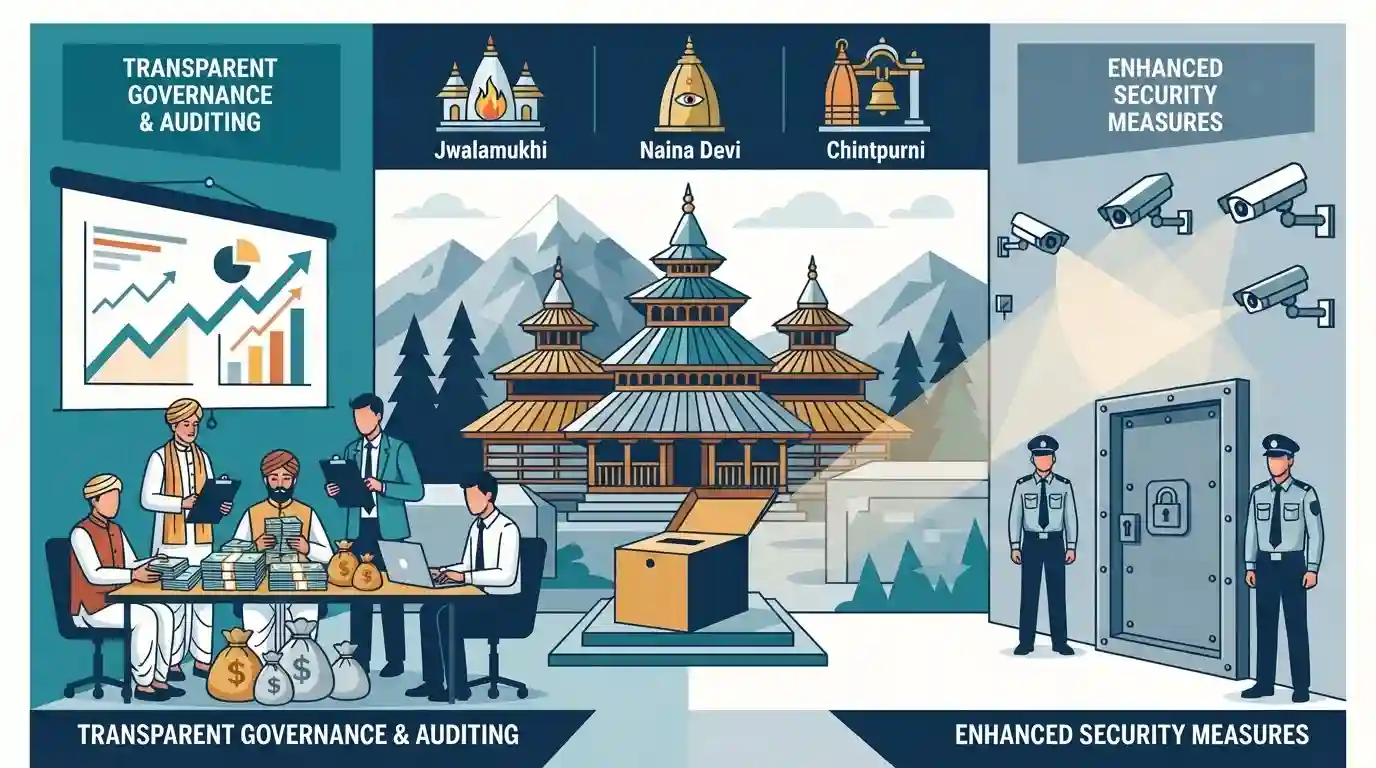
The Himachal Pradesh Government has introduced stringent new Standard Operating Procedures (SOPs) to oversee the management and security of donations at 36 government-controlled temples under the HP Public Religious Institutions and Charitable Endowments Act, 1984. Prompted by the immense value of offerings—including massive cash deposits, gold, and silver—the directives require comprehensive financial auditing, fortified strong rooms, and enhanced CCTV monitoring at prominent shrines like Chintpurni, Jwalamukhi, and Naina Devi.
Key Points
- The Himachal Pradesh Government has issued comprehensive Standard Operating Procedures (SOPs) for the 36 state-managed temples to ensure the security and transparent management of donations.
- New guidelines mandate the installation of tamper-proof donation boxes, expanded CCTV surveillance, robust strong rooms, and mandatory auditing of cash, jewellery, and precious metals.
- The regulated temples, which include major shrines like Chintpurni, Jwalamukhi, and Naina Devi, must submit detailed compliance reports within 30 days.
- In 2024 alone, devotees contributed assets worth ₹200.49 crore, supplementing cumulative reserves of ₹346.26 crore in fixed deposits, 600 kg of gold, and 250 quintals of silver across these shrines.
Important Terms
Himachal Pradesh Public Religious Institutions and Charitable Endowments Act, 1984

A state legislation enacted to administer public religious institutions, ensure transparent management of temple trusts, and oversee pilgrim facilities at 36 government-managed shrines.
UPSC context
Relevant to GS-2 (Governance/State laws) and GS-1 (Culture), focusing on the state's legal framework for managing and securing religious endowments.
Language, Art and Culture Department
The nodal state department in Himachal Pradesh responsible for issuing administrative SOPs and overseeing the security, cultural preservation, and financial transparency of government-controlled temples.
UPSC context
Relates to GS-2 (Governance) regarding departmental accountability and institutional oversight of cultural and religious assets in state administration.
Temple Management Committees
Local administrative bodies at major state-run shrines tasked with implementing SOPs, managing daily affairs, securing offerings, and maintaining transparent financial records.
UPSC context
Key for GS-2 (Transparency & Accountability), testing knowledge of decentralized governance and financial auditing in public trusts.
Prelims Trap
The Indian Constitution absolutely prohibits the State from regulating or managing the financial assets and properties of religious denominations.
Under Article 25(2)(a) and Article 26(d), the State is constitutionally empowered to regulate the 'secular, economic, financial, and political' activities associated with religious practices, provided it does not interfere with essential religious rituals.
Static Concepts Connected
How does the Indian Constitution balance state control of temple assets with religious freedom?
- Secular Regulation: Article 25(2)(a) empowers the state to regulate economic, financial, political, or other secular activities associated with religious practices.
- Property Administration: Article 26(d) guarantees religious denominations the right to own and acquire property, but mandates that its administration must be 'in accordance with law'.
- Essential Practices Doctrine: The Supreme Court (e.g., Shirur Mutt Case) established that while essential religious practices cannot be touched, secular management of wealth/land is subject to state laws.
What was the literary and historical significance of Firoz Shah Tughlaq's Jwalamukhi campaign?
- Manuscript Seizure: During his 1360-61 AD Nagarkot campaign, Firoz Shah Tughlaq collected 1,300 Sanskrit manuscripts from the library of the Jwalamukhi Temple.
- Dalail-i-Firoz Shahi: He commissioned the scholar Izzuddin Khalid Khani to translate these texts into Persian, focusing on astronomy, philosophy, and divination.
- Intellectual Synthesis: The exercise demonstrated the Delhi Sultanate's strategic interest in absorbing indigenous Indian scientific and astrological knowledge.
Cross-Topic Patterns
Temple Economics and Public Finance
State-managed temple boards act as massive financial custodians, raising legal debates over whether secular state machinery can utilize religious endowments for public welfare.
Rock-Cut Architecture: Deccan vs. Himalayas
Comparing Rashtrakuta rock-cut temples (Ellora) with the 8th-century Masrur Temple cluster reveals how monolithic Shikhara styles migrated and adapted to the outer Himalayan terrain.

Medieval translation bureaus (like Dalail-i-Firoz Shahi under Tughlaq) are highly probable targets for UPSC history matching questions.
Linked PYQs · 3
Linked PYQs · 3
- 2018HPAS_PRELIMSGS1
Which is the earliest specimen of 'Nagara design' found in H.P. ?
- 2014HPAS_PRELIMSGS1
Which one of the following is a Pagoda style temple in H.P. ?
- 2022HPAS_PRELIMSGS1
Read the following sentences and select the incorrect one : (i) St. Andrew's Church in Chamba carries the influence of Scottish architecture. (ii) The architecture of 'Manimahesh Lakshana Devi temple' is 'Indo-Aryan Nagar style (Shikhar)'. (iii) 'Champavati temple' in Chamba is built in 'Graeco Buddhist art of Gandhara'. (iv) The brass idol of the Goddess at Chatrari Shakti Devi temple in Chamba district is in the 'Kashmiri style'.
