Himachal Revises Transfer Policy for Tribal and Remote Areas
Source:thenewshimachal ↗
Why It Matters
Personnel administration and policies regarding tribal and remote areas are crucial components of State Governance (GS2) in Himachal Pradesh, ensuring balanced administrative delivery across the state's difficult terrains.
Summary
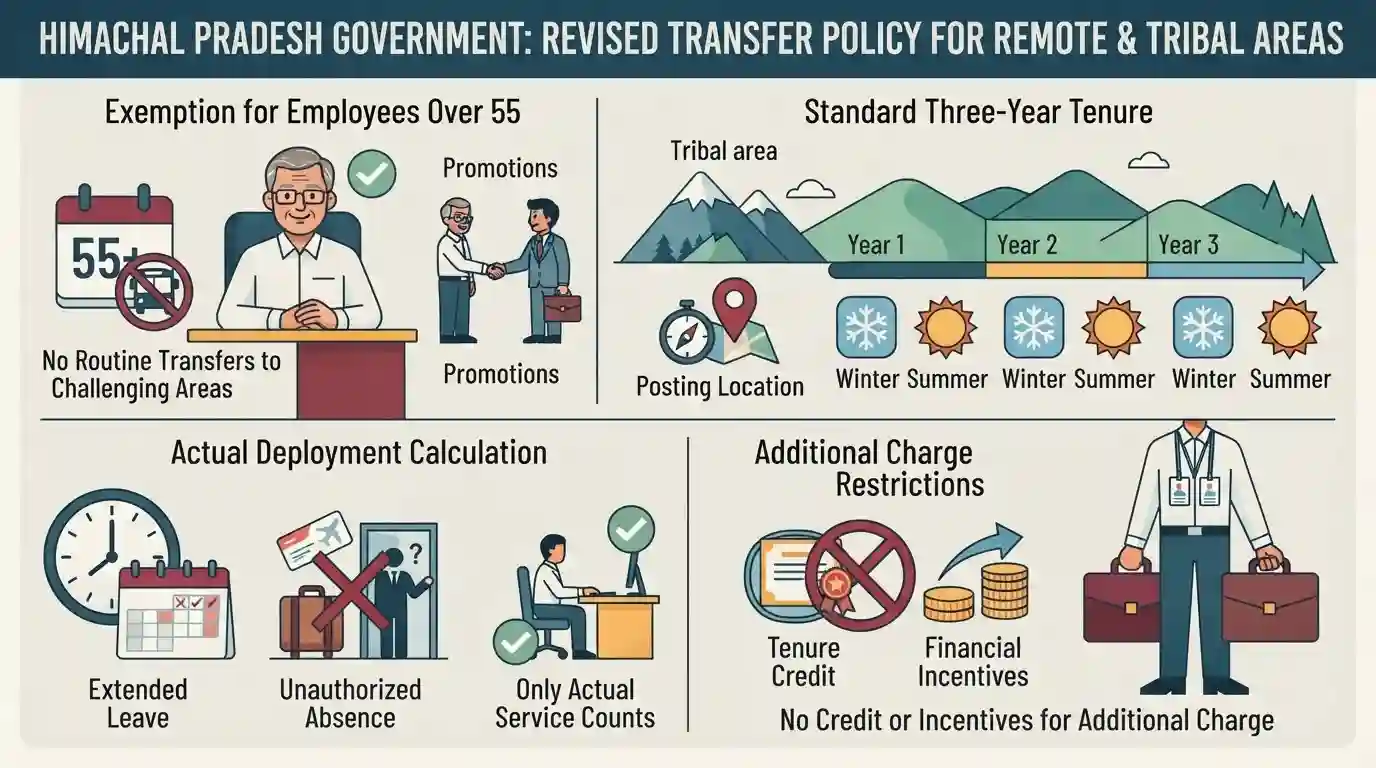
The Himachal Pradesh Government has significantly revised its transfer and posting policy for remote, tribal, difficult, and extremely difficult areas by amending the Comprehensive Guiding Principles-2013. A central feature of the revision is the exemption of state employees over the age of 55 from routine postings to these challenging zones, except in cases involving promotions. The government has formalized a standard three-year tenure, stipulating that it must encompass two winter and three summer seasons. To ensure substantive service, this tenure is calculated strictly on the actual period of deployment, explicitly excluding any extended leaves or unauthorized absences. Furthermore, employees holding an additional charge in such regions will neither accrue tenure credit nor be eligible for the incentives traditionally associated with remote-area postings. This policy shift aims to streamline personnel administration and optimize service delivery in the state's most challenging terrains while providing relief to senior personnel.
Key Points
- The state government amended Para 16.1 of the Comprehensive Guiding Principles-2013 to exempt employees above 55 years of age from routine transfers to remote, tribal, difficult, and extremely difficult areas.
- The mandatory service tenure in these challenging regions is strictly fixed at three years, which must cover two winter seasons and three summer seasons.
- The three-year tenure is calculated based on the actual period of service; periods of extended leave or prolonged absence are discounted.
- Assignments involving additional charges in tribal or difficult areas will no longer be counted toward fulfilling the required service tenure, nor will they qualify for associated incentives or concessions.
Important Terms
Comprehensive Guiding Principles-2013 (CGP-2013)

The official framework regulating state employee transfers in Himachal Pradesh. Recently amended, it mandates strict service requirements and a non-negotiable three-year physical tenure in difficult terrains, excluding extended leaves.
UPSC context
GS Paper 2 (Governance, Role of Civil Services). Highlights state-level public personnel management and administrative reforms.
Tribal and Hard Area Postings
Mandatory administrative deployments to geographically difficult or tribal zones. In Himachal Pradesh, standard tenure requires three years of actual physical presence—spanning two winters and three summers—to ensure uninterrupted public services.
UPSC context
GS Paper 2 (Governance, Welfare Administration). Tests knowledge of equitable service delivery and administrative challenges in tribal regions.
Additional Charge (Public Administration)
An arrangement where an official temporarily manages a secondary post. Recent state reforms deny remote-area incentives and tenure credits to personnel holding such intermittent charges in tribal regions to prevent administrative exploitation.
UPSC context
GS Paper 2 (Governance). Illustrates policy measures to close loopholes in public personnel administration and ensure substantive governance.
Routine Posting Exemption
A personnel policy provision that exempts senior civil servants (e.g., above 55 years) from mandatory transfers to exceptionally difficult or remote regions, prioritizing employee welfare unless promoted into such roles.
UPSC context
GS Paper 2 (Civil Service Rules). Connects to compassionate and pragmatic dimensions of civil service management and human resource utilization.
Prelims Trap
Personnel policies in 5th Schedule Areas are exclusively determined by the Governor under special powers.
While the Governor has special legislative powers under the 5th Schedule, routine administrative policies like employee transfers remain under the State Government's executive domain.
Static Concepts Connected
What is the governance framework for 5th Schedule Areas?
- Governor's Report: The Governor submits an annual report to the President regarding the administration of these scheduled areas.
- Law Modification: The Governor can direct that any specific Act of Parliament or State Legislature does not apply, or applies with specified modifications.
- Tribal Advisory Council: A TAC (up to 20 members) must be established to advise on matters pertaining to the welfare and advancement of the Scheduled Tribes.
What are the key committees on Civil Services Reform?
- Hota Committee (2004): Recommended a fixed tenure for civil servants to ensure administrative stability and accountability.
- Baswan Committee (2016): Suggested domain specialization and performance-based continuation in service after 15 and 25 years.
Cross-Topic Patterns
Tribal Governance + Administrative Reforms
Personnel challenges in difficult terrains link GS2 Civil Service reforms with GS3 Internal Security (e.g., LWE areas) and GS1 Himalayan geography.
Aging Workforce + Personnel Management
Exempting staff over 55 highlights the broader governance challenge of managing an aging administrative machinery effectively without compromising service delivery.

Expect 2026 Mains GS2 questions on civil service reforms to reward case studies like HP's tenure rules for difficult terrains.
Linked PYQs · 1
Linked PYQs · 1
- 2020HPAS_PRELIMSGS1
Consider the given four statements and choose the correct answer from the given options. Which of the following statement(s) is / are not correct about the Social Welfare programs of Government of Himachal Pradesh? 1. e-Udyan portal: Where farmers can avail Horticulture farming service benefits while sitting in their home. 2. Vishesh Mahila Uthan Yojna: Scheme formulated for rehabilitation of physically and sexually abused women through technical and vocational training. 3. Medha Protsahan Yojna: Rupees one lakh is provided to the meritorious students to provide guidance at coaching centers. 4. Mukhya Mantri Ek Bigha Scheme: State Government will empower rural women by helping them become self-sufficient and get employment under MGNREGS.
