Himachal Plans to Procure 1000 Buses to Modernise HRTC Fleet
Source:theprint ↗
Why It Matters
Highlights state-level initiatives in Himachal Pradesh toward transitioning to green public transport, reducing carbon footprint, and managing public sector utilities. Important for HP-specific current affairs and GS3 Environment/Infrastructure sections.
Summary
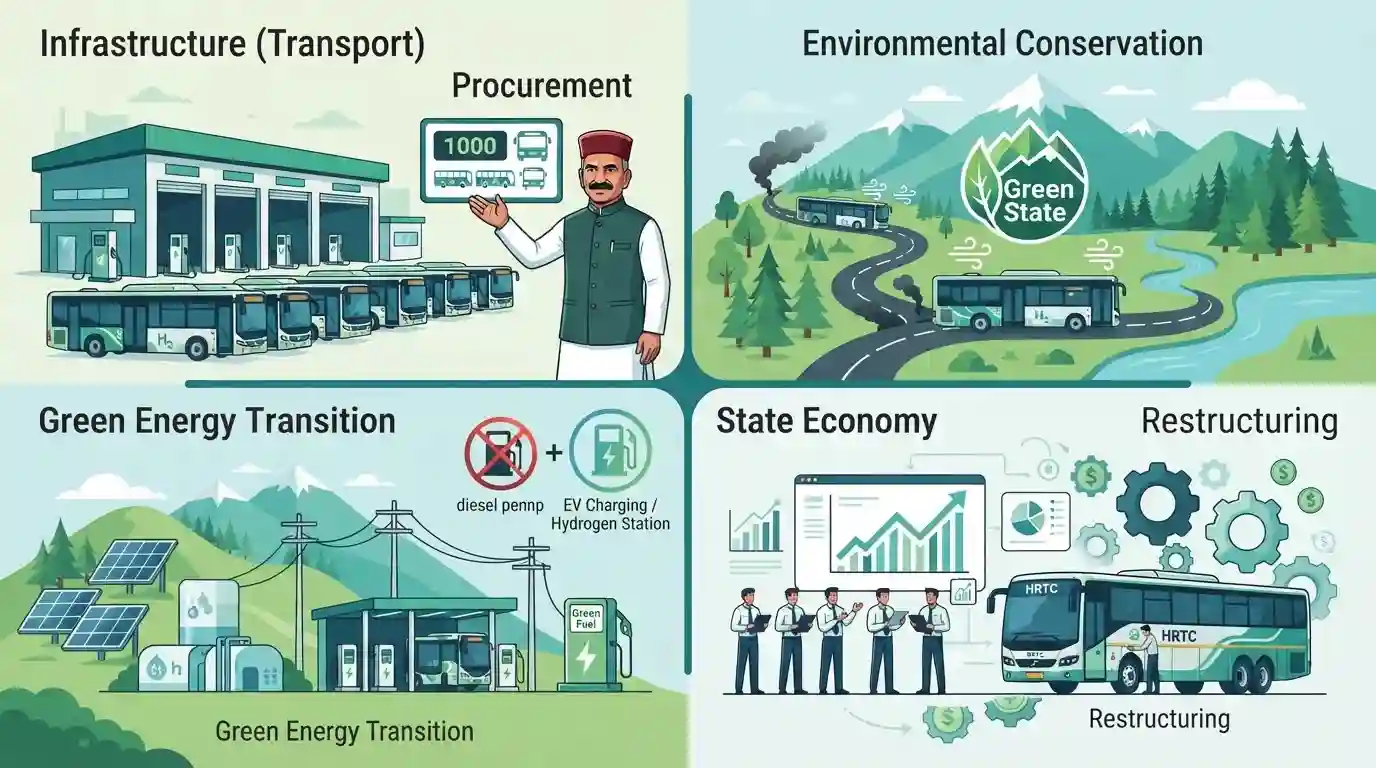
The Himachal Pradesh government, under Chief Minister Sukhvinder Singh Sukhu, has announced plans to procure 1,000 new buses to strengthen the Himachal Road Transport Corporation (HRTC). To align with the goal of making Himachal Pradesh a 'green state' by March 2026, the new additions will include electric and potentially hydrogen-powered buses, which offer significantly lower operational costs compared to diesel buses. Alongside this green transition, the government is also working on restructuring HRTC to improve its financial health and operational efficiency.
Key Points
- The Himachal Pradesh government plans to procure 1,000 new buses to modernize and strengthen the HRTC fleet.
- A significant focus is placed on electric and hydrogen-powered buses to lower operating costs (e-buses cost ~Rs 38/km vs. diesel at Rs 70-75/km) and reduce emissions.
- The state government aims to transform Himachal Pradesh into a 'green state' by 31 March 2026.
- Efforts are underway to restructure HRTC financially and administratively to ensure long-term viability and improve public transport infrastructure.
Important Terms
Hydrogen-Powered Buses

Public transport vehicles powered by hydrogen fuel cells. They generate electricity by combining hydrogen and oxygen, producing zero tailpipe emissions and emitting only water vapor.
UPSC context
Tests GS Paper 3 (Science & Tech/Environment) on clean mobility, alternative fuels, and decarbonizing heavy transport.
Green Energy State Target
Himachal Pradesh's initiative to transition to 100% renewable energy and green public mobility by March 2026, phasing out thermal power and diesel vehicles.
UPSC context
Relevant for GS Paper 3 (Environment/Energy) as a model case study for state-level climate action and energy transition.
National Green Hydrogen Mission (NGHM)
A central government initiative aiming to establish a green hydrogen ecosystem, targeting 5 million metric tonnes of annual production by 2030 to decarbonize transport and industry.
UPSC context
Crucial for GS Paper 3 (Economy/Environment) focusing on India's renewable energy targets and Net Zero 2070 commitments.
Himachal Road Transport Corporation (HRTC)
The state-owned public road transport corporation in Himachal Pradesh. It is currently being modernized with electric and hydrogen-powered buses to achieve financial viability and environmental sustainability.
UPSC context
Links to GS Paper 3 (Infrastructure) and GS Paper 2 (Governance) regarding the restructuring and green transition of state PSUs.
Prelims Trap
Electric and hydrogen-powered buses eliminate all carbon emissions associated with public transport.
While BEVs and FCEVs have zero tailpipe emissions, they are only truly carbon-neutral if the electricity or hydrogen is generated using renewable sources (Green Hydrogen).
Static Concepts Connected
How do Hydrogen Fuel Cell Vehicles (FCEVs) differ from Battery Electric Vehicles (BEVs)?
- Power generation: FCEVs generate electricity onboard through a chemical reaction between hydrogen and oxygen; BEVs store pre-generated grid electricity.
- Emissions: FCEVs emit only water vapor and warm air. BEVs have zero tailpipe emissions of any kind.
- Refueling speed: FCEVs can be refueled in minutes similar to conventional fuel, whereas BEVs typically require hours to fully recharge.
Why do India's State Transport Undertakings (STUs) face chronic financial distress?
- Social obligations: STUs must balance commercial viability with the mandate to provide subsidized or free transit to specific demographics (students, women).
- Unviable routes: Mandatory plying on non-lucrative, remote rural routes to ensure last-mile connectivity leads to massive under-recovery of costs.
- Legacy fleets: Heavy reliance on aging diesel fleets exposes STUs to volatile global crude prices and high maintenance overheads.
Cross-Topic Patterns
FCEVs + Green Hydrogen Mission
State-level adoption of hydrogen buses directly operationalizes the National Green Hydrogen Mission's mandate to decarbonize heavy mobility and reduce fossil fuel import dependence.
State Finances + Welfare vs CapEx
The restructuring of loss-making STUs highlights the macro-economic tension between welfare schemes (e.g., subsidized bus rides) and the necessary capital expenditure required for green transitions.

Hydrogen fuel cell vs BEV mechanics and National Green Hydrogen Mission targets are highly probable for a 2026 Science & Tech question.
