Himachal Government Plans 3,000 Crore Investment In Tourism Sector
Source:The Hindu ↗
Why It Matters
Crucial for understanding Himachal Pradesh's economic growth strategies, state revenue enhancement, and policy initiatives focusing on tourism development and infrastructure investments as reflected in state economic data.
Summary
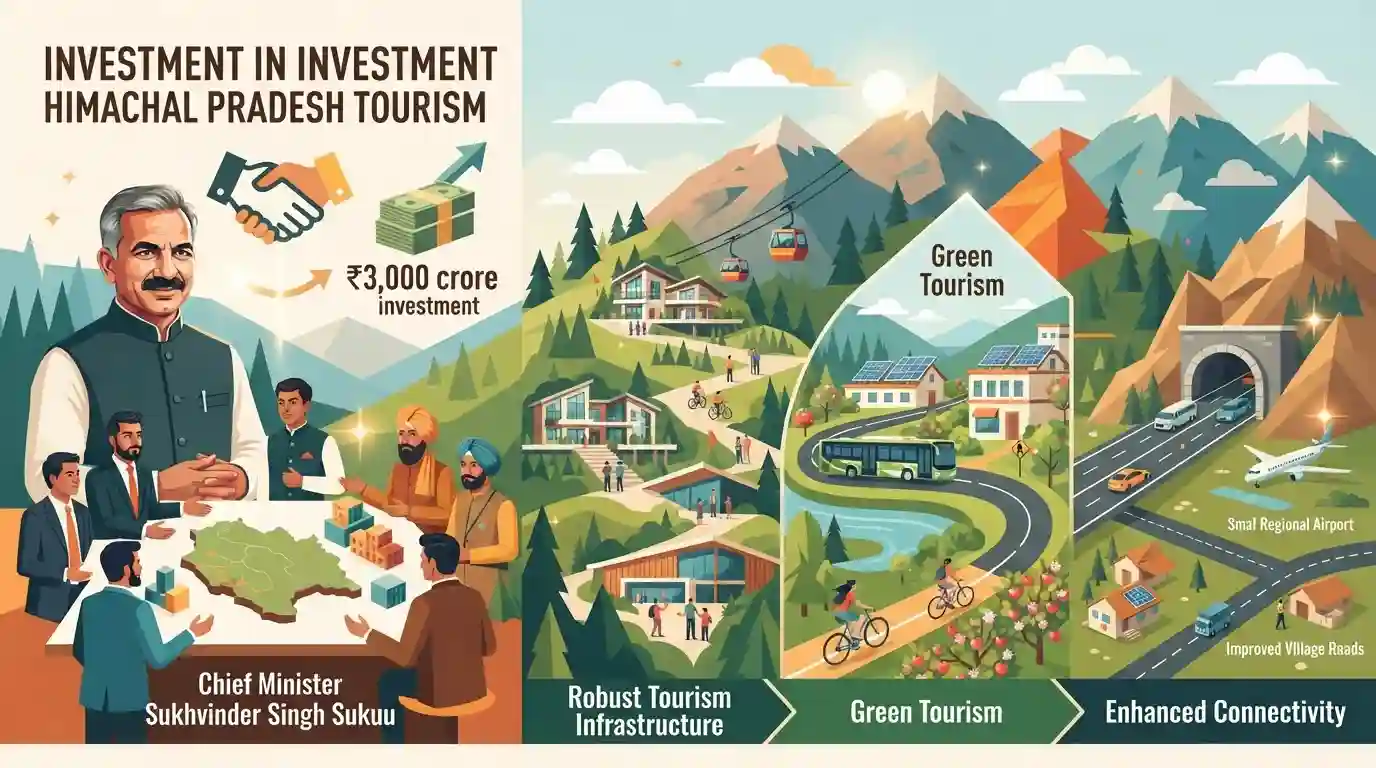
The Himachal Pradesh government has announced plans to invest ₹3,000 crore in the tourism sector, with Chief Minister Sukhvinder Singh Sukhu engaging industry stakeholders to promote robust tourism infrastructure, green tourism, and enhanced connectivity across the hill state.
Key Points
- The Himachal Pradesh government intends to invest ₹3,000 crore in the tourism sector to boost state revenue and employment.
- Chief Minister Sukhvinder Singh Sukhu wooed tourism industry leaders, highlighting initiatives to expand tourist infrastructure like heliports and wayside amenities.
- The state aims to position itself as a premier destination for high-end, eco-friendly, and adventure tourism.
Important Terms
Himachal Pradesh Government

The apex elected body governing Himachal Pradesh, responsible for policy formulation, state administration, and economic initiatives such as boosting tourism infrastructure and green investments.
UPSC context
HPAS Paper 2 (Polity and Governance) and Paper 3 (Himachal Economy) – evaluates governance, administrative initiatives, and state economic policies.
Asian Development Bank (ADB)
A multilateral financial institution partnering with Himachal Pradesh to implement tourism infrastructure projects worth over ₹2,350 crore to promote sustainable and inclusive tourism.
UPSC context
HPAS Paper 3 (Economy and External Aid) – tests knowledge of international financial institutions funding developmental projects in the hill state.
Tourism Sector Investment
The premier state-level sector accounting for a significant share of Himachal Pradesh’s GDP, driven by natural beauty, religious tourism, and eco-friendly infrastructure initiatives.
UPSC context
HPAS Paper 3 (Himachal Economy) – crucial for questions related to economic diversification, service sector growth, and employment generation in HP.
Prelims Trap
The central government directly funded the entire ₹3,000 crore tourism infrastructure outlay in Himachal Pradesh.
Aspirants often confuse central tourism sector allocations or general capital expenditure figures with specific state-budgeted outlays announced by the Chief Minister.
Static Concepts Connected
What are the key pillars and strategic objectives of the Himachal Pradesh Tourism Policy?
- Diversification Focus: Focuses on diversification from traditional leisure tourism to eco-tourism, religious tourism, adventure tourism, and rural homestays.
- Green Tourism: Emphasizes sustainable development, minimizing carbon footprint, and protecting fragile Himalayan ecosystems.
- Infrastructure Upgrade: Upgrading transport networks, constructing heliports, and expanding wayside amenities to decongest major tourist hubs.
Cross-Topic Patterns
Tourism Investment vs. Ecological Carrying Capacity
HP's push for ₹3,000 crore tourism investment directly links state fiscal deficit management under FRBM limits with ecologically fragile hill-area development under GS Paper III environment.

HPAS Prelims loves exact fiscal outlay figures; watch for mismatched investment amounts or misplaced eco-tourism policy mandates in MCQs.
Linked PYQs · 2
Linked PYQs · 2
- 2024HPAS_PRELIMSGS1
Arrange the following years based on the number of foreign tourist arrivals in Himachal Pradesh in descending order : (1) 2020 (2) 2021 (3) 2022 (4) 2023 (up to December 2023) Choose the correct option :
- 2023HPAS_PRELIMSGS1
Consider the following statements : (1) In Himachal Pradesh, Grant from the Centre is the highest percentage of revenue receipts. (2) In Himachal Pradesh, non-tax revenue is likely to increase to Rs. 3,769 crore in FY 2022-23 (BE). (3) In Himachal Pradesh, the tax revenue growth rate is estimated at 10.84 per cent in FY 2022-23 (BE). (4) In Himachal Pradesh, growth of subsidy expenditure is estimated to be 4.44 per cent in FY 2022-23 (BE). Choose the correct answer from the options given below :
