Himachal Explores Advanced Gene and Phototherapy with US Experts
Source:dailypioneer ↗
Why It Matters
State government initiatives to modernize healthcare infrastructure and retain specialized doctors are highly relevant for the GS2 Health and Governance syllabus. Gene therapy and phototherapy additionally intersect with the GS3 Science & Technology syllabus.
Summary
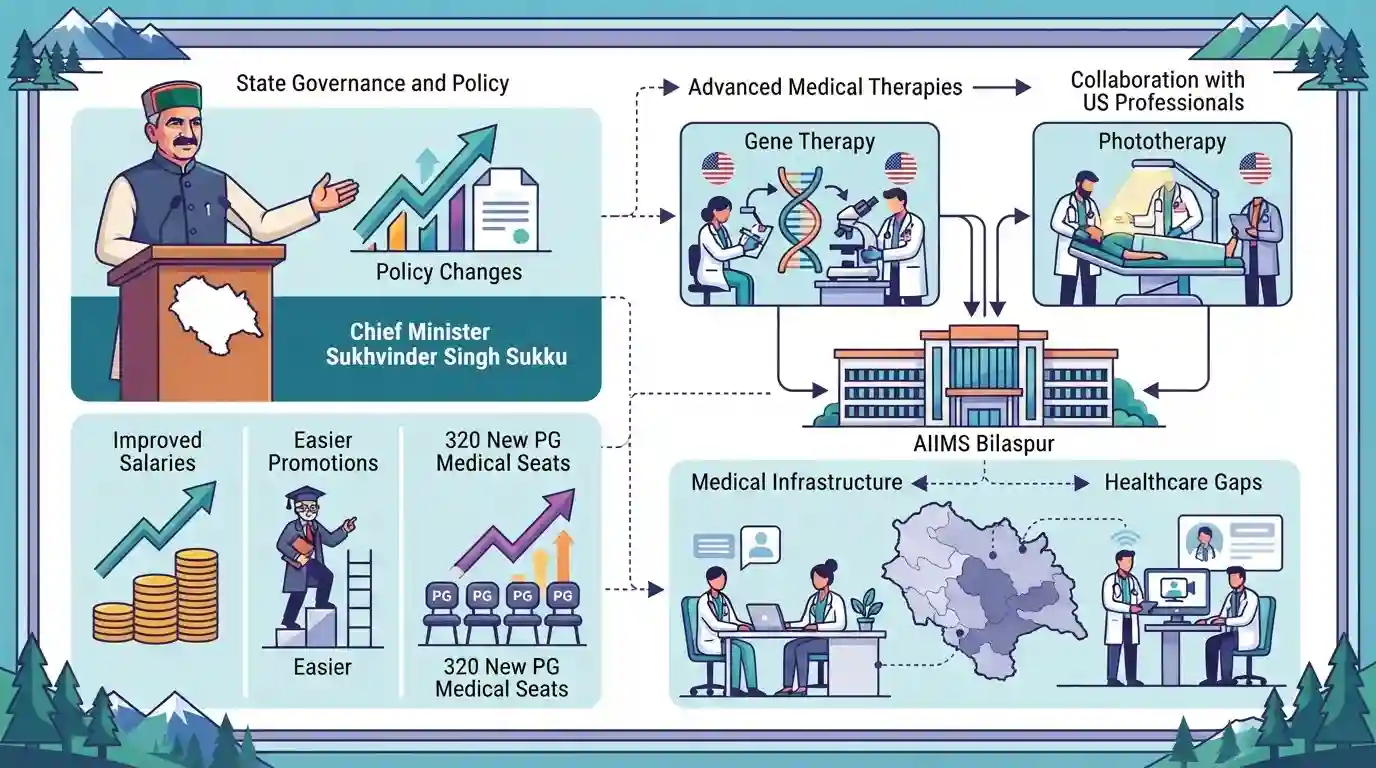
The Himachal Pradesh government, under Chief Minister Sukhvinder Singh Sukhu, is taking significant steps to reform its health sector by exploring advanced medical treatments like gene therapy and phototherapy in collaboration with US medical professionals. During a visit to AIIMS Bilaspur, the CM emphasized policy changes aimed at retaining medical professionals, such as improving salaries, easing promotion criteria for professors, and increasing postgraduate medical seats by 320. These reforms seek to address existing healthcare gaps and bring cutting-edge medical technologies to the state.
Key Points
- The Himachal Pradesh government is initiating work in the fields of gene therapy and phototherapy, aiming for collaboration with US doctors.
- Chief Minister Sukhvinder Singh Sukhu visited AIIMS Bilaspur and highlighted the state's intent to modernize its healthcare capabilities.
- Reforms in the health sector include better salaries and perks for doctors to retain talent and relaxing norms for designating doctors as professors.
- The government plans to increase postgraduate medical seats by 320 to improve specialized healthcare services in the state.
Important Terms
Gene Therapy

A medical technique that treats or prevents diseases by introducing, altering, or removing genetic material (such as DNA or RNA) within a patient's cells to target the underlying genetic causes.
UPSC context
GS Paper III (Science & Technology). Tests biotechnology concepts, healthcare innovations, and ethical implications.
Phototherapy
A medical treatment that uses specific wavelengths of light (such as blue or ultraviolet light) to treat physical conditions, including neonatal jaundice, skin disorders like psoriasis, and some cancers.
UPSC context
GS Paper III (Science & Technology). Tests application of physical science technologies in human health and development.
Tertiary Healthcare
The highly specialized tier of healthcare that offers advanced medical treatments, complex surgeries, and high-end diagnostics, usually delivered by specialized hospitals and national-level research institutes.
UPSC context
GS Paper II (Social Justice and Health). Tests understanding of healthcare delivery structure and governance policies.
AIIMS Bilaspur
An autonomous public medical school and premier healthcare institute in Himachal Pradesh, designated as an Institute of National Importance to improve tertiary care and regional health equity.
UPSC context
GS Paper II (Health Policy). Tests the decentralization of advanced medical infrastructure and regional healthcare governance.
Prelims Trap
Under current Indian clinical trial regulations, both somatic and germline gene therapies are equally permitted for therapeutic human trials.
India's National Guidelines for Gene Therapy Product Development strictly prohibit germline gene therapy and gene editing in human embryos; only somatic gene therapy is allowed.
Static Concepts Connected
How do Somatic and Germline Gene Therapies differ in application and ethics?
- Somatic Therapy: Modifies genes in non-reproductive cells (e.g., bone marrow). The genetic changes affect only the patient and are not passed on to offspring.
- Germline Therapy: Modifies genes in reproductive cells (sperm, eggs, zygotes). The changes are heritable, raising massive ethical concerns and leading to bans in India and globally.
What is the mandate of the Pradhan Mantri Swasthya Suraksha Yojana (PMSSY)?
- Core Objective: Aims to correct regional imbalances in affordable tertiary healthcare and augment facilities for quality medical education in underserved states.
- Execution Pillars: Achieved through setting up new AIIMS-like institutions and upgrading existing state government medical colleges.
Cross-Topic Patterns
Cooperative Federalism in Tertiary Healthcare
State health departments utilizing central infrastructure like AIIMS Bilaspur to scale up localized treatments exemplifies functional policy alignment and cooperative federalism in social sector delivery.
Hilly State Medical Brain Drain
Addressing rural specialist shortages by tying advanced biotech research to relaxed academic promotion criteria, transforming under-resourced states into attractive clinical hubs to check brain drain.

UPSC may contrast somatic and germline gene therapy regulations alongside central-state collaborative tertiary healthcare models in 2026.
Linked PYQs · 3
Linked PYQs · 3
- 2024HPAS_PRELIMSGS1
The process by which the heat comes to us from the sun is called :
- 2023HPAS_PRELIMSGS1
Match List I with List II : | List-I | List-II | |---|---| | (a) Himachal Pradesh Skill Development Project | (i) 2018 | | (b) Himachal Pradesh Kaushal Vikas Nigam | (ii) 2017 | | (c) Mukhya Mantri Yuva Ajivika Yojana | (iii) 2014 | | (d) Himachal Grhini Suvidha Yojana | (iv) 2019 | Choose the correct answer from the options given below : Code: (a) (b) (c) (d)
- 2025HPAS_PRELIMSGS1
According to PLFS 2023-24, share of secondary and tertiary sector in total employment in Himachal Pradesh respectively are :
