Himachal Extends 2019 Industrial Investment Policy Validity
Source:tribune ↗
Why It Matters
Himachal Pradesh is a crucial manufacturing and pharmaceutical hub in Northern India. Understanding the specifics of its industrial policies, state-level subsidies (such as SGST reimbursement and DPR subsidies), and infrastructural bottle-necks is highly important for the state economic section of the HPAS Prelims and Mains exams.
Summary
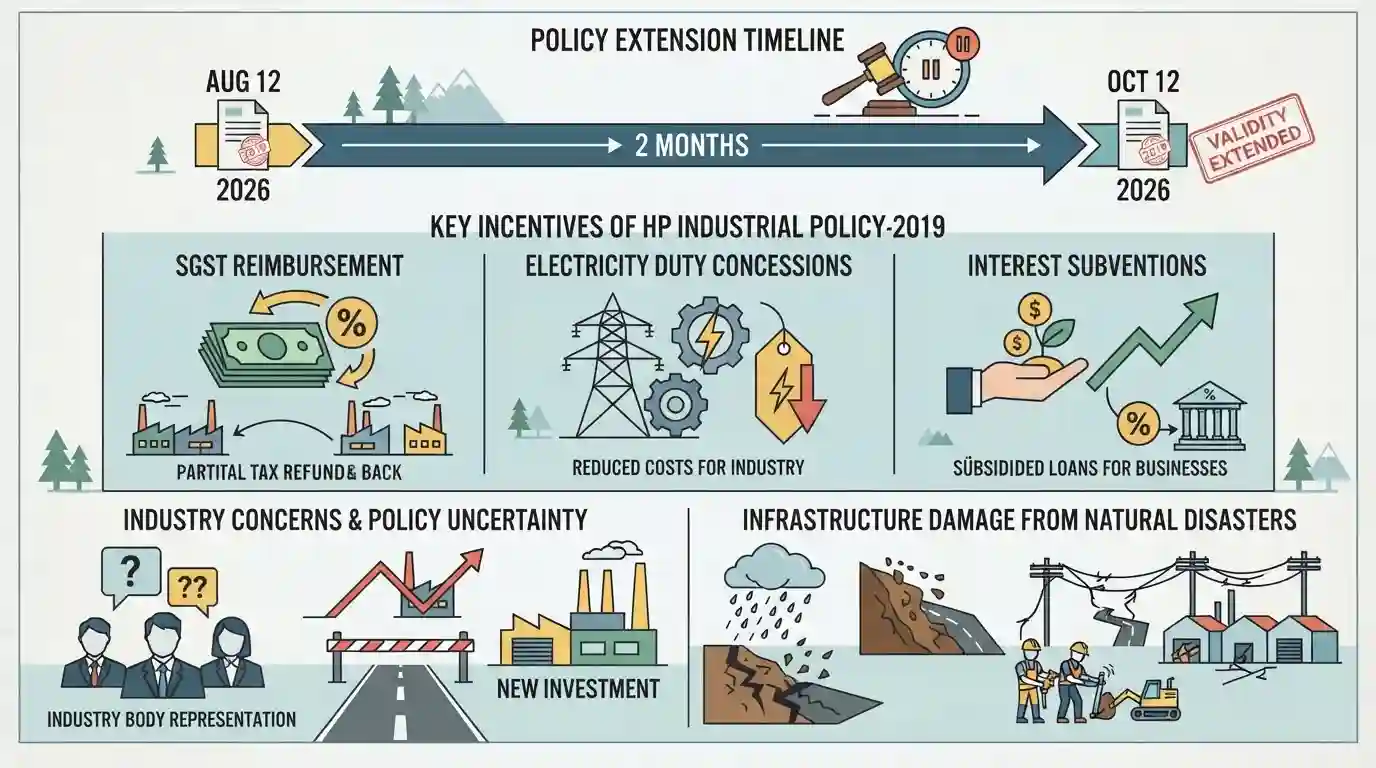
The Himachal Pradesh government has extended the validity of the Himachal Pradesh Industrial Investment Policy-2019 by two months (from August 12 to October 12, 2026). The decision comes amid an inordinate delay in finalizing and notifying a new industrial policy, which has been in the works since 2023. The 2019 policy is a crucial driver for industrial development in the state, offering key incentives such as SGST reimbursement, electricity duty concessions, and interest subventions. Industry bodies like the BBNIA and CII have voiced concerns that the ongoing policy uncertainty, coupled with infrastructure damage from natural disasters, is stalling fresh investment in key industrial belts like Nalagarh.
Key Points
- The Himachal Pradesh government has extended the Himachal Pradesh Industrial Investment Policy-2019 by an additional two months (from August 12 to October 12, 2026) due to delays in finalising a new industrial policy.
- The 2019 policy originally expired on December 31, 2025, and had previously received an extension until March 31, 2026.
- Work on the new industrial policy began in 2023 under the Sukhvinder Singh Sukhu-led government, but it has not been notified even after more than three-and-a-half years.
- Key incentives under the 2019 policy include a 50% subsidy on preparing detailed project reports (DPRs), concessional allotment of industrial sheds, reduced stamp duty and registration charges, exemption from land use charges, interest subvention, transport subsidies, electricity duty concession, and reimbursement of net State Goods and Services Tax (SGST).
- Incentives apply to both new investors and existing units undertaking substantial expansion, provided they commence commercial production.
- The Baddi-Barotiwala Nalagarh Industries Association (representing over 650 industries) and the Himachal chapter of the CII have flagged the policy vacuum as a major deterrent to fresh investments.
- Industrial progress in the region is already facing headwinds due to the COVID-19 pandemic, frequent natural disasters, and poor logistical connectivity, particularly around Nalagarh.
Important Terms
Himachal Pradesh Industrial Investment Policy-2019

A state framework offering subsidies, SGST reimbursement, and duty concessions to attract investment, support MSMEs, and boost employment in Himachal Pradesh.
UPSC context
Crucial for HPAS GS Paper 3 (HP Economy) to understand state-led industrial growth, MSME challenges, and fiscal incentives.
State Goods and Services Tax (SGST)
An indirect tax levied by state governments on the intra-state supply of goods and services, ensuring state-level revenue and fiscal autonomy within India's dual GST structure.
UPSC context
Important for GS Paper 3 (Economy) in understanding taxation policy, state revenue generation, and center-state financial relations.
Baddi-Barotiwala Nalagarh Industries Association (BBNIA)
A prominent industry body representing enterprises in Solan district's BBN industrial belt, advocating for policy reforms, infrastructure improvements, and business growth in the region.
UPSC context
Highly relevant for HPAS GS Paper 3 (HP Economy) as the BBN corridor is the state's core manufacturing and pharmaceutical hub.
Confederation of Indian Industry (CII)
A premier, not-for-profit business association in India that partners with government and civil society to shape industrial policies, enhance competitiveness, and drive economic development.
UPSC context
Relevant for GS Paper 3 (Economy) for understanding the role of industry bodies in shaping national and state economic policies.
Prelims Trap
Incentives under the HP Industrial Investment Policy 2019 apply exclusively to newly established industrial units.
The policy explicitly applies to both newly established enterprises AND existing units that are undertaking substantial expansion, not just new ones.
Static Concepts Connected
What are the core fiscal incentives under the HP Industrial Investment Policy 2019?
- Employment Mandate: 80% employment of Bonafide Himachalis at all levels is strictly mandatory to qualify for any fiscal incentive or concessional land.
- Financial Subsidies: A 50% subsidy on preparing Detailed Project Reports (DPRs), alongside a 3% interest subvention for eligible enterprises.
- Tax Concessions: Includes reimbursement of net SGST, electricity duty concessions, reduced stamp duty, and exemption from land use charges.
How does Himachal Pradesh classify 'Anchor Enterprises' under the 2019 Industrial Policy amendments?
- Category A: Minimum fixed capital investment of ₹200 crore and employing at least 200 local Himachalis.
- Category B: Minimum fixed capital investment of ₹150 crore and employing at least 150 local Himachalis.
- Category C: Minimum fixed capital investment of ₹100 crore and employing at least 100 local Himachalis.
Cross-Topic Patterns
Natural Disasters + Industrial Infrastructure bottlenecks
Frequent monsoon devastation and poor logistical connectivity in the Baddi-Barotiwala-Nalagarh (BBN) belt are increasingly cited as structural bottlenecks for secondary sector growth in GS-3.
Local Domicile Rules + Investment Climate
The strict mandate for 80% Bonafide Himachali employment highlights the constant policy balancing act between maximizing local state welfare and ensuring a flexible, skilled labor pool for industrialists.

Expect a multi-statement question on HP's GSVA composition testing the secondary sector's exact share alongside 2019 policy incentives.
Linked PYQs · 2
Linked PYQs · 2
- 2025HPAS_PRELIMSGS1
According to PLFS 2023-24, share of secondary and tertiary sector in total employment in Himachal Pradesh respectively are :
- 2024HPAS_PRELIMSGS1
For the year 2022-23, match the Industry sub-sector in Himachal Pradesh with the percentage of workers employed in them : | List I (Industry Sub-sector) | List II (Percentage of workers employed) | |---|---| | (a) Mining and Quarrying | (i) 2 | | (b) Manufacturing | (ii) 41 | | (c) Electricity and Other Utilities | (iii) 50 | | (d) Construction | (iv) 7 | Choose the correct option : Code: (a) (b) (c) (d)
