Himachal Approves Market Intervention Scheme for Fruits
Source:hindustantimes ↗
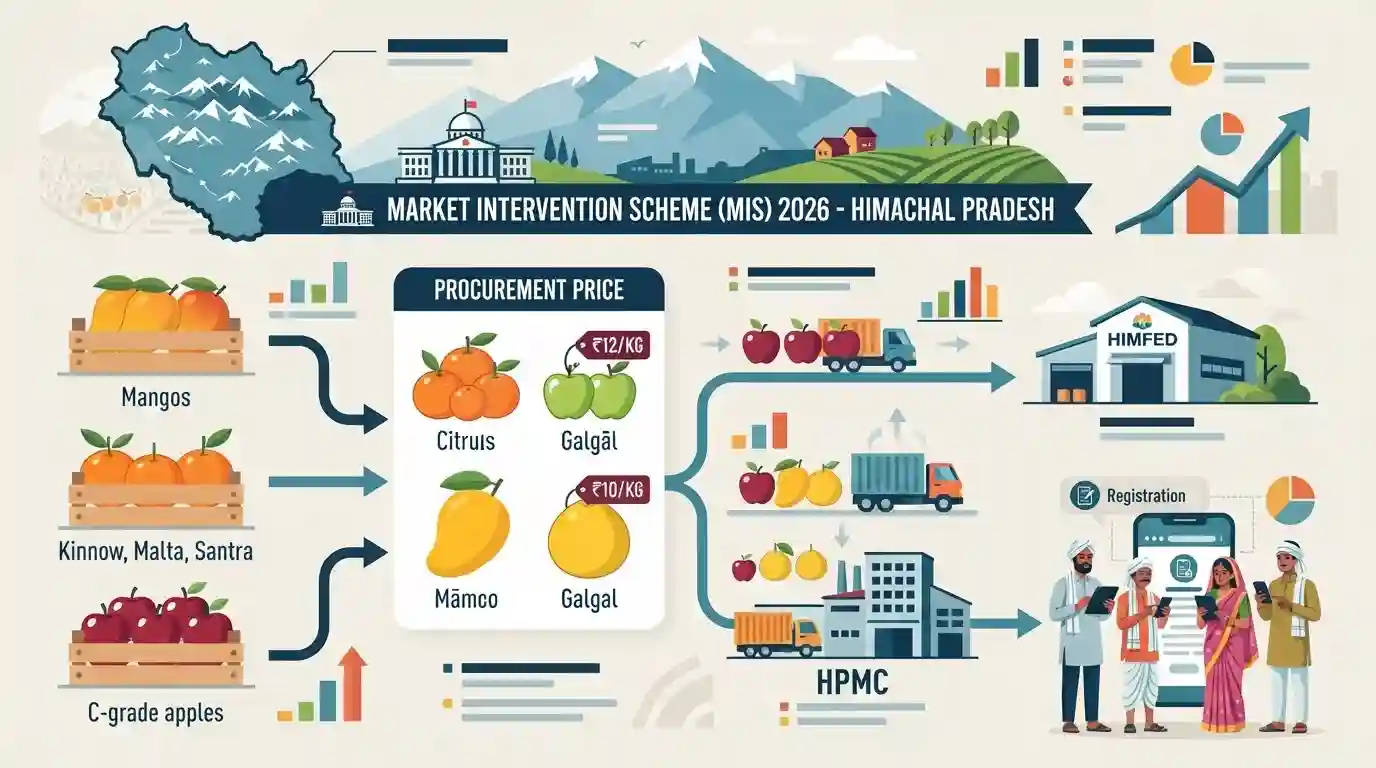
Why It Matters
Understanding state-specific agricultural interventions like the MIS is vital for assessing how governments stabilize farm incomes, handle market surplus of perishable commodities, and manage procurement agencies like HPMC and HIMFED.
Summary
The Himachal Pradesh government has approved the implementation of the Market Intervention Scheme (MIS) for the 2026 procurement of processing grade mangoes, citrus fruits, and c-grade apples. By establishing a fixed procurement price—₹12/kg for Kinnow, Malta, Santra, and c-grade apples, and ₹10/kg for Galgal—the scheme aims to safeguard horticulturists from price crashes and distress sales. Procurement will be conducted through HPMC and, for apples, HIMFED as well, with eligibility strictly limited to farmers registered on the HPMC MIS Portal.
Key Points
- The Himachal Pradesh government has implemented the Market Intervention Scheme (MIS) for the procurement of processing grade mangoes, citrus fruits, and c-grade apples for the year 2026.
- Procurement prices are set at ₹12/kg for Kinnow, Malta, Santra, and c-grade apples (up to 1.50 lakh metric tonnes), and ₹10/kg for Galgal.
- The procurement process will be facilitated by HPMC, with the potential involvement of HIMFED for apples.
- Only farmers officially registered on the HPMC MIS Portal will be eligible to benefit from this scheme.
Important Terms
Market Intervention Scheme (MIS)

An ad hoc price support mechanism for perishable agricultural and horticultural commodities not covered by MSP. It is implemented at a state's request to protect farmers from distress sales during bumper harvests.
UPSC context
GS Paper 3 (Agriculture). Tests the differences between MIS and MSP, and mechanisms to address price volatility for perishables.
Himachal Pradesh Horticultural Produce Marketing and Processing Corporation (HPMC)
A state-owned undertaking established in 1974 to market fresh fruits, process surplus produce, and procure unmarketable fruits like processing-grade apples under the Market Intervention Scheme to ensure remunerative prices.
UPSC context
GS Paper 3 (Food Processing / Marketing). Relevant as a case study for state intervention in post-harvest management and agro-processing.
HIMFED (Himachal Pradesh State Cooperative Marketing and Consumer's Federation Ltd)
An apex cooperative marketing federation in Himachal Pradesh that procures agricultural produce, distributes fertilizers, and acts as a major procurement agency to protect farmers from unstable markets and middlemen.
UPSC context
GS Paper 2 and 3 (Cooperatives / Agriculture). Demonstrates the role of cooperative societies in rural development and agricultural supply chains.
Prelims Trap
"The Market Intervention Scheme (MIS) functions as a permanent Minimum Support Price for all horticultural crops."
MIS is an ad hoc measure only triggered by a 10% price crash or production hike. It strictly covers perishables NOT included in the 23 standard MSP crops.
Static Concepts Connected
What are the four components of the PM-AASHA umbrella scheme?
- Price Support Scheme: Physical procurement of pulses, oilseeds, and copra by central nodal agencies to ensure MSP to farmers.
- Price Deficiency Payment: Direct bank transfer of the difference between MSP and the market selling price; involves no physical procurement of crops.
- Private Procurement Pilot: Allows pre-vetted private sector entities to undertake procurement operations in selected pilot districts to boost market efficiency.
- Market Intervention Scheme: Ad hoc procurement of perishable horticultural and agricultural produce to protect farmers from sudden, severe price crashes.
How does the Market Intervention Scheme (MIS) differ from the regular MSP regime?
- Crop Coverage: MSP guarantees prices for 23 mandated crops annually. MIS covers perishable perishables (fruits, vegetables) on an ad hoc basis.
- Trigger Conditions: MIS is strictly activated upon a 10% market price decline or a 10% unexpected production increase, unlike MSP which is declared regardless.
- Fiscal Burden: MIS procurement losses are shared between the Center and States (typically 50:50), whereas MSP operation costs are entirely borne by the Center.
Cross-Topic Patterns
Digital agriculture and targeted procurement
Mandating registration on the HPMC portal mirrors the broader national push for AgriStack and digital crop registries to ensure price support reaches actual cultivators, bypassing middlemen.
Climate volatility in horticulture
As erratic weather triggers unexpected gluts or quality drops (like c-grade apples), ad hoc safety nets like MIS become critical climate-adaptation tools for vulnerable horticultural farmers.

UPSC is likely to frame a multi-statement question contrasting the trigger conditions, crop coverage, and cost-sharing models of MIS vs MSP.
Linked PYQs · 2
Linked PYQs · 2
- 2025HPAS_PRELIMSGS1
Mountain Soil Zone in Himachal Pradesh is found between :
- 2018HPAS_PRELIMSGS1
'Lanjī', 'Saro' and 'Rajnagar' in Chamba district are the centres for development of the following :
