Governor Inaugurates Historic International Minjar Fair
Source:socialnews.xyz ↗
Why It Matters
The Minjar Fair is a major cultural event in Himachal Pradesh and frequently appears in HPAS Prelims. The historical context involving King Sahila Varma, the associated temples (Champavati, Lakshmi Narayan), and the region's GI-tagged traditional crafts form a dense cluster of highly testable facts for the State Services examination.
Summary
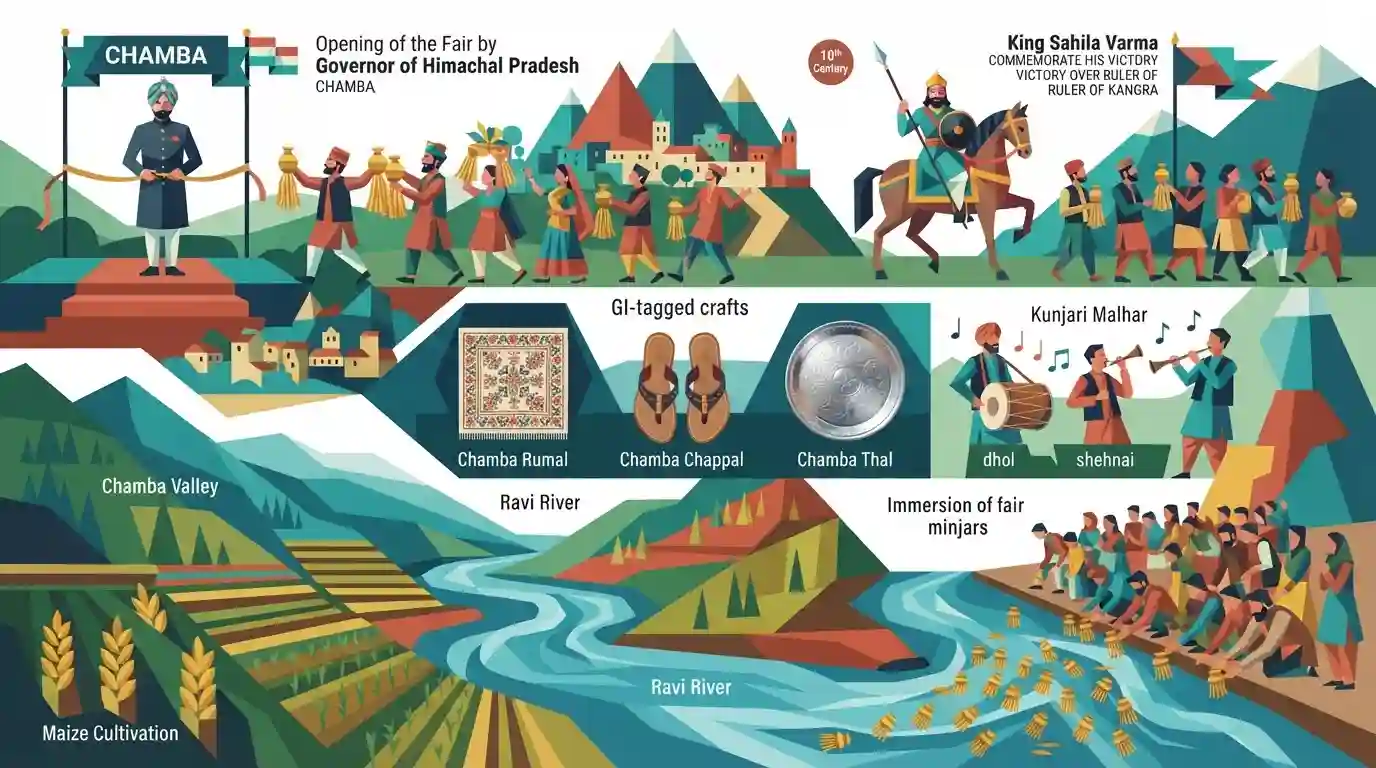
The International Minjar Fair commenced in Chamba, Himachal Pradesh, with Governor Shiv Pratap Shukla formally opening the week-long cultural celebration. Symbolising the blossoming of maize and a prayer for a good agricultural harvest, 'minjars' (golden silk tassels) are tied to deities and distributed among attendees. The historic fair dates back to the 10th century, marking the victory of Chamba's King Sahila Varma over the ruler of Kangra. The fair celebrates traditional music like 'Kunjari Malhar' and highlights Chamba's celebrated crafts, including the GI-tagged Chamba Rumal, Chamba Chappal, and Chamba Thal. The festivities conclude with the immersion of minjars in the Ravi River.
Key Points
- The international Minjar Fair commenced in Chamba, Himachal Pradesh, symbolising the blossoming of maize and agricultural prosperity.
- Governor Shiv Pratap Shukla inaugurated the fair, participating in the traditional singing of 'Kunjari Malhar'.
- The fair originated in the 10th century to commemorate the victory of King Sahila Varma (Raja Sahil Varman) over the king of Kangra.
- The eight-day festival concludes with a grand procession from Akhand Chandi Palace to the banks of the Ravi River, where 'minjars' (silk tassels) are immersed.
- The event highlights the rich heritage and traditional GI-tagged crafts of Chamba, including the Chamba Rumal, Chamba Chappal, and Chamba Thal.
Important Terms
Minjar Fair

A week-long traditional agricultural festival in Chamba, Himachal Pradesh, celebrating the blossoming of maize. Tracing its origins to the 10th century, it concludes by immersing 'minjars' (golden silk tassels) in the Ravi River for a good harvest.
UPSC context
Relevant for Art & Culture (State fairs and festivals). Highlights India's agrarian traditions and the cultural geography of Himachal Pradesh.
Chamba Rumal
A GI-tagged, hand-embroidered cloth from Himachal Pradesh known as a "needle wonder". It employs a double-sided reversible stitch (do-rukha) to seamlessly depict Pahari miniature art, mythology, and folklore on fine muslin or silk.
UPSC context
Important for Prelims and GS-1 Art & Culture. Illustrates the translation of Pahari miniature paintings into traditional Indian textile arts.
Chamba Chappal
A GI-tagged indigenous leather slipper from Himachal Pradesh. Handcrafted using age-old techniques, it features intricate and brightly colored silk embroidery (Chamba kadhai) and traces its distinctive design origins to royal patronage in the 19th century.
UPSC context
Tests knowledge of regional GI tags, rural economy, and traditional crafts in Prelims and GS-1 Art & Culture.
Chamba Thal
A GI-recognized embossed brass plate from Himachal Pradesh, crafted using ancient metalworking techniques. Distinctive for its intricate, hand-beaten motifs of deities and local tribes, it holds deep ceremonial and cultural significance in the Chamba region.
UPSC context
Relevant for Prelims (GI Tags) and GS-1 Art & Culture (Traditional metal crafts and heritage preservation).
Kunjari Malhar
A soulful, traditional folk music style specific to the Chamba region of Himachal Pradesh. Performed predominantly by local artisans during the Minjar Fair, the melodies symbolise the pain of separation and the area's rich cultural legacy.
UPSC context
Significant for GS-1 Art & Culture (Folk Music/Regional Traditions) and Prelims cultural mapping of India.
Prelims Trap
Chamba Rumal embroidery features a distinct front and back, with the intricate satin stitch visible only on the primary face.
The 'Dorukha-tanka' (double-faced stitch) is the defining feature of Chamba Rumal. Unlike normal embroidery, it leaves no knots or messy threads, making both sides of the cloth look completely identical.
Static Concepts Connected
What is the 'Dorukha-tanka' technique of Chamba Rumal?
- Embroidery Stitch: A double-sided satin stitch embroidery technique where both sides of the fabric look completely identical, leaving no loose threads or knots.
- Thematic Influence: Designs are heavily inspired by Pahari miniature paintings (Chamba and Kangra schools), depicting Raslila, Mahabharata, and local folklore.
- Material Used: Traditionally done on unbleached muslin, khaddar, or fine silk using untwisted silk threads (pat).
What is the historical and geographic context of Chamba?
- Historical Origin: Founded by Raja Sahil Varman (Sahila Varma) in the 10th century, shifting the capital from Bharmour to Chamba (named after his daughter Champavati).
- Geographic Location: Situated on the banks of the Ravi River, a major left-bank tributary of the Indus, flowing between the Pir Panjal and Dhauladhar ranges.
Cross-Topic Patterns
Pahari Miniatures and Textile Confluence
The Chamba Rumal serves as a unique medium where classical Kangra and Basohli miniature painting compositions were directly transposed onto textiles using fine double-sided embroidery.
Hydrology and Cultural Geography
Ritual cycles like the Minjar Fair's immersion in the Ravi River show how Himalayan river hydrology dictates the seasonal, agricultural, and cultural calendars of mountain communities.

GI-tagged textiles like Chamba Rumal (dorukha technique) paired with Himalayan river networks and harvest fairs likely for Prelims 2026.
Linked PYQs · 3
Linked PYQs · 3
- 2020HPAS_PRELIMSGS1
Consider the given four statements and choose the correct answer from the given options. Which of the following are not true about folk dances, fair and festivals of H.P.? 1. 'Kharait' and 'Ujagjama' are the famous sword dances. 2. 'Bhunda', 'Shant' and 'Bhoj' are given the importance of 'Kumbha' by the hill people. 3. 'Minjar' fair starts on the second Sunday of sawan. 4. 'Chhamb' is the sacred masked dance performed only by Lamas.
- 2024HPAS_PRELIMSGS1
Given below are two statements : Statement I : Chamba had its own currency since ancient times. This was called "Chakli". Statement II : Raja Lalit Vernan of Chamba had built two temples named 'Chandragupta' and 'Kameshwar' in Chamba. In the light of the above statements, choose the most appropriate answer from the options given below :
- 2022HPAS_PRELIMSGS1
Read the following sentences and select the incorrect one : (i) St. Andrew's Church in Chamba carries the influence of Scottish architecture. (ii) The architecture of 'Manimahesh Lakshana Devi temple' is 'Indo-Aryan Nagar style (Shikhar)'. (iii) 'Champavati temple' in Chamba is built in 'Graeco Buddhist art of Gandhara'. (iv) The brass idol of the Goddess at Chatrari Shakti Devi temple in Chamba district is in the 'Kashmiri style'.
