Himachal government employees entitled to full salary on study leave
Source:thenewshimachal ↗
Why It Matters
This development represents a notable shift in state governance and personnel administration, directly affecting the welfare and professional development of civil servants. Understanding state-specific administrative reforms and amendments to civil service rules is crucial for HPAS Prelims as it deals with state policies, public administration, and governance.
Summary
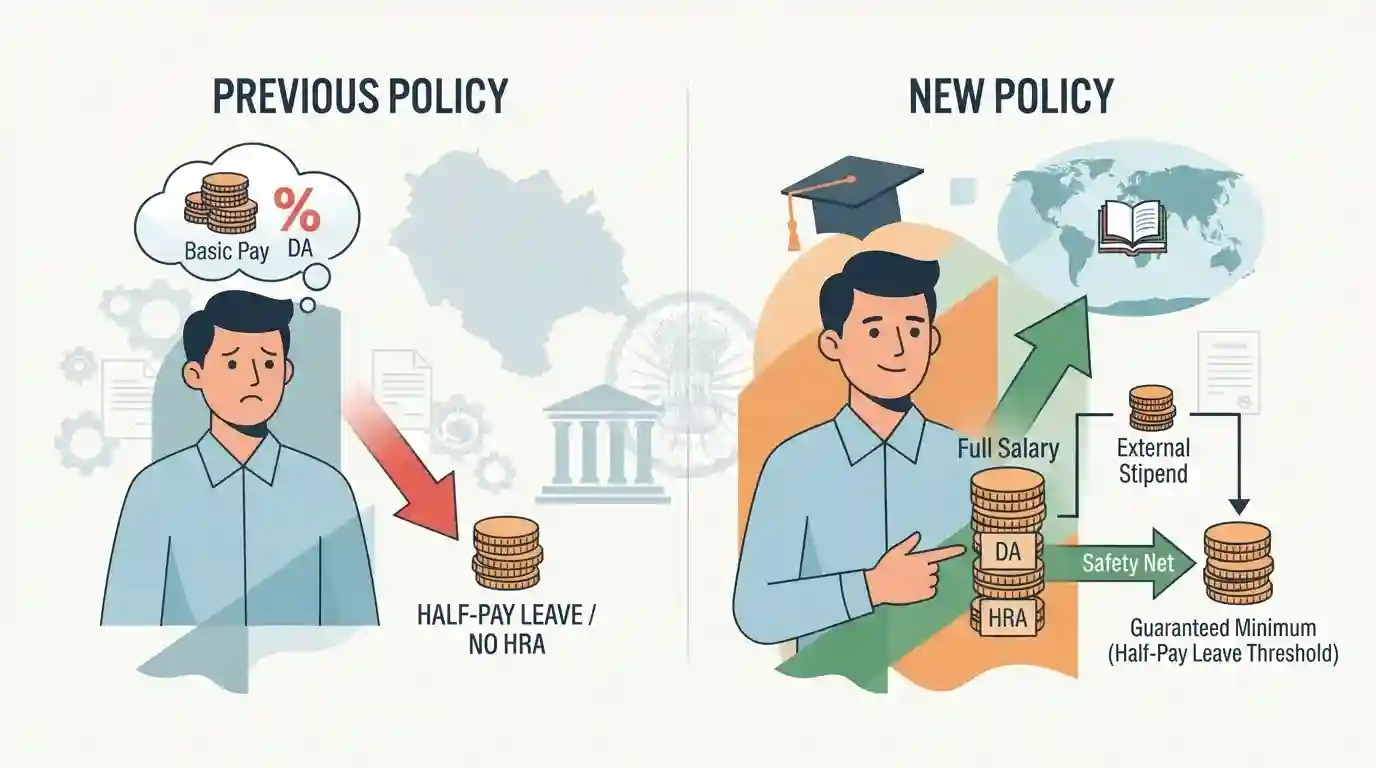
The Himachal Pradesh government has significantly upgraded the benefits for state employees undertaking study leave by amending the Central Civil Services (Leave) Rules, 1972. As of August 7, 2024, employees pursuing further education to improve their professional skills either within India or abroad will be entitled to their full salary, inclusive of Dearness Allowance (DA) and House Rent Allowance (HRA). Previously, employees were restricted to basic pay and DA or half-pay leave without HRA. The new rules specify that while any external stipends or scholarships will be deducted from their pay, the resulting salary will never drop below the standard half-pay leave threshold. This administrative reform is aimed at removing financial disincentives for civil servants seeking to enhance their capabilities.
Key Points
- The Himachal Pradesh government has amended the Central Civil Services (Leave) Rules, 1972 to enhance benefits for state employees on study leave.
- Effective from August 7, 2024, employees pursuing higher studies in India or abroad will receive their full salary, along with Dearness Allowance (DA) and House Rent Allowance (HRA).
- Prior to this amendment, employees on study leave were only entitled to basic pay and DA, or an equivalent of half-pay leave plus DA, with no HRA provided.
- While any scholarship or stipend received by the employee will be deducted from their salary, their final pay will not fall below the half-pay leave amount.
- This policy change aims to encourage government officials to upgrade their skills and efficiency by facilitating higher education without severe financial loss.
Important Terms
Central Civil Services (Leave) Rules, 1972

A comprehensive set of rules governing various types of leave, eligibility, and leave salaries for Central Government civil servants in India, often adopted or adapted by State Governments.
UPSC context
GS Paper II (Governance/Public Administration); tests understanding of civil service personnel management, rules, and administrative reforms in India.
Article 309 of the Constitution of India
A constitutional provision empowering Parliament and State Legislatures (and the President/Governors via provisos) to regulate the recruitment and conditions of service of public servants.
UPSC context
GS Paper II (Polity & Constitution); tests knowledge of legislative and executive powers over civil services and public service personnel administration.
Study Leave
A special category of leave granted to government employees to pursue higher studies, specialized training, or research that directly enhances their professional skills and public service capability.
UPSC context
GS Paper II (Governance/Civil Services); relates to administrative reforms, civil service capacity building, and employee welfare within public administration.
Dearness Allowance (DA)
A cost-of-living adjustment allowance paid to government employees and pensioners to mitigate the inflationary impact on their purchasing power, calculated as a percentage of basic salary.
UPSC context
GS Paper III (Economy); tests understanding of macroeconomic inflation, fiscal administration, and public expenditure management of state and central governments.
House Rent Allowance (HRA)
A structured financial allowance provided by employers, including governments, to employees to help cover accommodation costs associated with their place of posting.
UPSC context
GS Paper III (Economy/Public Finance); tests knowledge of public welfare compensation, salary structures of government employees, and state budget outlays.
Prelims Trap
States cannot independently amend the Central Civil Services Rules to govern state public services.
Under Article 309, states have full legislative and executive competence to amend or modify adopted Central Civil Services rules for state cadre employees.
Static Concepts Connected
What is the constitutional basis for regulating the civil services in India?
- Legislative competence: Parliament and state legislatures can regulate the recruitment and conditions of service of public services in their respective jurisdictions.
- Rule-making power: The President or Governor can make rules regulating civil services until the appropriate legislature passes an act under Article 309.
- Doctrine of pleasure: Under Article 310, civil servants hold office during the pleasure of the President or Governor, subject to Article 311 safeguards.
What is the relation between Central Civil Services (CCS) Rules and State Civil Services?
- Adoption model: States often adopt Central Civil Services rules mutatis mutandis to maintain administrative standards and simplify personnel management frameworks.
- Modification autonomy: Under Article 309, states possess sovereign competence to amend, suspend, or override these adopted rules for state cadre employees.
Cross-Topic Patterns
Capacity building vs Fiscal prudence
Linking state administrative reforms to the national agenda of civil service capacity building (Mission Karmayogi) balanced against state fiscal deficits and rising committed expenditure.
Centralization of financial control
Shifting approval authority from line departments to the state Finance Department highlights how fiscal consolidation concerns often override decentralization in state governance.

Questions may test the constitutional boundaries of Article 309, specifically state powers to amend adopted central civil service templates.
Linked PYQs · 1
Linked PYQs · 1
- 2020HPAS_PRELIMSGS1
Consider the given four statements and choose the correct answer from the given options. Which of the following statement(s) is / are not correct about the Social Welfare programs of Government of Himachal Pradesh? 1. e-Udyan portal: Where farmers can avail Horticulture farming service benefits while sitting in their home. 2. Vishesh Mahila Uthan Yojna: Scheme formulated for rehabilitation of physically and sexually abused women through technical and vocational training. 3. Medha Protsahan Yojna: Rupees one lakh is provided to the meritorious students to provide guidance at coaching centers. 4. Mukhya Mantri Ek Bigha Scheme: State Government will empower rural women by helping them become self-sufficient and get employment under MGNREGS.
