Himachal Pradesh Nutrition Policy for Anaemia and Malnutrition
Source:hindustantimes ↗
Why It Matters
Crucial for HPAS aspirants tracking state-specific health policies, human development indicators, and welfare initiatives targeting malnutrition and anaemia in Himachal Pradesh.
Summary
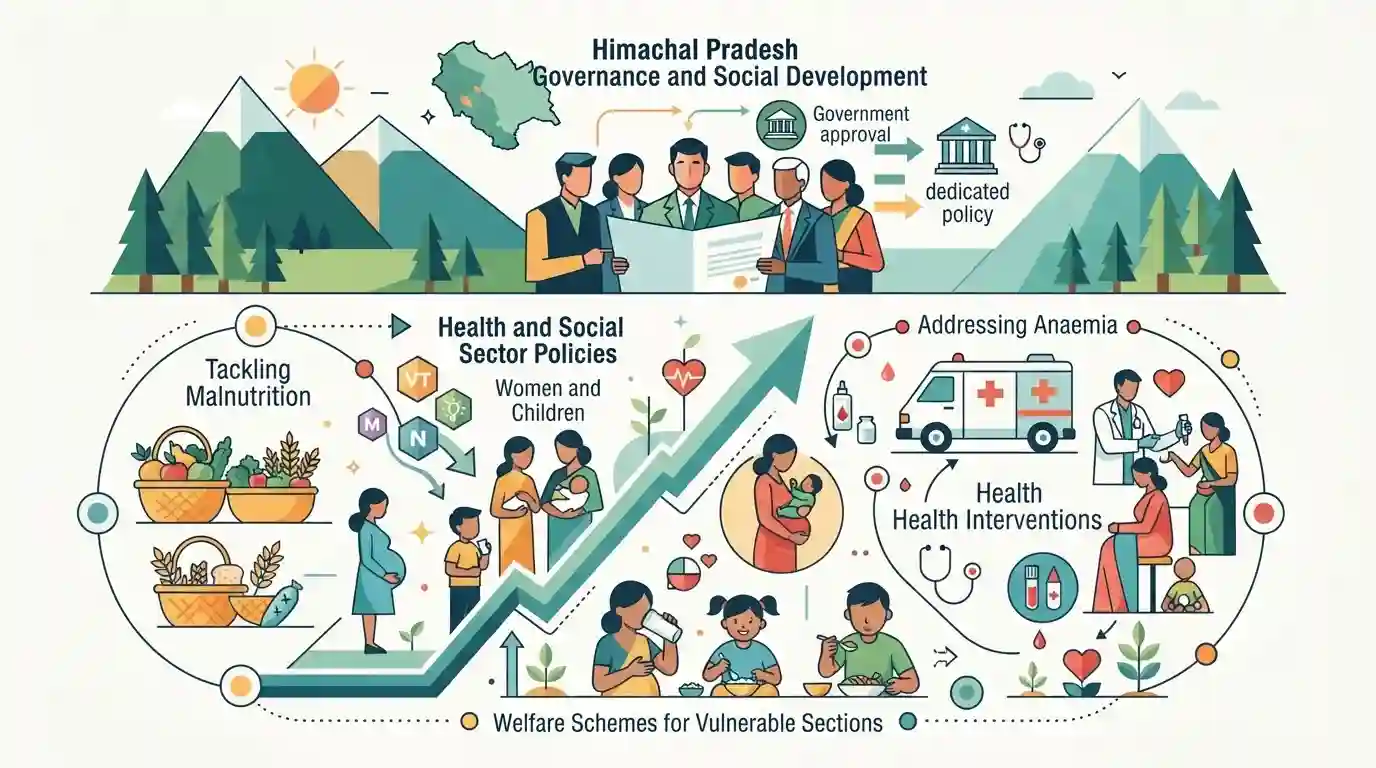
The Himachal Pradesh government has approved a dedicated policy aimed at effectively tackling malnutrition and anaemia across the state, prioritizing vulnerable demographics like women and children through strategic health interventions.
Key Points
- The Himachal Pradesh government has cleared a comprehensive policy aimed at tackling malnutrition and anaemia in the state.
- The policy focuses on targeted interventions, inter-sectoral coordination, and improving nutritional outcomes among vulnerable groups, particularly women and children.
- It aligns with broader state and national public health objectives to address hidden hunger and nutritional deficiencies.
Important Terms
Himachal Pradesh Nutrition Policy, 2026

A comprehensive state policy launched by Himachal Pradesh to systematically combat malnutrition, anaemia, and micronutrient deficiencies through a life-cycle approach, traditional diets, and inter-departmental convergence.
UPSC context
Essential for HPAS Mains (Paper II - Social Sector Policies, Health and Welfare Schemes in Himachal Pradesh).
State Nutrition Coordination Cell (SNCC)
A specialized state-level body proposed under the nutrition policy to coordinate multi-sectoral planning, implementation, and monitoring of nutrition interventions across departments in Himachal Pradesh.
UPSC context
Important for HPAS governance questions regarding administrative machinery, institutional convergence, and social welfare delivery.
Indira Gandhi Matri Shishu Sankalp Yojna (IGMSSY)
A dedicated state welfare scheme with a substantial financial outlay aimed at strengthening maternal and child healthcare services and tackling intergenerational malnutrition in Himachal Pradesh.
UPSC context
Crucial for HPAS Mains (Welfare Schemes for Vulnerable Sections and Women/Child Development in HP).
First 1,000 Days of Life
A foundational concept prioritized in nutrition policies focusing on pregnancy and a child's first two years of life to prevent irreversible physical and cognitive stunting.
UPSC context
Valuable for HPAS questions on public health indicators, child development, and preventive health strategies.
Prelims Trap
Policy aimed exclusively at combating malnutrition and anaemia among children below five years of age.
Aspirants often assume malnutrition policies only cover children under 5, whereas comprehensive state policies like HP's target the entire life-cycle including adolescents and pregnant women.
Static Concepts Connected
What are the core objectives and implementation framework of the PM POSHAN Scheme?
- Objective: Centrally sponsored scheme providing hot cooked meals to children in primary and upper primary schools to improve nutritional status.
- Evolution: Rebranded from the National Programme of Mid-Day Meal in Schools in 2021, expanding coverage to children studying in balvatikas (pre-primary).
Cross-Topic Patterns
Nutrition Policy Meets Millets & Tribal Welfare
HP's nutrition policy integrates traditional millets and local agriculture, bridging state-level public health targets with national agricultural diversification and tribal welfare mandates.
Decentralized Governance in Public Health Delivery
Institutional frameworks like SNCC and DNCC link state health planning with decentralized district administration, a recurrent theme in HPAS governance questions.

HP Nutrition Policy's life-cycle approach and institutional cells (SNCC/DNCC) will likely feature in HPAS Mains social sector questions.
Linked PYQs · 2
Linked PYQs · 2
- 2025HPAS_PRELIMSGS1
Consider the following statements regarding public finance of Himachal Pradesh : (1) According to Budget Estimate for the year 2024-25, share of revenue expenditure out of total expenditure is around 80 percent. (2) Debt as a percentage of GSDP reached 75.33 during the year 2022-23. (3) State's own tax revenue as a percentage of total revenue for the year 2024-25 (BE) increased to 27.4. (4) During FY 2024-25 (BE) education and health sector were allocated Rs. 9995 and Rs. 8575 crores respectively. Choose the correct answer from the options given below :
- 2023HPAS_PRELIMSGS1
Consider the following statements : (1) The sex ratio in the state is 972 females per 1000 males, which is higher than the national average of 940 females per 1000 males. (2) Service is the primary occupation of people in Himachal Pradesh, with over 90% of the population dependent on it for their livelihood. (3) Himachal Pradesh has a per capita income of Rs. 3,58,369, which is higher than the national average. (4) The state has a high Human Development Index (HDI) of 0.707, which is higher than the national average of 0.640. Choose the correct answer from the options given below :
