Subsidies introduced on fishing gear and boats via cooperative network
Source:thenewshimachal ↗
Why It Matters
Illustrates state-level economic interventions targeting the primary sector to uplift rural livelihoods. It underscores the practical application of DBT and cooperatives for efficient subsidy distribution and aligns with the national focus on the Blue Economy.
Summary
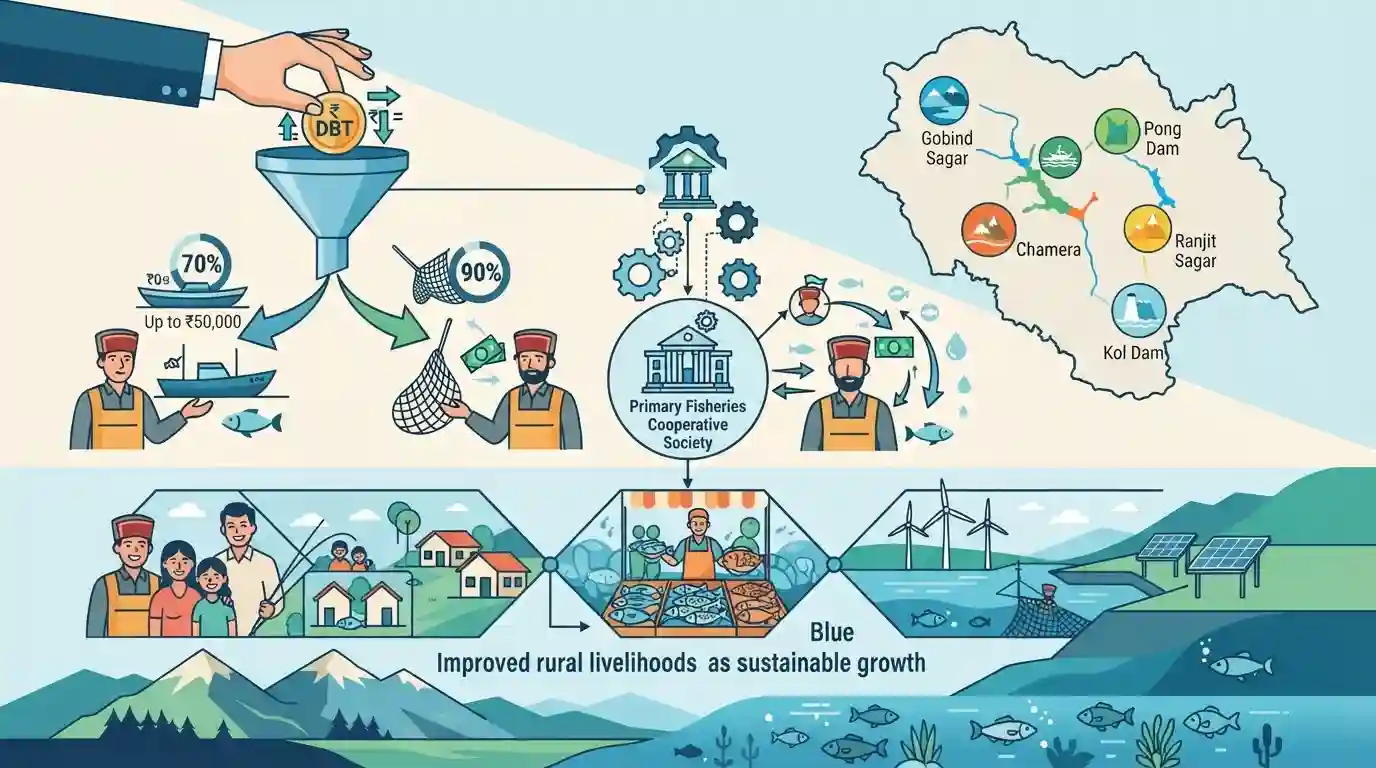
The Himachal Pradesh government has announced significant subsidies to boost its fisheries sector and promote the blue economy. Fishermen will receive a 70% subsidy on the purchase of boats (costing up to ₹50,000) and a 90% subsidy on fishing nets. The scheme applies to those operating in major reservoirs such as Gobind Sagar, Pong Dam, Chamera, Ranjit Sagar, and Kol Dam. Financial assistance is channeled directly to beneficiaries through the Direct Benefit Transfer (DBT) mechanism via Primary Fisheries Cooperative Societies, aiming to improve rural livelihoods and ensure transparent welfare delivery.
Key Points
- The Himachal Pradesh government introduced a 70% subsidy on fishing boats (costing up to ₹50,000) for fishermen operating in major reservoirs like Gobind Sagar and Pong Dam.
- A 90% subsidy is provided for purchasing fishing nets, with cast nets for riverine areas and gill nets for reservoir operations.
- The initiative aims to promote the state's blue economy, strengthen the fisheries sector, and improve the livelihoods of local fishing communities.
- Subsidies are delivered directly to beneficiaries' bank accounts via the Direct Benefit Transfer (DBT) system through Primary Fisheries Cooperative Societies.
Important Terms
Direct Benefit Transfer (DBT)

A government reform that electronically transfers subsidies and welfare payments directly into beneficiaries' bank accounts. It leverages digital platforms to eliminate intermediaries, plug leakages, and ensure transparent, timely welfare delivery.
UPSC context
Important for GS Paper 2 (Governance) and GS 3 (Economy), testing e-governance, targeted subsidies, and financial inclusion.
Blue Revolution
A comprehensive national program designed to sustainably increase aquaculture and marine fish production. It focuses on modernizing fisheries with advanced technologies to boost incomes, generate employment, and ensure food security.
UPSC context
Relevant to GS Paper 3 (Agriculture and Allied Sectors), testing economic development, rural livelihoods, and sustainable resource management.
Primary Fisheries Cooperative Society
Grassroots-level cooperative organizations formed by local fishermen. They facilitate access to credit, provide market linkages, and act as nodal agencies to implement and distribute government welfare subsidies directly to communities.
UPSC context
Fits into GS Paper 2 (Cooperatives, SHGs), highlighting the role of collective action in rural empowerment and grassroots governance.
Prelims Trap
"Blue Economy initiatives are exclusively restricted to India's marine and coastal states."
The Blue Economy is not just marine-focused; it actively encompasses inland water bodies like rivers, dams, and reservoirs in landlocked states like Himachal Pradesh.
Static Concepts Connected
Which rivers feed the major hydroelectric reservoirs in Himachal Pradesh?
- Pong Dam: An earth-fill dam constructed on the Beas River, creating the Maharana Pratap Sagar reservoir.
- Gobind Sagar: An artificial lake formed by the massive Bhakra Dam, constructed on the Sutlej River.
- Kol Dam: A major hydroelectric project also situated on the Sutlej River.
- Ravi River Projects: The Ravi River feeds both the Chamera Dam and the Ranjit Sagar Dam (Thein Dam).
What role do Primary Cooperative Societies play in allied agricultural sectors?
- Direct Delivery: They act as grassroots nodal agencies for routing state subsidies via Direct Benefit Transfer (DBT), effectively eliminating local middlemen.
- Collective Power: They aggregate local producers and fishermen, enhancing their bargaining power for purchasing gear and marketing their catch collectively.
Cross-Topic Patterns
Reservoir Fisheries & Dam Ecology
While large dams are routinely criticized for riverine ecology disruption, state subsidies highlight their crucial secondary utility: generating sustainable inland fishing livelihoods for displaced or local communities.
Cooperatives in Allied Sectors
Channeling DBT directly through Primary Fisheries Cooperative Societies aligns with the Centre's broader push to transform primary societies (like PACS) into multi-purpose socio-economic delivery hubs in rural areas.

A Prelims match-the-following question pairing North Indian dams (Pong, Chamera, Kol, Gobind Sagar) with their rivers is highly probable.
Linked PYQs · 1
Linked PYQs · 1
- 2018HPAS_PRELIMSGS1
What is Blue economy ?
