Kutki cultivation in Himachal supports Himalayan biodiversity
Source:The Hindu ↗
Why It Matters
The article provides a real-world case study on linking biodiversity conservation with sustainable rural livelihoods. It covers highly testable Prelims topics including endangered species (IUCN/CITES), medicinal plants of the Himalayas, and government S&T initiatives like the SEED programme and Himalayan Bioresource Mission.
Summary
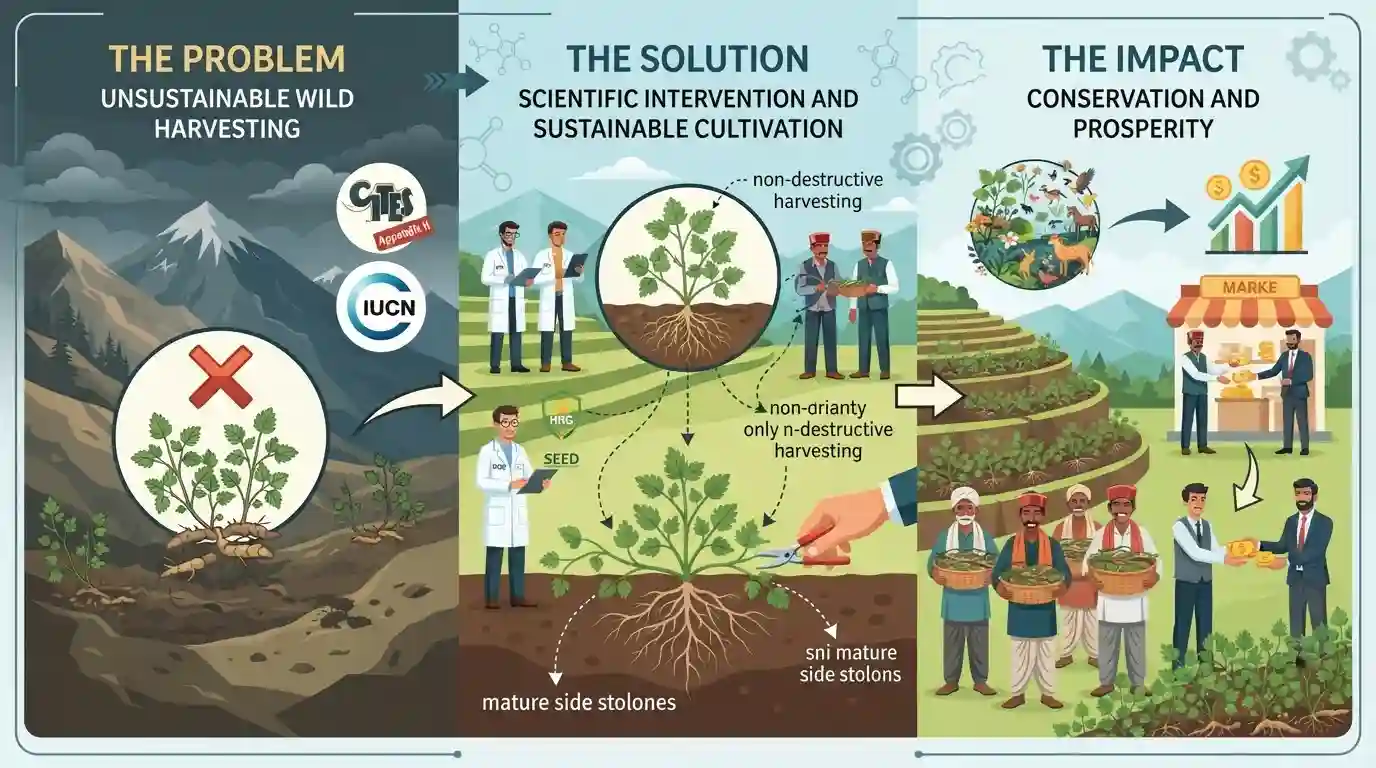
Farmers in Himachal Pradesh's Mandi district are leading the sustainable cultivation of 'Kutki' (Picrorhiza kurroa), an endangered medicinal herb native to the high Himalayas. Previously subjected to destructive wild harvesting that uprooted the entire plant, Kutki is currently listed in CITES Appendix II and the IUCN Red List. To counter this, scientists from the Himalayan Research Group (HRG) under the DST's SEED programme developed a non-destructive method of harvesting only the plant's mature side 'stolons'. Supported by the Department of Biotechnology's Himalayan Bioresource Mission, this approach preserves the mother plant, allowing for continuous perennial yields. This sustainable farming model not only conserves local biodiversity but also significantly boosts farmers' incomes through direct sales to major buyers.
Key Points
- Kutki (Picrorhiza kurroa) is an endangered high-altitude Himalayan medicinal herb listed in CITES Appendix II and the IUCN Red List due to over-exploitation.
- Traditionally, Kutki faced destructive wild harvesting where the entire plant was uprooted, threatening its survival.
- Under the DST's SEED programme, scientists introduced a sustainable harvesting method that extracts only the mature side stolons (nodes), leaving the mother plant intact to act as a perennial crop.
- The initiative, supported by the Himalayan Bioresource Mission, has transformed Kutki cultivation into a sustainable agricultural model in the Mandi district.
- Farmers are now achieving higher incomes by selling directly to major pharmaceutical buyers, eliminating middlemen and linking conservation with livelihood generation.
Important Terms
Kutki (Picrorhiza kurroa)

An endangered, bitter medicinal herb native to the high Himalayas. Highly valued in Ayurveda for its hepatoprotective (liver-healing) properties, it has faced severe threats from destructive wild harvesting.
UPSC context
GS-3 (Environment/Agriculture). Important for questions on Himalayan biodiversity, medicinal plant conservation, and sustainable non-destructive farming models.
CITES Appendix II
A global list of species not necessarily threatened with extinction, but whose international trade must be strictly regulated to ensure their survival and sustainable utilization.
UPSC context
GS-3 (Environment). A highly tested Prelims topic concerning global wildlife and flora trade regulations, treaties, and conservation statuses.
Programme of Science for Equity Empowerment and Development (SEED)
A Department of Science and Technology (DST) initiative that promotes the application of scientific innovation to generate sustainable rural livelihoods and empower marginalized communities.
UPSC context
GS-2 (Vulnerable Sections) and GS-3 (S&T). Tests awareness of government schemes bridging scientific innovation with grassroots socio-economic development.
Himalayan Bioresource Mission
A Department of Biotechnology (DBT) initiative aimed at exploring, conserving, and sustainably utilizing the rich biological resources of the Indian Himalayan region to boost the local bio-economy.
UPSC context
GS-3 (S&T / Environment). Relevant for understanding biotechnology's role in ecosystem conservation and sustainable mountain development.
IUCN Red List
The world's most comprehensive inventory assessing the extinction risk of biological species. It categorizes flora and fauna globally, currently classifying Kutki as "Endangered".
UPSC context
GS-3 (Environment). A staple Prelims and Mains topic for identifying the threat status of species and shaping conservation policies.
Himalayan Research Group (HRG)
A Shimla-based research organization supported by the DST. It develops hill-specific agricultural technologies, such as the sustainable stolon-based harvesting method for Kutki, enhancing rural incomes.
UPSC context
GS-3 (S&T / Agriculture). Can be cited in Mains as a successful case study of NGO and scientific institutional intervention.
Prelims Trap
"The SEED programme for the conservation of medicinal plants is administered by the Ministry of Environment, Forest and Climate Change."
Because it concerns biodiversity and conservation, aspirants naturally assume MoEFCC. However, SEED is a Department of Science and Technology (DST) initiative focused on rural technological interventions.
Static Concepts Connected
How do CITES Appendices regulate international wildlife trade?
- Appendix I: Species threatened with extinction. Commercial international trade is strictly prohibited (e.g., Tigers, Tibetan Antelope).
- Appendix II: Trade must be controlled to prevent extinction. Requires strict export permits (e.g., Kutki, Red Sanders, Rosewood).
- Appendix III: Species protected in at least one country that has requested CITES assistance to control international trade.
What is vegetative propagation via stolons?
- Vegetative Propagation: A form of asexual reproduction in plants where new individuals grow directly from stems, roots, or leaves without seeds.
- Stolons: Horizontal creeping stems (runners) growing at or just below the soil surface that produce new roots and shoots at nodes.
- Agricultural Benefit: Harvesting only stolons (as done with Kutki) prevents uprooting the mother plant, allowing for continuous, non-destructive perennial yields.
Cross-Topic Patterns
MFP to Sustainable Agriculture
Wild harvesting of Kutki was traditionally governed by Minor Forest Produce rights. Its sustainable cultivation shifts it to an agricultural model, reducing pressure on fragile alpine ecology while boosting livelihoods.
Phytopharmaceuticals and Bio-economy
CSIR's development of phytopharmaceuticals (like 'Picroliv' from Kutki) connects native Himalayan biodiversity to modern drug approvals, a key theme in India's expanding bio-economy and patent regimes.

Expect a prelims question on CITES-listed Himalayan flora (Kutki, Gucchi) mapping their propagation methods and DST/DBT linkages in 2026.
Linked PYQs · 3
Linked PYQs · 3
- 2020HPAS_PRELIMSGS1
'National Mission for Sustainable Agriculture' has been launched to:
- 2023HPAS_PRELIMSGS1
International Day of Forests, 2023 pertains to the theme of :
- 2014HPAS_PRELIMSGS1
Which one of the following agricultural practices is eco-friendly ?
