Supreme Court Directs Probe into Himachal Green Belt Construction
Source:lawbeat ↗
Why It Matters
The ongoing ecological crisis in Himachal Pradesh represents a critical case study on the impacts of unplanned urbanization and infrastructure development in fragile mountain ecosystems. It highlights the urgent need for robust disaster management frameworks, effective enforcement of town planning laws, and the role of judicial oversight in environmental conservation, all of which are frequent themes in the HPAS examination.
Summary
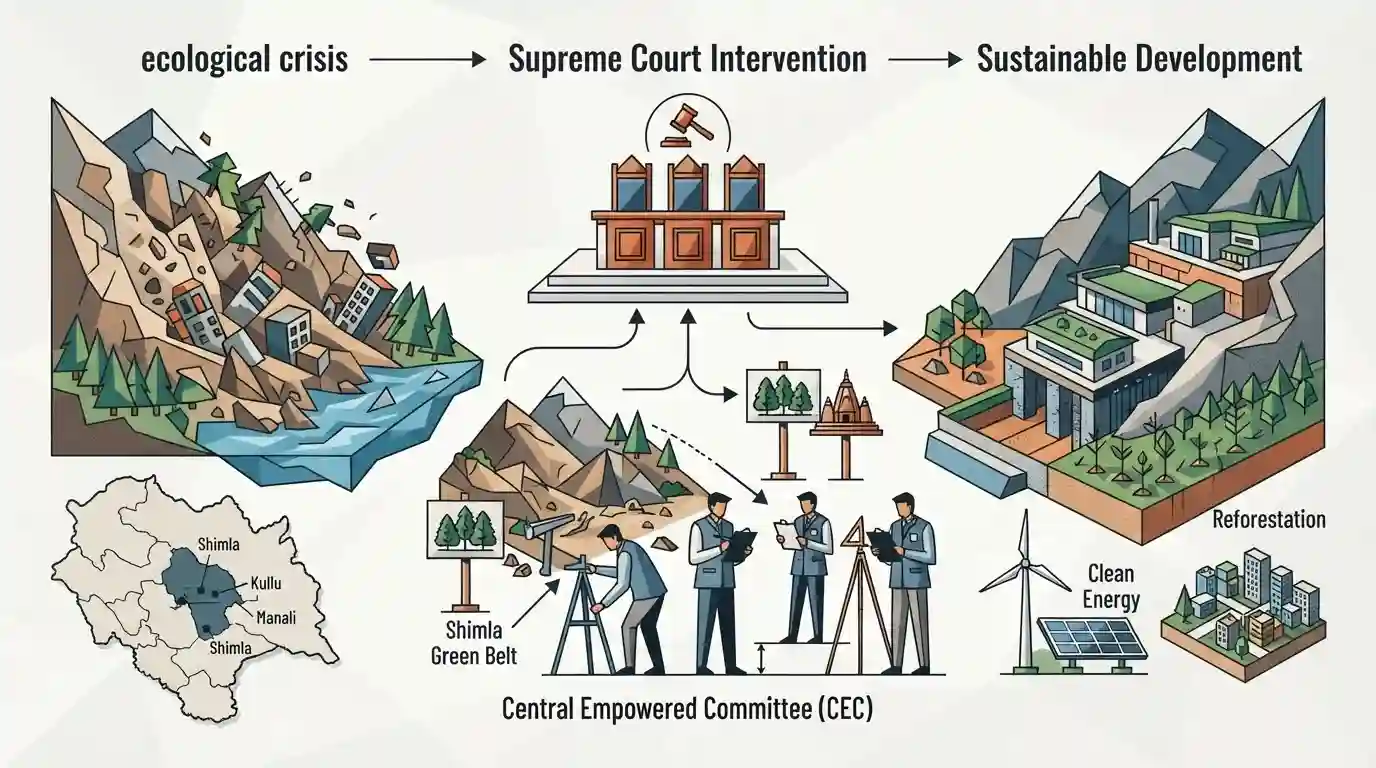
The Supreme Court of India has intervened suo motu to address the worsening ecological crisis in Himachal Pradesh, characterized by deadly landslides, floods, and infrastructure collapses triggered by unregulated construction and deforestation. Criticizing the state government's inaction and delays, a three-judge bench directed the Central Empowered Committee (CEC) to conduct a thorough investigation into environmental violations, particularly around the eco-sensitive Shimla Green Belt and Shri Tara Mata Hill. The CEC is mandated to file phased reports on various regions, including Kullu and Manali, to help formulate sustainable urban planning and conservation strategies for the fragile Himalayan ecosystem.
Key Points
- The Supreme Court has taken suo motu cognizance of the severe ecological degradation in Himachal Pradesh, which has led to devastating landslides and floods.
- The Court heavily criticized the state government for bureaucratic delays and apathy toward environmental conservation and unregulated construction.
- The Central Empowered Committee (CEC) has been directed to probe multi-storey constructions, deforestation, and road collapses, starting with the Shimla Green Belt and Shri Tara Mata Hill areas.
- The CEC will submit phased reports on specific regions (like Kullu and Manali) to ensure targeted judicial oversight over environmental restoration and urban planning.
Important Terms
Central Empowered Committee (CEC)

A permanent statutory body under MoEFCC, originally established by the Supreme Court in 2002, to monitor compliance with environmental rulings and advise courts on forest and conservation issues.
UPSC context
GS Paper III (Environment & Biodiversity). Tests understanding of environmental monitoring bodies and judicial oversight in conservation.
Shimla Development Plan 2041
A comprehensive urban planning framework formulated by Himachal Pradesh to regulate construction, balancing rapid urbanization with ecological safeguards in the fragile Himalayan terrain of Shimla.
UPSC context
GS Paper I & III (Urbanization, Disaster Management). Evaluates strategies for sustainable hill town planning and mitigating ecological vulnerabilities.
National Green Tribunal (NGT)
A specialized statutory tribunal established under the NGT Act 2010 to ensure the speedy and effective disposal of cases related to environmental protection and forest conservation.
UPSC context
GS Paper II & III (Statutory Bodies, Environment). Tests knowledge of environmental jurisprudence and the role of specialized tribunals.
Himachal Pradesh Town and Country Planning Act, 1977
A state law enacted to control, guide, and regulate the preparation of land-use maps, regional development plans, and sectoral planning to prevent haphazard constructions in Himachal Pradesh.
UPSC context
GS Paper III (Urban Planning, Disaster Management). Examines legislative frameworks governing land-use planning in disaster-prone hilly regions.
Shimla Green Belt
Ecologically sensitive forest areas designated as 'no-construction zones' in Shimla to preserve pristine deodar forests, maintain the slope stability of hilly terrain, and act as the city's green lungs.
UPSC context
GS Paper III (Environment, Disaster Management). Highlights localized ecological preservation zones and the conflict between development and conservation.
Prelims Trap
The Central Empowered Committee (CEC) is an ad-hoc judicial committee established under the Forest (Conservation) Act.
The CEC was originally an ad-hoc judicial body, but as of September 2023, it is a permanent statutory body under the Environment (Protection) Act, 1986.
Static Concepts Connected
What is the Central Empowered Committee (CEC) and how did it evolve?
- Judicial Origin: Established by the Supreme Court in 2002 in the T.N. Godavarman Thirumulpad case to monitor compliance with its forest conservation orders.
- Statutory Status: Reconstituted by the Union government in 2023 as a permanent statutory body under Section 3(3) of the Environment (Protection) Act, 1986.
- Primary Role: Acts as a fact-finding and technical compliance body reporting to the Supreme Court on environmental violations and forest encroachment.
How does the CEC differ from the National Green Tribunal (NGT)?
- Nature of Power: The NGT is an adjudicatory tribunal with powers of a civil court, while the CEC's role is investigative, technical, and reporting-based.
- Statutory Backing: NGT derives its powers from the NGT Act 2010; the CEC currently operates under the Environment (Protection) Act 1986.
- Jurisdictional Limits: The Supreme Court has ruled that town planning rules formed by states do not strictly fall under the NGT's exclusion-based veto.
Cross-Topic Patterns
Judicial Review vs. State Town Planning
The SC's previous overturning of the NGT's ban on Shimla's Development Plan 2041 highlights the constitutional tension between state legislative autonomy over urban planning and centralized environmental adjudication.
Anthropogenic Triggers in Himalayan Disasters
Connects localized urban construction norms in Shimla/Kullu with broader Himalayan ecosystem challenges, including Joshimath subsidence (Uttarakhand) and South Lhonak GLOF (Sikkim), driven by tourism carrying-capacity breaches.

Expect a 2026 multi-statement prelims question contrasting the CEC's new statutory status under the EPA 1986 with the NGT's mandate.
Linked PYQs · 4
Linked PYQs · 4
- 2020HPAS_PRELIMSGS1
Which of the following is / are correct about the Himachal Pradesh Town | Country Planning Act-1977? 1. It has been enforced in 55 Planning areas. 2. Planning area constitutes to 1.60 % of the total geographical area of the state. 3. The above act is enforced in 35 special areas of Himachal Pradesh. 4. 2.06% area of the total geographical area of the state comes under special area.
- 2024HPAS_PRELIMSGS1
Match the forest cover area/type with their total area in Himachal Pradesh (2021) : | List I (Density/Total Forest Cover) | List II (Area in sq. kms.) | |---|---| | (a) Very dense forest above 70 percent | (i) 7,100 | | (b) Moderate dense forest 40 to 70 percent | (ii) 5,180 | | (c) Open forest 10 percent to 40 percent | (iii) 15,443 | | (d) Total forest cover | (iv) 3,163 | Choose the correct options : Code: (a) (b) (c) (d)
- 2025HPAS_PRELIMSGS1
When was the National Centre for Disaster Management established in India ?
- 2023HPAS_PRELIMSGS1
Consider the following Acts and Policy : (1) Water (Prevention and Control of Pollution) Act (2) Water Cess Act (3) The National Water Policy (4) Air (Prevention and Control of Pollution) Act With reference to the Acts and Policy mentioned above, in terms of their starting year, which one of the following is the correct ascending order? Choose the correct answer from the options given below :
