Himachal Cooperative Bank Receives National Award for SHG Linkage
Source:Indian Express ↗
Why It Matters
The article provides a concrete success story of a state-level cooperative bank excelling in the SHG-Bank Linkage programme. Aspirants can use HPSCB and its 'Sashakt Mahila Rin Yojna' as case studies in Mains answers regarding grassroots financial inclusion, the role of cooperatives in rural credit, and microfinance as a tool for women's empowerment.
Summary
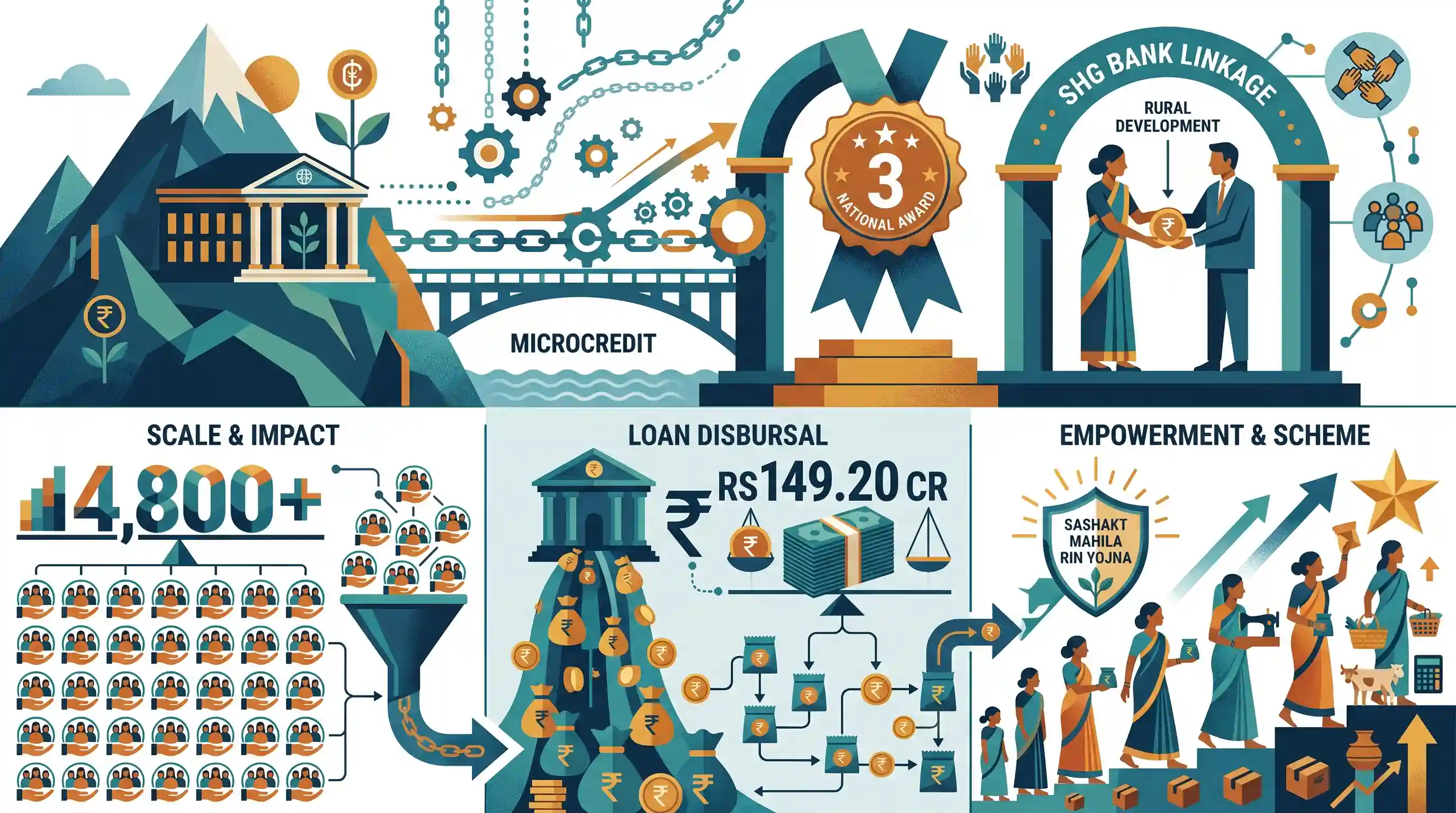
The Himachal Pradesh State Co-operative Bank (HPSCB) has been conferred with a National Award for its outstanding performance in the SHG Bank Linkage programme under the Deendayal Antyodaya Yojana National Rural Livelihood Mission (DAY-NRLM) for the financial year 2023-24. Winning this award for the third consecutive year, the bank disbursed loans worth Rs 149.20 crore to over 4,800 Self-Help Groups, significantly boosting women's empowerment. The bank's bespoke 'Sashakt Mahila Rin Yojna' was also highlighted for effectively providing microcredit to rural women.
Key Points
- Himachal Pradesh State Co-operative Bank (HPSCB) received a National Award for its outstanding execution of the SHG Bank Linkage programme under DAY-NRLM.
- This achievement marks the third consecutive year HPSCB has won this recognition for the 2023-24 financial year.
- During 2023-24, the cooperative bank disbursed loans totaling Rs 149.20 crore to over 4,800 Self-Help Groups (SHGs).
- HPSCB also launched the 'Sashakt Mahila Rin Yojna', a dedicated credit scheme aimed at empowering rural women.
Important Terms
SHG Bank Linkage Programme (SHG-BLP)

A microfinance model launched by NABARD in 1992 that enables Self-Help Groups to access formal banking services and collateral-free credit by leveraging their internal savings and group discipline.
UPSC context
GS Paper II & III; crucial for understanding financial inclusion, rural credit mechanisms, and poverty alleviation strategies.
Deendayal Antyodaya Yojana-National Rural Livelihood Mission (DAY-NRLM)
A flagship poverty alleviation scheme under the Ministry of Rural Development that organizes rural poor women into Self-Help Groups to improve livelihoods through access to financial services and self-employment.
UPSC context
GS Paper II (Government Schemes); evaluates understanding of social security, rural development, and institutional frameworks for empowerment.
Self-Help Groups (SHGs)
Voluntary associations of 10–20 people, primarily women, who pool small savings to provide internal loans to members, later graduating to bank credit for income-generating activities.
UPSC context
GS Paper II (Governance); critical for understanding community-based development, social capital, and grassroots governance.
Microfinance
Financial services, including small loans and savings, provided to low-income individuals who lack access to traditional banking, often delivered via SHGs to foster inclusive growth.
UPSC context
GS Paper III (Economy); core topic for inclusive growth, credit accessibility, and reducing dependency on informal moneylenders.
Cooperative Banks
Member-owned financial institutions providing credit mainly to the agriculture and rural sectors, operating on cooperative principles to ensure local-level financial inclusion and democratic management.
UPSC context
GS Paper III (Banking); tests knowledge of India's multi-tier banking structure and rural financial stability.
Sashakt Mahila Rin Yojna
A collateral-free credit scheme by the Himachal Pradesh State Co-operative Bank providing tiered loans (up to ₹1.01 lakh) to rural women to foster entrepreneurship and financial independence.
UPSC context
GS Paper II (Welfare Schemes); represents a localized successful model of microcredit and women-led rural development.
Ministry of Rural Development (MoRD)
The nodal ministry for the socio-economic development of rural India, responsible for implementing major social welfare programs including MGNREGA and DAY-NRLM.
UPSC context
GS Paper II (Governance); essential for identifying the administrative authority behind national poverty alleviation initiatives.
Prelims Trap
"The SHG-Bank Linkage Programme is a flagship initiative managed and funded entirely by the Reserve Bank of India."
SBLP was pioneered by NABARD, not the RBI. Additionally, the DAY-NRLM is administered by the Ministry of Rural Development, not the Finance Ministry.
Static Concepts Connected
What are the core features of the SHG-Bank Linkage Programme (SBLP)?
- Pioneering Agency: Launched by NABARD in 1992, it has evolved into the world's largest microfinance project, linking unbanked rural populations to formal finance.
- Collateral-Free Credit: Banks provide loans based on collective group guarantee and savings history, relying on peer pressure and social capital rather than physical collateral.
- DAY-NRLM Integration: SBLP is now a key credit delivery mechanism under DAY-NRLM, utilizing 'Bank Sakhis' (women bank agents) to facilitate local loan recovery.
How is the rural cooperative banking system structured and regulated in India?
- Three-Tier Structure: It typically follows a three-tier structure: State Cooperative Banks (SCBs) at the apex, District Central Cooperative Banks (DCCBs), and Primary Agricultural Credit Societies (PACS) at the village level.
- Dual Control: Historically regulated by RBI for banking operations (under BR Act, 1949) and by the Registrar of Cooperative Societies for management and registration.
- Recent Amendments: The Banking Regulation (Amendment) Act 2020 significantly increased RBI’s direct supervisory and regulatory powers over cooperative banks to protect depositors.
Cross-Topic Patterns
SHG products + ONDC market linkage
The evolution of DAY-NRLM is transitioning from mere credit access (SHG-Bank linkage) to digital market access, integrating SHG products into ONDC platforms to bypass middlemen and boost rural women's incomes.
Feminization of Agriculture + SHG Credit
As rural men migrate, agriculture is feminizing. SHG micro-credit empowers these women to access inputs and form Farmer Producer Organizations (FPOs), altering rural agrarian dynamics and filling the institutional credit void.

Expect a mixed-statement Prelims question intertwining NABARD's historical SBLP role with recent DAY-NRLM sub-schemes like Lakhpati Didi.
Linked PYQs · 5
Linked PYQs · 5
- 2015MainsGS2
The Self-Help Group (SHG) Bank Linkage Programme (SBLP), which is India's own innovation, has proved to be one of the most effective poverty alleviation and women empowerment programmes. Elucidate.
- 2020MainsGS2
Micro-Finance as an anti-poverty vaccine, is aimed at asset creation and income security of the rural poor in India". Evaluate the role of the Self Help Groups in achieving the twin objectives along with empowering women in rural India.
- 2021MainsGS2
Can the vicious cycle of gender inequality, poverty and malnutrition be broken through microfinancing of women SHGs? Explain with examples.
- 2014MainsGS3
In the villages itself no form of credit organization will be suitable except the cooperative society. -All India Rural Credit Survey. Discuss this statement in the background of agricultural finance in India. What constraints and challenges do financial institutions supplying agricultural finance face? How can technology be used to better reach and serve rural clients?
- 2023PrelimsGS1
Consider the following statements: 1. The Self-Help Group (SHG) programme was originally initiated by the State Bank of India by providing microcredit to the financially deprived. 2. In an SHG, all members of a group take responsibility for a loan that an individual member takes. 3. The Regional Rural Banks and Scheduled Commercial Banks support SHGs. How many of the above statements are correct?
