Himachal Plans Confiscation and Redistribution of Illicit Wealth
Source:tribuneindia ↗
Why It Matters
The article touches on crucial aspects of state governance (anti-corruption asset confiscation), energy infrastructure (Kishau hydropower project, power-sharing agreements), and Centre-State financial frictions (withheld grants). These are highly testable areas for HPAS Prelims, particularly regarding regional geography, specific state hydroelectric projects, and federal dynamics.
Summary
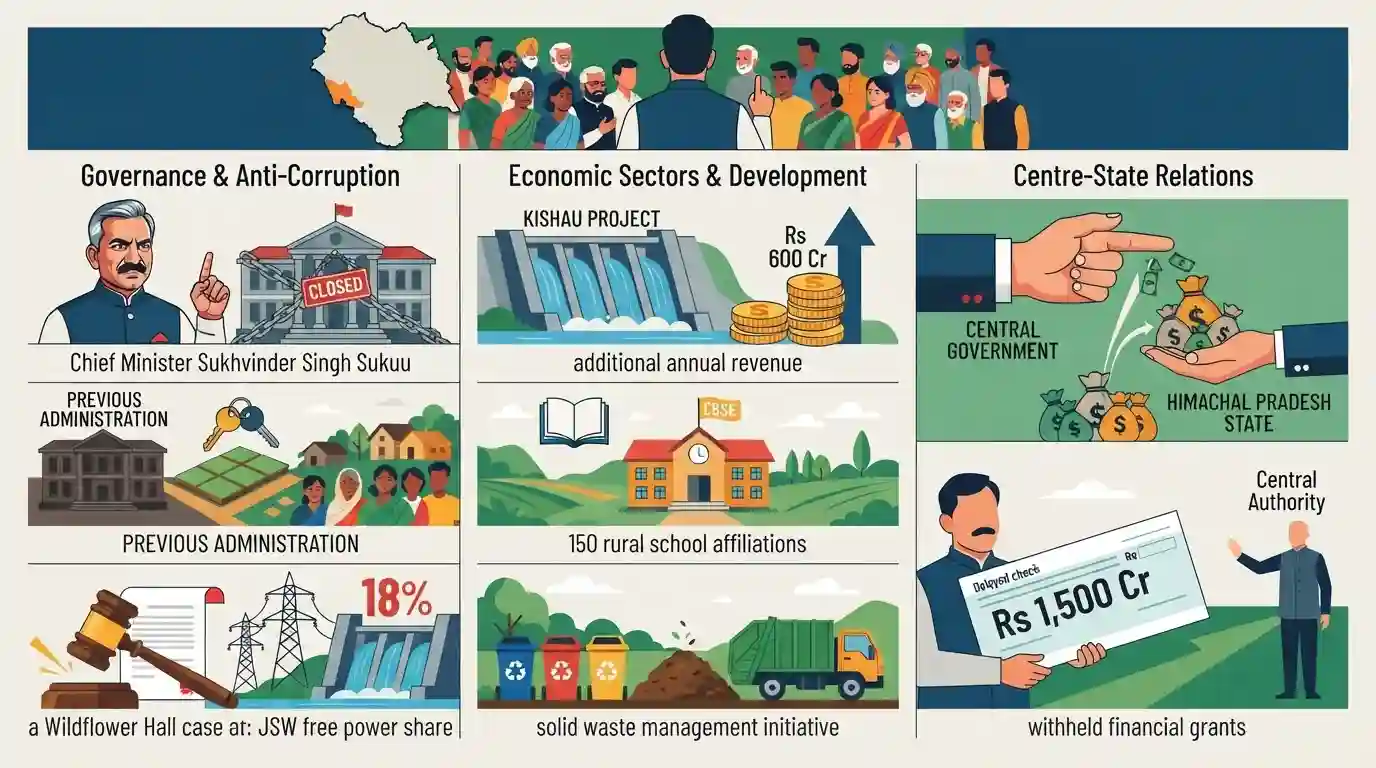
Himachal Pradesh Chief Minister Sukhvinder Singh Sukhu has vowed to crack down on corruption by confiscating illicitly acquired assets and redistributing them to the poor. Speaking at a public event in Kasumpti, Shimla, he targeted the previous BJP government for allotting prime industrial land in Baddi at throwaway prices. Sukhu highlighted his government's success in defending state interests, including a legal victory in the Wildflower Hall case, securing an 18% free power share from JSW, and protecting the state's rights in the Kishau hydropower project to generate an additional Rs 600 crore annually. The administration is also prioritizing rural development by affiliating 150 rural schools with CBSE and launching a rural solid waste management initiative. Meanwhile, Minister Anirudh Singh criticized the Central Government for withholding due financial grants, including a Rs 1,500 crore assistance package announced by the Prime Minister.
Key Points
- Himachal CM Sukhvinder Singh Sukhu announced a policy to confiscate properties acquired through corruption and redistribute them to the poor to enhance transparency.
- The current administration accused the former BJP government of improperly allocating nearly 5,000 bighas of land in the Baddi industrial area at throwaway prices.
- The state has successfully safeguarded its economic interests by winning the Wildflower Hall case, securing an 18% free power share from JSW, and protecting its stake in the Kishau hydropower project (yielding an extra Rs 600 crore annually).
- Rural development initiatives include affiliating 150 government schools with CBSE (adding 24,000 students) and rolling out door-to-door rural solid waste collection.
- Rural Development Minister Anirudh Singh alleged the Centre is withholding legitimate financial grants, including Rs 1,500 crore promised by the Prime Minister.
Important Terms
Kishau hydropower project

A 660 MW multipurpose concrete gravity dam project on the Tons River (Yamuna's tributary) along the Himachal Pradesh-Uttarakhand border, aimed at water sharing and clean power among six northern states.
UPSC context
GS Paper I (Water Resources) and GS Paper II (Cooperative Federalism: Inter-state river disputes and resource sharing).
Rural solid waste management initiative
A localized policy to implement scientific, door-to-door waste collection and processing across rural panchayats, aligning with the Swachh Bharat Mission (Grameen) and Solid Waste Management Rules, 2016.
UPSC context
GS Paper II (Social Sector/Services) and GS Paper III (Environment and Pollution Management).
Centre-State financial relations
The constitutional framework (Articles 268-293 of Part XII) that governs the allocation of taxing powers, revenue sharing, and grants-in-aid between the Union and state governments to ensure fiscal federalism.
UPSC context
GS Paper II (Polity & Constitution: Federal structure, fiscal federalism, and devolution of resources).
Wildflower Hall case
A landmark thirty-year legal battle in which the Himachal Pradesh government successfully secured sole ownership and financial benefits from Mashobra Resort Limited, a joint venture once co-owned with the Oberoi Group’s East India Hotels.
UPSC context
GS Paper II (Polity and Governance: Government-controlled assets, public-private partnerships, and state litigation).
Prelims Trap
States have independent executive power to confiscate and redistribute corrupt properties.
Confiscation requires judicial backing under laws like the Prevention of Corruption Act, PMLA, or specific state acts, not mere executive orders.
Static Concepts Connected
What are the constitutional provisions for Centre-State financial grants?
- Statutory Grants: Article 275 allows Parliament to give grants to states in need of assistance, typically guided by the Finance Commission's recommendations.
- Discretionary Grants: Article 282 empowers the Centre and States to make grants for any public purpose, historically discretionary and a frequent source of political friction.
How is electricity typically shared in central or joint hydropower projects?
- Home State Royalty: Under the National Hydro Policy, the host state typically receives 12% free power as a royalty for resource utilization and environmental impact (HP negotiated 18% with JSW).
- Unallocated Quota: 15% of the generated power is usually kept as an unallocated quota at the Centre's disposal to meet emergency requirements of deficit states.
Cross-Topic Patterns
Fiscal federalism & disaster grants
HP's grievance over withheld funds mirrors recent Supreme Court petitions by Karnataka and Kerala regarding delayed NDRF and discretionary grant releases by the Centre.
PMLA asset restitution to victims
The CM's vow to redistribute corrupt wealth aligns with the recent legal mechanism where the ED restores attached PMLA assets to defrauded victims via judicial orders.

Expect a multi-statement question on Art 282 discretionary vs Art 275 statutory grants amid rising Centre-State fiscal frictions.
Linked PYQs · 2
Linked PYQs · 2
- 2017HPAS_PRELIMSGS1
Where does river Yamuna, after flowing through Uttarakhand, enter in Sirmaur district of Himachal Pradesh ?
- 2023HPAS_PRELIMSGS1
Match List I with List II : | List-I | List-II | |---|---| | (a) Himachal Pradesh Skill Development Project | (i) 2018 | | (b) Himachal Pradesh Kaushal Vikas Nigam | (ii) 2017 | | (c) Mukhya Mantri Yuva Ajivika Yojana | (iii) 2014 | | (d) Himachal Grhini Suvidha Yojana | (iv) 2019 | Choose the correct answer from the options given below : Code: (a) (b) (c) (d)
