CBSE curriculum integration in Himachal Pradesh government schools
Source:economictimes ↗
Why It Matters
It highlights a unique state-level governance model in Himachal Pradesh—adopting the national CBSE curriculum in state-run public schools to provide high-quality education and counter the privatization of schooling. It also illustrates ongoing administrative decentralization and infrastructure strengthening in Baddi, a pivotal industrial zone contributing heavily to the state's manufacturing employment.
Summary
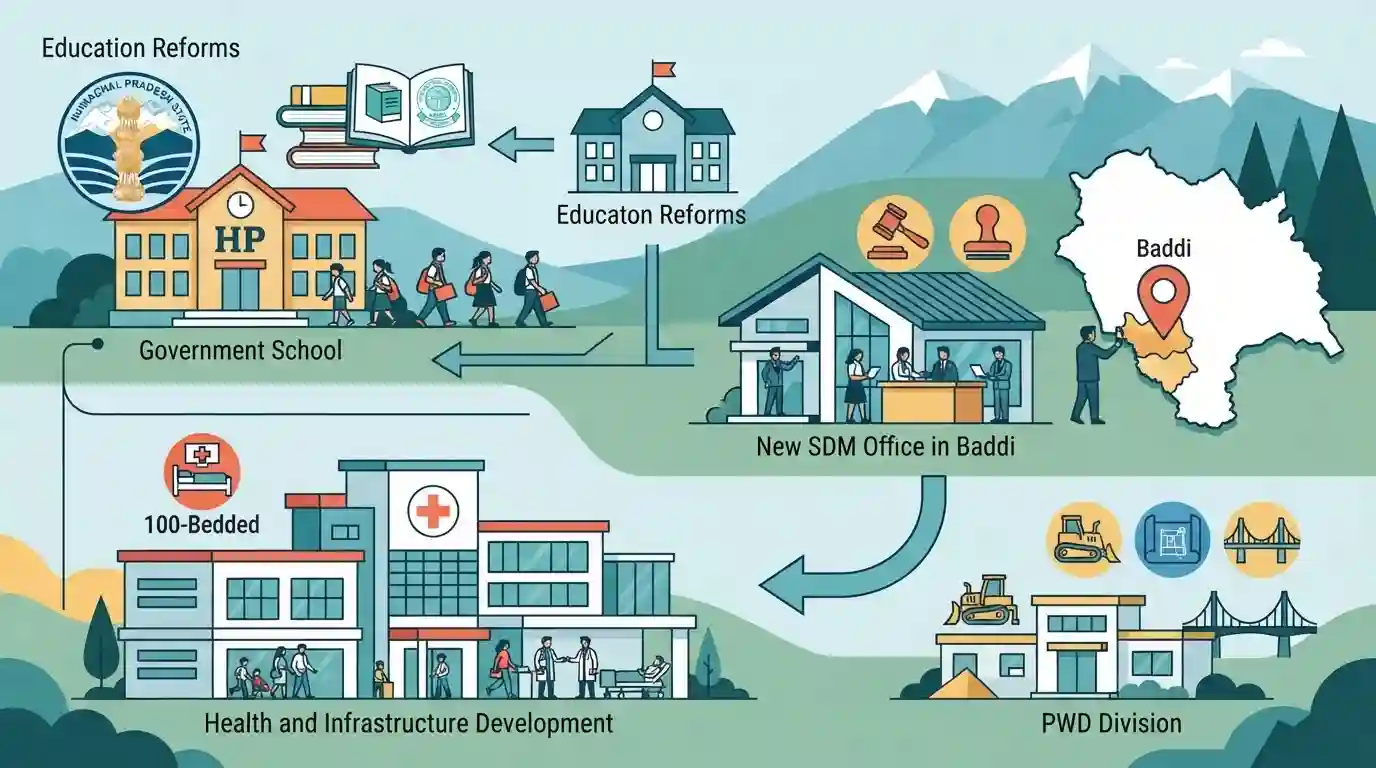
Himachal Pradesh Chief Minister Sukhvinder Singh Sukhu emphasized the state government's dedication to balanced and inclusive development, spotlighting significant reforms in health and education. Key among these initiatives is the integration of the CBSE curriculum into government schools to democratize access to quality education at nominal costs. Furthermore, the administration is focusing on regional infrastructure and governance by setting up a Sub-Divisional Magistrate (SDM) office in the industrial hub of Baddi, alongside a 100-bedded hospital and a PWD Division in the Doon Assembly constituency of Solan district.
Key Points
- Chief Minister Sukhvinder Singh Sukhu reiterated the state government's commitment to balanced and inclusive development across Himachal Pradesh.
- Primary focus is on sweeping reforms in the state's health and education sectors to ensure accessible and quality public services.
- The state is introducing the CBSE curriculum in government schools to provide quality education at a nominal fee, competing with expensive private schools.
- Three government schools in the Doon Assembly constituency have already been upgraded to the CBSE pattern, with ongoing teacher recruitment.
- Administrative and infrastructural push in the Doon constituency includes the establishment of a Sub-Divisional Magistrate (SDM) office at Baddi, a 100-bedded hospital, and a PWD Division.
Important Terms
Central Board of Secondary Education (CBSE)

A national-level education board in India under the Union Government. It manages the curriculum, standards, and examinations for affiliated public and private schools, utilizing the NCERT syllabus.
UPSC context
Relevant for GS Paper 2 (Education). It highlights the standardization of education and accessibility policies under social sector development and human resources.
Public Works Department (PWD)
A government agency at the central and state levels responsible for the planning, construction, and maintenance of public infrastructure like roads, bridges, drinking water systems, and government buildings.
UPSC context
Important for GS Paper 2 (Governance) and GS Paper 3 (Infrastructure). Relates to regional infrastructure development and decentralized public service delivery.
Sub-Divisional Magistrate (SDM)
A key administrative officer heading a district subdivision. Often an entry-level post for IAS or State PCS officers, they are responsible for revenue administration, law and order, and local development.
UPSC context
Relevant for GS Paper 2 (Governance). Illustrates local administrative structures, decentralized governance, and the roles of civil servants in grassroots management.
Inclusive Development
A developmental paradigm ensuring all segments of society, particularly marginalized groups, have equal access to the opportunities, resources, and benefits of economic and social progress.
UPSC context
Crucial for GS Paper 3 (Inclusive Growth) and GS Paper 2 (Social Justice). Tests understanding of equitable welfare delivery and poverty reduction strategies.
Prelims Trap
Himachal Pradesh's economy is entirely dependent on tourism and horticulture, lacking large-scale manufacturing hubs.
Aspirants often assume Himalayan states lack heavy industry. However, the Baddi-Barotiwala-Nalagarh (BBN) corridor in HP is one of Asia's largest pharmaceutical hubs, producing ~40% of India's medicines.
Static Concepts Connected
What is the role of a Sub-Divisional Magistrate (SDM) in state administration?
- Revenue Administration: Acts as the head of the sub-division for land records, land acquisition, and revenue collection.
- Magisterial Duties: Exercises powers of an Executive Magistrate under the CrPC to maintain law and order.
- Disaster Management: Serves as the primary incident commander at the sub-divisional level during natural or man-made crises.
Why do pharmaceutical manufacturing hubs require specialized physical infrastructure?
- Effluent Treatment: Requires robust Common Effluent Treatment Plants (CETPs) to handle highly toxic chemical and biological waste.
- Cold Chain Logistics: Needs uninterrupted power, reliable road transport, and cold-chain facilities for temperature-sensitive drugs and APIs.
- Regulatory Compliance: Requires state-of-the-art testing laboratories to ensure compliance with strict CDSCO and FDA quality standards.
Cross-Topic Patterns
Economic clusters vs. Social infrastructure
The BBN industrial belt highlights a classic governance paradox where massive pharmaceutical investments severely outpace local health, education, and basic civic amenities, requiring retroactive social sector interventions.
Standardizing education via central boards
HP integrating the CBSE curriculum into state government schools reflects a broader governance strategy to bridge the perceived quality gap and curb rural student migration to private schooling.

Mapping pharma hubs like Baddi (HP) alongside API vulnerabilities and PLI schemes is a high-probability Prelims geography/economy crossover.
Linked PYQs · 3
Linked PYQs · 3
- 2025HPAS_PRELIMSGS1
According to PLFS 2023-24, share of secondary and tertiary sector in total employment in Himachal Pradesh respectively are :
- 2024HPAS_PRELIMSGS1
For the year 2022-23, match the Industry sub-sector in Himachal Pradesh with the percentage of workers employed in them : | List I (Industry Sub-sector) | List II (Percentage of workers employed) | |---|---| | (a) Mining and Quarrying | (i) 2 | | (b) Manufacturing | (ii) 41 | | (c) Electricity and Other Utilities | (iii) 50 | | (d) Construction | (iv) 7 | Choose the correct option : Code: (a) (b) (c) (d)
- 2023HPAS_PRELIMSGS1
Towards its journey to become full state what is correct about Himachal Pradesh ? (1) It became Chief Commissioner's Province in 1948 (2) It became Union Territory in 1956 (3) It got its first Chief Minister in 1967 (4) It became 18th State of the Union in 1971 Choose the correct answer from the options given below :
