Revenue Deficit Grants and Fiscal Federalism Challenges in States
Source:The Hindu ↗
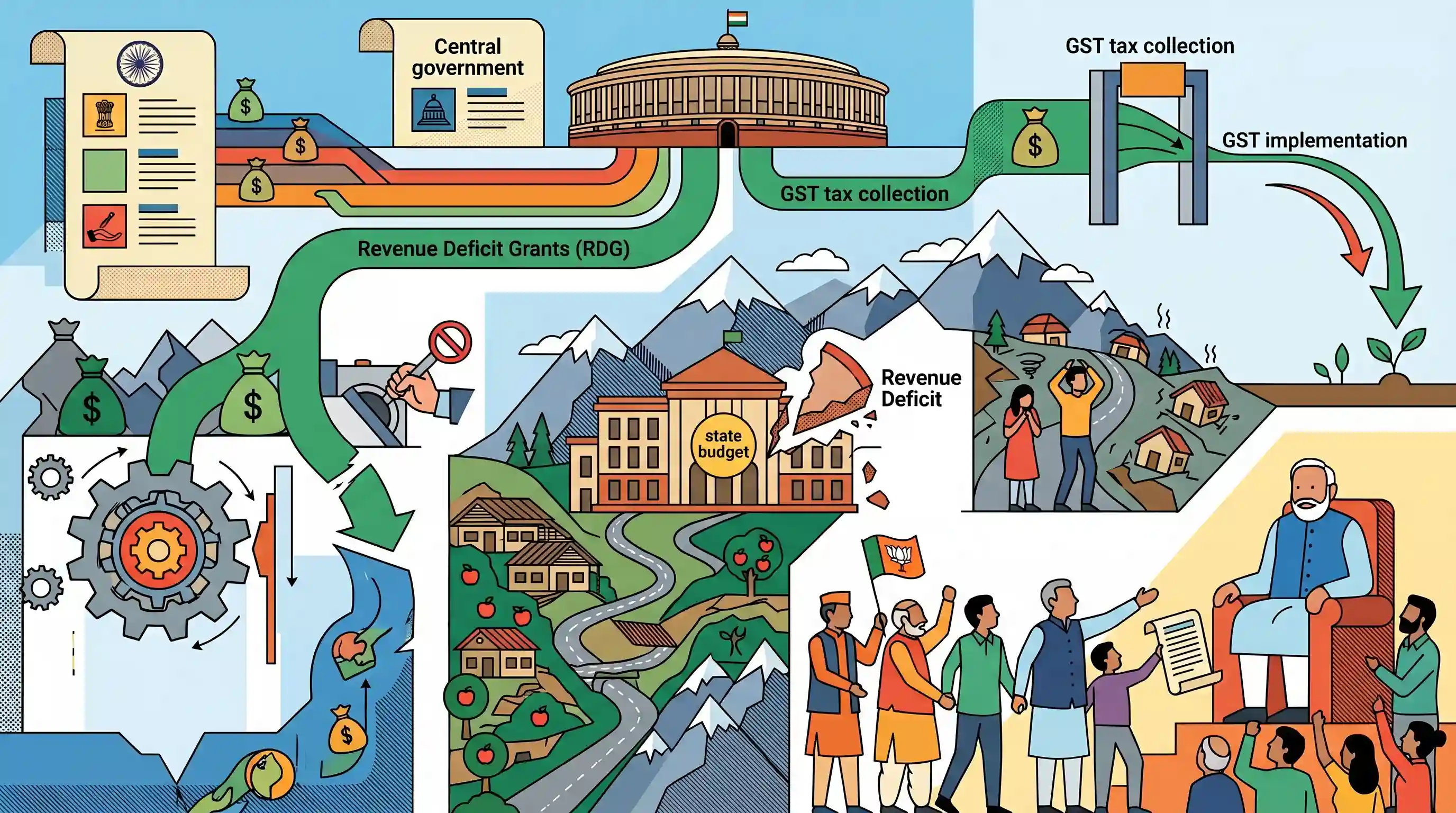
Why It Matters
The potential scrapping of Revenue Deficit Grants by the 16th Finance Commission brings Centre-State fiscal relations into sharp focus. For UPSC aspirants, this issue exemplifies the challenges of fiscal federalism in India, particularly the vulnerability of special category/hill states in the post-GST era and the importance of constitutional safety nets like Article 275 in balancing regional inequalities.
Summary
Himachal Pradesh Chief Minister Sukhvinder Singh Sukhu has warned that the 16th Finance Commission's recommendation to scrap Revenue Deficit Grants (RDG) will have a devastating long-term impact on the state's economy. Highlighting that RDG makes up 12.7% of the state's budget, Sukhu has urged for a united, cross-party effort involving BJP leaders to appeal to the Prime Minister. He emphasized that the grant, provided under Article 275(1) of the Constitution, is vital for a hill state that was formed on the basis of aspirations rather than pure financial viability. Furthermore, the state is already grappling with a drop in tax collection growth to 8% following the implementation of GST.
Key Points
- The 16th Finance Commission's recommendation to abolish Revenue Deficit Grants (RDG) will severely impact Himachal Pradesh, as the state relies on RDG for 12.7% of its budget.
- Chief Minister Sukhvinder Singh Sukhu called for a cross-party delegation, including BJP MLAs and MPs, to meet Prime Minister Narendra Modi and protest the scrapping of the grant.
- RDG is a constitutional mechanism under Article 275(1) designed to bridge the gap between a state's assessed revenue receipts and expenditures.
- The implementation of the GST regime has already caused Himachal Pradesh's tax collection growth to drop from 13-14% to about 8%, exacerbating the state's fiscal stress.
- Sukhu argued that hill states like Himachal Pradesh were formed to meet regional aspirations rather than strict financial viability, necessitating continued Central financial support.
Important Terms
Revenue Deficit Grant (RDG)

Statutory transfers recommended by the Finance Commission to States whose revenue expenditure exceeds receipts even after tax devolution, ensuring they can maintain basic public services.
UPSC context
GS-III Indian Economy; essential for understanding fiscal imbalances and the role of the Union in supporting resource-strapped states.
Article 275(1)
Constitutional provision empowering Parliament to provide financial assistance (grants-in-aid) to states in need, specifically for developmental projects or promoting tribal welfare.
UPSC context
GS-II Polity/Federalism; tests knowledge of constitutional mechanisms for addressing regional disparities and mandatory financial transfers.
16th Finance Commission
A constitutional body chaired by Arvind Panagariya tasked with recommending the tax-sharing formula and grant principles between the Centre and States for 2026–2031.
UPSC context
GS-III Economics/Current Affairs; vital for understanding current fiscal policy shifts and evolving criteria for state resource allocation.
Finance Commission
A constitutional body (Article 280) appointed every five years by the President to recommend the distribution of financial resources between the Union and States.
UPSC context
GS-II Polity; a core constitutional institution frequently tested for its composition, powers, and role in fiscal federalism.
Cooperative Federalism
A governance model where Union and State governments work as partners to achieve national goals, balancing regional needs with national priorities through collaborative institutions.
UPSC context
GS-II Federalism; a fundamental theme regarding power-sharing and collaboration between different levels of government in India.
Goods and Services Tax (GST)
A comprehensive, destination-based indirect tax that unified India's market but limited states' independent power to raise tax revenue, affecting their fiscal growth.
UPSC context
GS-III Economics; tests knowledge of tax reforms and their long-term impact on state fiscal autonomy and revenue growth.
Prelims Trap
Revenue Deficit Grants are discretionary grants awarded by the Centre under Article 282.
RDGs are statutory grants-in-aid under Article 275(1), mandated by Finance Commission recommendations to cover post-devolution gaps, not discretionary grants under Article 282.
Static Concepts Connected
How do Article 275 and Article 282 grants differ in the Indian Constitution?
- Article 275 (Statutory): Provided from the Consolidated Fund of India based on Finance Commission recommendations to states in need of financial assistance.
- Article 282 (Discretionary): Grants by the Centre or States for any public purpose, historically used for plan grants outside the Finance Commission's purview.
What is the fundamental purpose of the Revenue Deficit Grant (RDG)?
- Core Objective: Bridges the gap between a state's assessed revenue expenditure and revenue receipts after central tax devolution is completed.
- Correcting Imbalances: Acts as a targeted mechanism to correct vertical fiscal imbalances, particularly for states with structural revenue-raising constraints like hill states.
Cross-Topic Patterns
GST impact + State fiscal autonomy
The end of the GST compensation period combined with the 16th FC's move to scrap RDGs places a severe double squeeze on state revenues, testing the limits of cooperative federalism.
Special Category Status revival
As unconditional transfers like RDGs dry up, hill states formed on 'regional aspirations' will likely intensify their demands for formal Special Category Status to secure conditional or capital-linked assistance.

Expect a multi-statement Prelims question contrasting Article 275 statutory grants vs Article 282 discretionary grants in 2026.
Linked PYQs · 5
Linked PYQs · 5
- 2025MainsGS2
Examine the evolving pattern of Centre-State financial relations in the context of planned development in India. How far have the recent reforms impacted the fiscal federalism in India?
- 2024MainsGS2
What changes has the Union Government recently introduced in the domain of Centre-State relations ? Suggest measures to be adopted to build the trust between the Centre and the States and for strengthening federalism.
- 2020MainsGS3
Explain the rationale behind the Goods and Services Tax (Compensation to States) Act of 2017. How has COVID-19 impacted the GST compensation fund and created new federal tensions?
- 2019MainsGS3
Enumerate the indirect taxes which have been subsumed in the Goods and Services Tax (GST) in India. Also, comment on the revenue implications of the GST introduced in India since July 2017.
- 2025PrelimsGS1
Which of the following statements with regard to recommendations of the 15th Finance Commission of India are correct? I. It has recommended grants of ₹ 4,800 crores from the year 2022-23 to the year 2025-26 for incentivizing States to enhance educational outcomes. II. 45% of the net proceeds of Union taxes are to be shared with States. III. ₹ 45,000 crores are to be kept as performance-based incentive for all States for carrying out agricultural reforms. IV. It reintroduced tax effort criteria to reward fiscal performance. Select the correct answer using the code given below.
