हिमाचल ने स्वच्छ गतिशीलता को बढ़ावा देने के लिए मंडी में इलेक्ट्रिक बसें उतारीं
स्रोत:tribune ↗
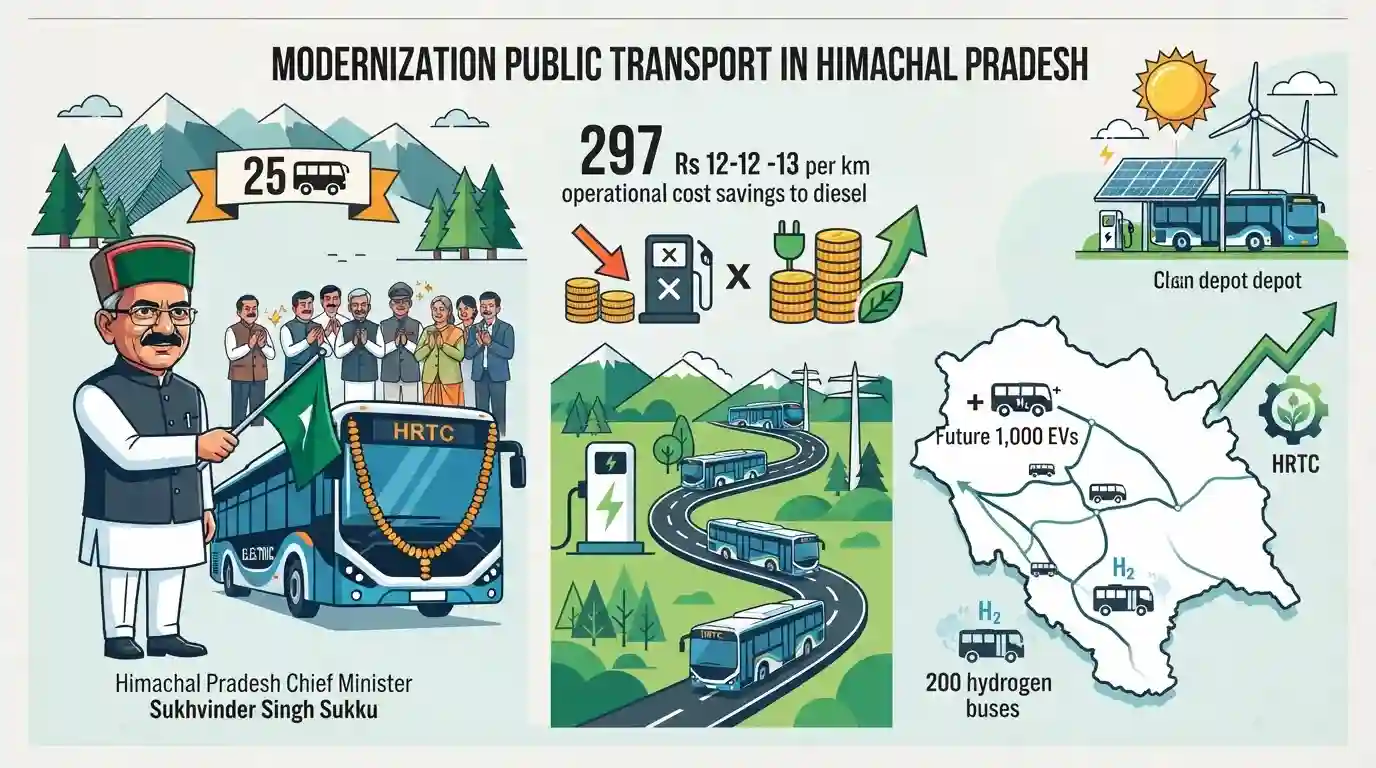
क्यों मायने रखता है
यह हरित गतिशीलता (green mobility) और सतत विकास की दिशा में बढ़ने के लिए राज्य-स्तरीय प्रशासनिक पहलों को प्रदर्शित करता है। यह स्वच्छ तकनीकों को अपनाने के दोहरे लाभों को रेखांकित करता है—पर्यावरण प्रदूषण को कम करना (EVs और हाइड्रोजन ईंधन) और परिचालन लागत को कम करके सार्वजनिक क्षेत्र के उपक्रमों (जैसे HRTC) की वित्तीय व्यवहार्यता में सुधार करना।
सारांश
Himachal Pradesh Chief Minister Sukhvinder Singh Sukhu flagged off 25 new type-1 electric buses in Mandi to modernize the state's public transport fleet and promote sustainable mobility. The induction of these buses, part of a larger 297-bus procurement for the Himachal Road Transport Corporation (HRTC), is expected to significantly lower operational costs, saving Rs 12-13 per km compared to diesel. With plans to procure 1,000 more EVs and 200 hydrogen-powered buses, the state government aims to make HRTC self-reliant within five years while aggressively pursuing clean energy and environmental sustainability goals.
मुख्य बिंदु
- Himachal Pradesh CM flagged off 25 new type-1 electric buses in Mandi, part of a 297-bus procurement drive for HRTC.
- The new electric buses save Rs 12 to Rs 13 per km in operational costs compared to traditional diesel buses.
- The driving range of these type-1 electric buses is approximately 180 km at an 80% state of charge.
- The state aims to make HRTC self-reliant within five years by modernizing its fleet and reducing fuel expenses.
- Future plans include the procurement of 1,000 more electric buses and 200 hydrogen-powered buses to boost green mobility.
महत्वपूर्ण शब्द
Himachal Road Transport Corporation (HRTC)

Formed in 1974, HRTC is Himachal Pradesh's state-owned transport provider. It is currently modernizing its fleet with electric and hydrogen-powered buses to achieve financial self-reliance within five years and significantly reduce operational costs.
UPSC context
HP General Studies & GS 3 (Infrastructure). Tests knowledge of state PSUs, transport economics, and structural reforms in public utilities.
Green Energy State Initiative
Himachal Pradesh's comprehensive policy vision to transition toward sustainable mobility and clean power. The induction of electric and hydrogen buses is a major step toward curbing pollution and protecting the state's fragile ecology.
UPSC context
GS 3 (Environment) & HP General Studies. Highly relevant for state-level climate mitigation strategies and sustainable development goals.
हाइड्रोजन संचालित बसें
Zero-emission public transit vehicles utilizing hydrogen fuel cells. The Himachal government plans to induct up to 200 such buses to complement its EV fleet, aggressively pursuing environmental sustainability and alternative clean energy goals.
UPSC context
GS 3 (Science & Tech, Environment). Important for questions on green fuels, zero-emission technologies, and clean mobility transitions.
Type-1 Electric Buses
Energy-efficient electric buses suited for hilly terrains. Part of HRTC's recent procurement, they have a prescribed driving range of 180-270 km per charge and save ₹12-13 per km in operational costs compared to diesel.
UPSC context
GS 3 (Infrastructure, Economy). Relevant for understanding the economic and ecological viability of electric vehicle adoption in mountainous regions.
प्रारंभिक ट्रैप
Himachal Pradesh mandates that 100% of all new vehicle registrations must be electric by 2025.
Aspirants often assume a complete transition is mandated. The HP EV Policy 2022 targets 15% of new registrations by 2025, not 100%.
संबंधित अवधारणाएँ
What are the core targets of HP's Green Energy and EV policies?
- Green State Deadline: Aims to be India's first fully Green Energy State by March 31, 2026, meeting >90% of energy needs via renewables.
- Registration Target: HP EV नीति 2022 के तहत यह अनिवार्य किया गया है कि 2025 तक सभी नए वाहन पंजीकरणों में बैटरी इलेक्ट्रिक वाहनों (BEVs) की हिस्सेदारी 15% होनी चाहिए।
- Model EV Cities: Shimla, Mandi, Baddi, and Dharamshala are designated to have at least one charging station per 1 sq km grid.
How do Hydrogen Fuel Cell EVs (FCEVs) function for public transport?
- Power Generation: Unlike BEVs that store power in batteries, FCEVs generate electricity onboard using a fuel cell powered by hydrogen gas.
- Zero Emissions: The only tailpipe emission is water vapour, making them true zero-emission vehicles if fueled by Green Hydrogen (produced via electrolysis).
- Operational Advantage: They offer faster refueling times and longer ranges for heavy public transport buses compared to battery electric equivalents.
अंतर-विषय पैटर्न
PSU revival via green technology
HRTC's push for EVs is a fiscal strategy as much as an environmental one, using ₹12-13/km savings to phase out its ₹840 crore state grant and achieve financial self-reliance.
Hill topography and EV charging grids
Deploying EVs in hilly terrain heavily taxes battery range (180 km for Type-1). This necessitates HP's specific policy mandate of localized charging grids (1 station per sq km) in model cities.

HP की ग्रीन एनर्जी स्टेट 2026 की समय-सीमा, 15% EV पंजीकरण लक्ष्य और HRTC के वित्तीय लक्ष्यों को मिलाकर एक बहु-कथनीय प्रश्न की उम्मीद करें।
संबद्ध PYQ · 2
संबद्ध PYQ · 2
- 2013HPAS_PRELIMSGS1
Which one of the following fuels causes minimum environmental pollution ?
- 2018HPAS_PRELIMSGS1
Which one is incorrect regarding sustainable development ?
