Himachal CM to meet PM Modi over revenue deficit grant halt
Source:Indian Express ↗
Why It Matters
The tapering and discontinuation of Post-Devolution Revenue Deficit Grants (PDRDG) pose a severe fiscal shock to structurally dependent states. This article is highly relevant for GS2 and GS3 as it illustrates the real-world frictions of fiscal federalism, the role of the Finance Commission, and the increasing likelihood of states using Article 131 to litigate against the Centre's financial policies.
Summary
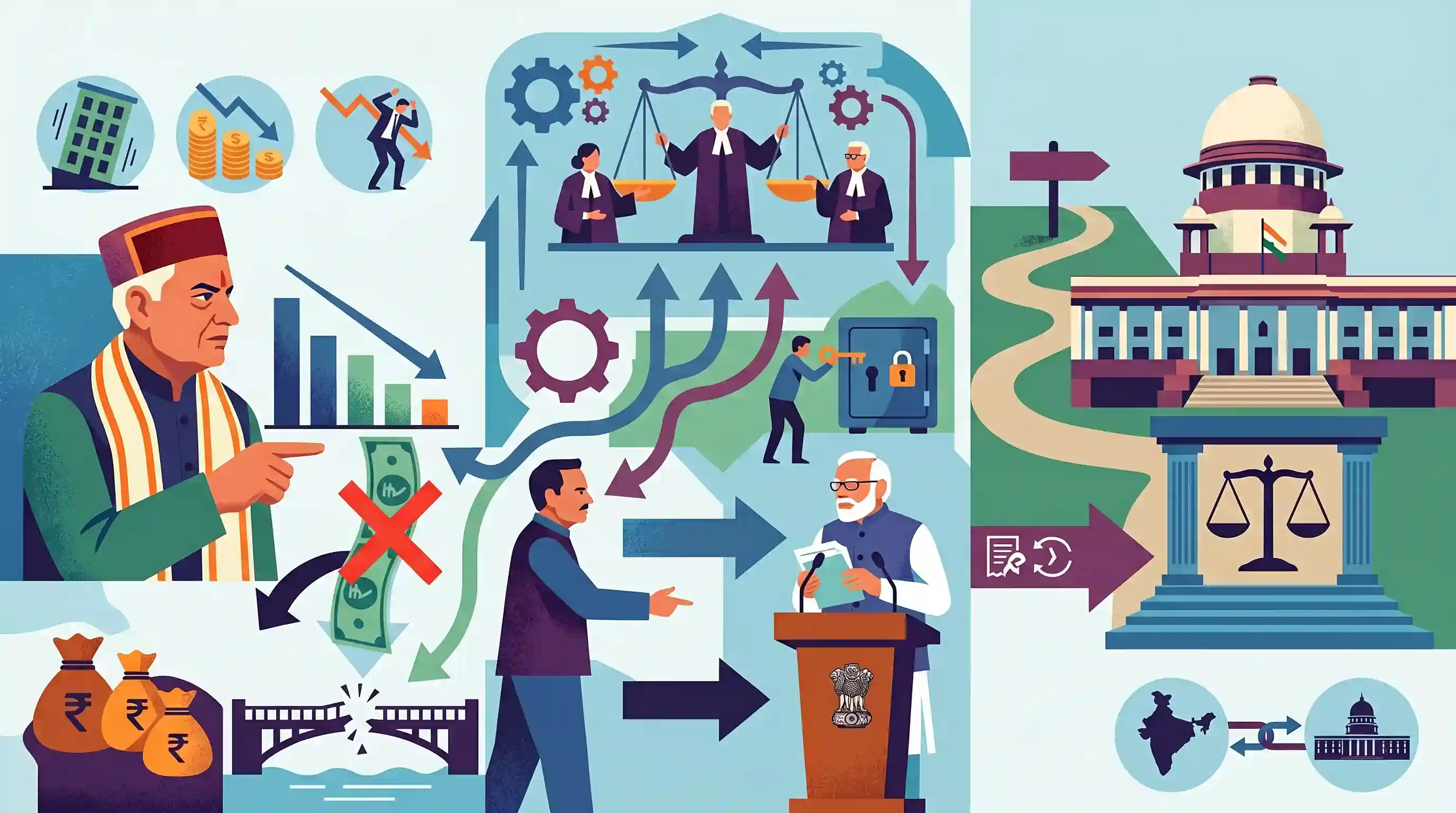
Himachal Pradesh Chief Minister Sukhvinder Singh Sukhu intends to meet PM Narendra Modi to negotiate a resolution following the discontinuation of the state's Revenue Deficit Grant (RDG). Describing the Supreme Court as a 'last resort' to recover pending financial dues from the Centre, the CM underscored the severe fiscal shock states face when post-devolution grants taper off. This dispute reflects broader challenges in Indian fiscal federalism, illustrating the friction over state borrowing capacities, Finance Commission recommendations under Article 275, and the potential invocation of Article 131 (Original Jurisdiction of the Supreme Court) to resolve Centre-State financial stalemates.
Key Points
- Himachal Pradesh Chief Minister Sukhvinder Singh Sukhu plans to meet Prime Minister Narendra Modi to resolve the financial strain caused by the discontinuation of the Revenue Deficit Grant (RDG).
- The discontinuation of this crucial Finance Commission grant creates a massive revenue shock for the state, exacerbating its fiscal deficit and borrowing constraints.
- The Chief Minister stated that approaching the Supreme Court over these financial dues is an option, but characterized it as a 'last resort'.
- The situation highlights an escalating trend of fiscal disputes between the Union and opposition-ruled States, bringing the Supreme Court's Original Jurisdiction (Article 131) into focus for adjudicating federal financial conflicts.
Important Terms
Post-Devolution Revenue Deficit Grant (PDRDG)

Financial assistance provided to states under Article 275 to bridge the gap in their revenue accounts after receiving their share of central taxes (devolution).
UPSC context
GS Paper II (Federal Structure) & GS Paper III (Public Finance). Tests understanding of vertical fiscal imbalance and Finance Commission mechanisms.
Statutory Grants
Grants-in-aid provided under Article 275, recommended by the Finance Commission and charged on the Consolidated Fund of India, making them mandatory rather than discretionary.
UPSC context
GS Paper II. Crucial for distinguishing between constitutional mandates (Art 275) and discretionary central spending (Art 282).
Article 131 (Original Jurisdiction)
The Supreme Court's exclusive power to hear cases in the first instance, specifically disputes between the Union and states or between states involving legal rights.
UPSC context
GS Paper II (Judiciary/Federalism). Essential for understanding constitutional remedies for Centre-State friction and the SC's role as a federal court.
Fiscal Federalism
The system of resource sharing and financial relations between different tiers of government, aimed at balancing revenue-raising powers with expenditure responsibilities.
UPSC context
GS Paper II & III. A core theme in Mains (Governance/Economy) regarding state autonomy and the 'strong Centre' bias in India.
Finance Commission
A constitutional body (Article 280) that recommends the formula for distributing tax proceeds between the Centre and States (vertical) and among states (horizontal).
UPSC context
GS Paper II & III. High-frequency topic for Prelims (composition/functions) and Mains (recommendations and impact on states).
Revenue Deficit
The difference between a government’s total revenue receipts and its total revenue expenditure, indicating that the government is borrowing to fund current consumption.
UPSC context
GS Paper III (Economy). Fundamental concept for analyzing state budget health and fiscal consolidation targets under the FRBM Act.
Prelims Trap
"Post-Devolution Revenue Deficit Grants are discretionary grants provided by the Centre under Article 282."
False. Post-Devolution Revenue Deficit Grants (PDRDG) are statutory grants provided under Article 275, directly mandated by Finance Commission recommendations, not discretionary Central funds.
Static Concepts Connected
What distinguishes Statutory Grants (Article 275) from Discretionary Grants (Article 282)?
- Article 275 (Statutory): Given from the Consolidated Fund of India to states in need, strictly based on Finance Commission recommendations. PDRDGs fall here.
- Article 282 (Discretionary): Grants made by the Centre or States for any public purpose. Historically used for Planning Commission schemes, not strictly bound by FC.
What are the core features of the Supreme Court's Original Jurisdiction (Article 131)?
- Exclusive Power: The Supreme Court is the sole forum for disputes involving the Union and States, or between two or more States.
- Legal Right Requirement: The dispute must involve a question of law or fact on which the existence or extent of a legal right depends (not purely political).
- Constitutional Exceptions: Disputes arising out of pre-constitution treaties, agreements, or covenants are explicitly excluded from this jurisdiction.
Cross-Topic Patterns
State borrowing limits & Article 293(3)
Discontinuation of RDGs pushes states to borrow, but Article 293(3) requires the Centre's consent if prior central loans are outstanding, creating severe fiscal bottlenecks.
Article 131: The new fiscal battleground
Originally seen in boundary or political disputes, Article 131 is increasingly used by states like Kerala, Punjab, and potentially HP to contest financial ceilings and dues.

Expect a multi-statement Prelims question merging Article 275 statutory grants with Article 293(3) state borrowing constraints in 2026.
Linked PYQs · 5
Linked PYQs · 5
- 2025MainsGS2
Examine the evolving pattern of Centre-State financial relations in the context of planned development in India. How far have the recent reforms impacted the fiscal federalism in India?
- 2024MainsGS2
What changes has the Union Government recently introduced in the domain of Centre-State relations ? Suggest measures to be adopted to build the trust between the Centre and the States and for strengthening federalism.
- 2018MainsGS2
How is the Finance Commission of India constituted? What do you know about the terms of reference of the recently constituted Finance Commission? Discuss.
- 2014PrelimsGS1
The power of the Supreme Court of India to decide disputes between the Centre and the States falls under its
- 2012PrelimsGS1
Which of the following are included in the original jurisdiction of the Supreme Court? 1. A dispute between the Government of India and one or more States 2. A dispute regarding elections to either House of the Parliament or that of Legislature of a State 3. A dispute between the Government of India and a Union Territory 4. A dispute between two or more States Select the correct answer using the codes given below:
