Himachal Pradesh launches HiBiSCUS scheme for biodiversity
Source:tribuneindia ↗
Why It Matters
State-specific environmental initiatives like HiBiSCUS are highly relevant for the HPAS Prelims, reflecting the intersection of biodiversity conservation, climate resilience, and community-driven economic empowerment. It provides an excellent case study for sustainable agriculture and joint forest management.
Summary
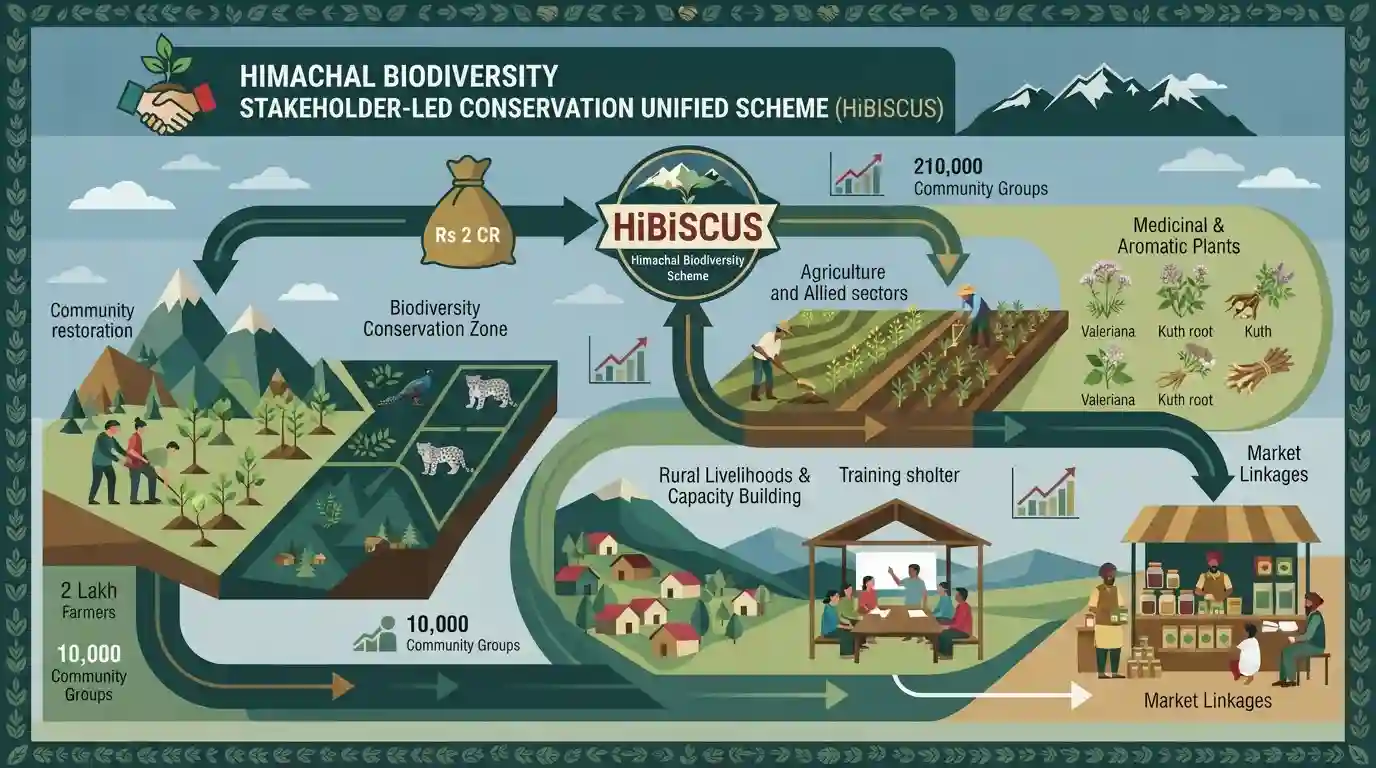
Himachal Pradesh Chief Minister Sukhvinder Singh Sukhu launched the Himachal Biodiversity Stakeholder-led Conservation Unified Scheme (HiBiSCUS) to strengthen biodiversity conservation and create sustainable livelihood opportunities for rural communities. With an initial funding of Rs 2 crore provided by the State Biodiversity Board to the Forest Department, the scheme focuses on ecological restoration and the sustainable use of biological resources. It aims to benefit around 2 lakh farmers and 10,000 community groups through activities such as cultivating medicinal and aromatic plants, capacity building, and establishing vital market linkages under a cost-sharing model.
Key Points
- Himachal Pradesh has launched the HiBiSCUS scheme to promote ecological restoration, biodiversity conservation, and rural livelihoods.
- The State Biodiversity Board has released an initial fund of Rs 2 crore to the Forest Department for the phased implementation of the scheme.
- The initiative targets engaging around 2 lakh farmers and 10,000 community groups to build climate resilience and sustainably use biological resources.
- The scheme emphasizes a cost-sharing model involving the biodiversity board, industry partners, and farmers to ensure long-term financial sustainability.
- Key activities include the cultivation of medicinal and aromatic plants, plantation drives across various land types, capacity building, and creating market linkages for farmers.
Important Terms
Himachal Biodiversity Stakeholder-led Conservation Unified Scheme (HiBiSCUS)

An HP state scheme blending ecological restoration with rural livelihoods. It promotes medicinal plant cultivation, community nursery development, and market linkages through a cost-sharing model involving key stakeholders.
UPSC context
GS Paper 3 (Environment). Highlights community-led conservation, sustainable agriculture, and climate resilience models.
Himachal Pradesh State Biodiversity Board
A statutory body constituted under the Biological Diversity Act, 2002. It regulates the commercial use of bio-resources and oversees biodiversity conservation, sustainable utilization, and equitable benefit-sharing within Himachal Pradesh.
UPSC context
GS Paper 3 (Environment). Relevant to institutional frameworks for biodiversity governance and Access and Benefit Sharing (ABS).
Forest Department (Himachal Pradesh)
The nodal government agency executing state forestry and wildlife policies. Under the HiBiSCUS scheme, it leads ecological restoration and community plantation drives using foundational funding from the State Biodiversity Board.
UPSC context
GS Paper 2 & 3 (Governance/Environment). Tests understanding of the administrative and implementing agencies in state-level environmental schemes.
Biodiversity Management Committees (BMCs)
Statutory local bodies formed under the Biological Diversity Act, 2002, to document and conserve local bio-resources. The HiBiSCUS scheme actively strengthens BMCs to ensure equitable benefit sharing and grassroots environmental management.
UPSC context
GS Paper 3 (Environment). Essential for decentralized biodiversity governance, equitable benefit sharing, and local ecosystem management topics.
Rajiv Gandhi Van Samvardhan Yojana
A state-level framework adopted by the HiBiSCUS scheme. It seeks to establish a biodiversity-positive development model by seamlessly integrating scientific forest management practices with traditional ecological knowledge at the grassroots.
UPSC context
GS Paper 3 (Environment). Useful as an example of state-specific afforestation and scientific ecosystem management strategies.
Prelims Trap
HiBiSCUS is a Central Sector Scheme launched by the Ministry of Environment, Forest and Climate Change.
Despite its polished acronym, HiBiSCUS is exclusively a state-level scheme in Himachal Pradesh. Aspirants often misidentify well-structured state conservation programs as national initiatives.
Static Concepts Connected
What is the 3-tier institutional structure under the Biological Diversity Act, 2002?
- National Level: National Biodiversity Authority (NBA) regulates access to biological resources and traditional knowledge by foreign entities, ensuring equitable benefit sharing.
- State Level: State Biodiversity Boards (SBBs) advise state governments and regulate the commercial utilization of biological resources by Indians and domestic entities.
- Local Level: Biodiversity Management Committees (BMCs), set up by local bodies, document local resources and traditional knowledge via People's Biodiversity Registers (PBRs).
How does the Access and Benefit Sharing (ABS) mechanism function in India?
- Nagoya Protocol: It originates from the Nagoya Protocol under the CBD, aiming to share benefits of genetic resources with local communities equitably.
- Financial Mechanism: Industries (like pharma/AYUSH) utilizing biological resources must pay a percentage of their revenue as an ABS fee to the SBB or NBA.
- Community Routing: The collected funds are routed back to the relevant Biodiversity Management Committees to incentivize community-led conservation and alternative livelihoods.
Cross-Topic Patterns
Biodiversity + Traditional Knowledge Protection
Cultivation of Medicinal and Aromatic Plants (MAPs) by local communities directly links to the Traditional Knowledge Digital Library (TKDL) and India's defensive IP strategy against bio-piracy.
Conservation + Climate-Resilient Agriculture
Integrating medicinal plant cultivation offers rural groups climate-resilient livelihoods, moving away from vulnerable monoculture cash crops in fragile Himalayan ecosystems.

Expect a multi-statement question linking Biodiversity Management Committees (BMCs) with local livelihood schemes and ABS mechanisms in 2026.
Linked PYQs · 3
Linked PYQs · 3
- 2025HPAS_PRELIMSGS1
Arrange the following schemes of Government of India from newest to oldest : (1) Pradhan Mantri Sahaj Bijli Har Ghar Yojana (2) Mangrove Initiative for Shoreline Habitats and Tangible Incomes (3) Atal Bhujal Yojana (4) Stand-up India Yojana Choose the correct answer from the options given below :
- 2020HPAS_PRELIMSGS1
'National Mission for Sustainable Agriculture' has been launched to:
- 2024HPAS_PRELIMSGS1
Consider the following statements : (1) Travancore agrobiodiversity Hot spot pertain to Rajasthan. (2) Konkan agrobiodiversity Hot spot is in Maharashtra and Goa. (3) National Herbarium of cultivated plants is at New Delhi. (4) Triveni agrobiodiversity Hot spot pertain to Assam. Choose the correct answer from the options given below :
