State Approves Salary Increase for Trainee Medical Officers
Source:lokmattimes.com ↗
Why It Matters
For HPAS Prelims, understanding state-specific policy decisions impacting public health infrastructure and budgetary allocations (such as salary and revenue expenditure increases) is highly relevant. Questions frequently test candidates on state budgets, salary/pension expenditures, and allocations to the health and social sectors.
Summary
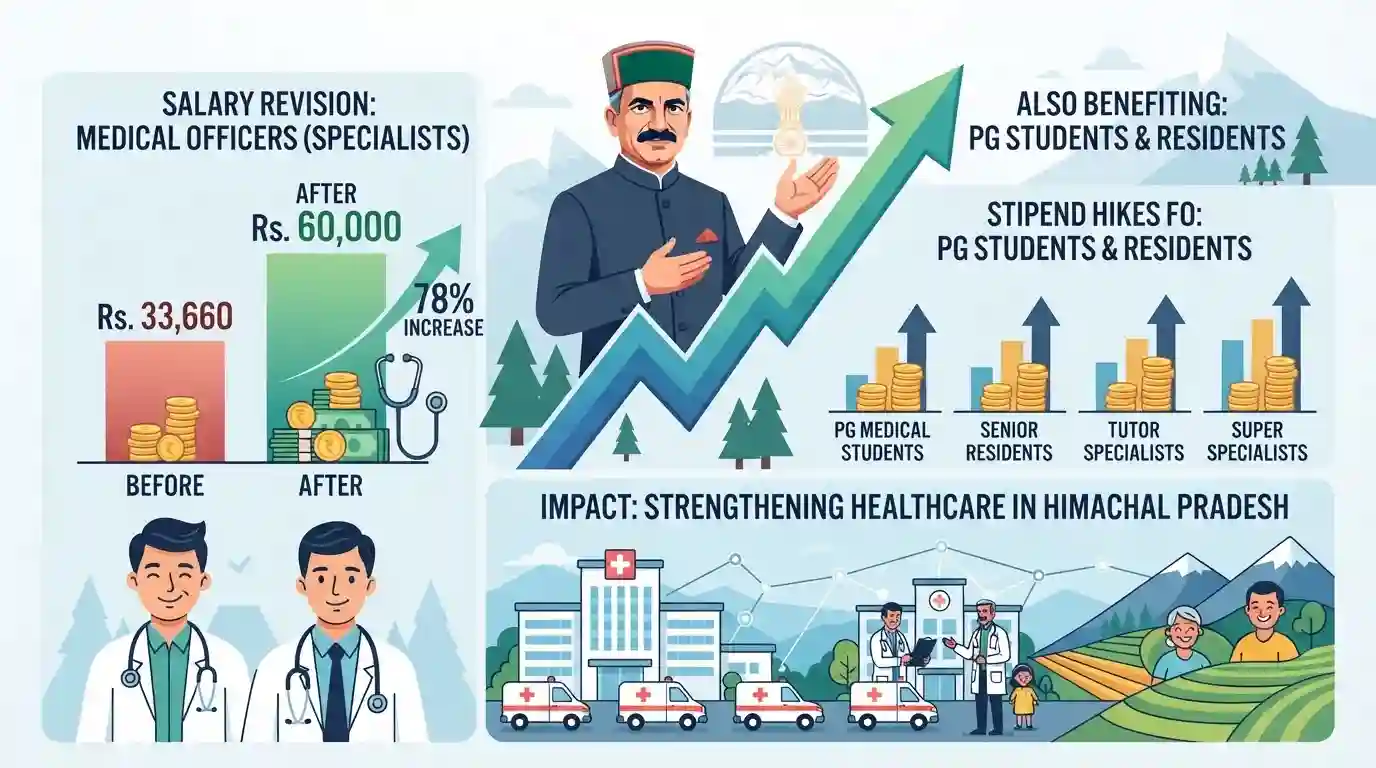
The Himachal Pradesh government, led by Chief Minister Thakur Sukhvinder Singh Sukhu, has announced a 78% salary increase for Contract and Job Trainee Medical Officers (Specialists), raising their monthly pay from Rs. 33,660 to Rs. 60,000. The decision also includes substantial stipend hikes for PG medical students, Senior Residents, Tutor Specialists, and Super Specialists. This policy initiative aims to address the shortage of medical professionals in government hospitals and remote areas, thereby improving the state's overall healthcare delivery network.
Key Points
- Himachal Pradesh CM approved a 78% salary hike for Contract and Job Trainee Medical Officers (Specialists).
- Monthly salary increased from Rs. 33,660 to Rs. 60,000 for these medical officers.
- Stipends for PG students, Senior Residents, Tutor Specialists, and Super Specialists have also seen significant increases.
- The move is intended to incentivize specialist doctors to serve in government healthcare institutions, particularly in remote areas, to strengthen the public health system.
Important Terms
Government of Himachal Pradesh

The elected state-level executive authority governing Himachal Pradesh, responsible for formulating and implementing regional policies on constitutional state subjects like public health, public order, and local governance.
UPSC context
Relevant for GS Paper II (Polity), highlighting state government responsibilities, federalism, and localized public policy execution.
Contract Medical Officers
Medical professionals employed by the government on fixed-term contracts rather than permanent roles. This model provides immediate staffing for public hospitals while bypassing lengthy recruitment cycles.
UPSC context
Highly relevant for GS Paper II (Health/Human Resources), addressing the severe shortage of specialist doctors in rural India.
Public Healthcare Network
The interconnected system of government-funded clinics, primary health centers, and hospitals designed to provide subsidized or free medical services to citizens, particularly in remote and rural regions.
UPSC context
Core component of GS Paper II (Social Justice & Health), focusing on equitable health access and state welfare schemes.
Public Finance
The management of a government's revenue, expenditures, and debt. In this context, it involves allocating state budgetary resources to fund salary hikes and stipends for public sector employees.
UPSC context
Essential for GS Paper III (Indian Economy), testing understanding of government budgeting and fiscal policy management.
Prelims Trap
"Public health and sanitation are items in the Concurrent List."
Public health and hospitals are strictly in the State List (Entry 6), while 'medical professions' (regulation/education) falls under the Concurrent List (Entry 26).
Static Concepts Connected
What constitutes the 'Committed Expenditure' of a State Government?
- Salaries & Wages: Routine pay and allowances distributed to actively serving state government employees and contract workers.
- Pensions: Mandatory retirement benefits and ongoing liabilities owed to former state employees.
- Interest Payments: Mandatory debt servicing costs and interest payouts on accumulated state borrowings.
What is the three-tier structure of rural public healthcare in India?
- Sub-Centres (SCs): The most peripheral contact point, catering to a population of 5,000 (3,000 in hilly/tribal areas).
- Primary Health Centres: Referral unit for 6 SCs, catering to 30,000 people (20,000 in hilly areas), led by a medical officer.
- Community Health Centres: 30-bed hospitals providing specialist care (surgeons, pediatricians, physicians) for roughly 1,20,000 people (80,000 in hilly areas).
Cross-Topic Patterns
State initiatives vs Central NHM
Doctor shortage interventions rely heavily on state-funded financial incentives supplementing the broader National Health Mission (NHM) framework for rural healthcare deployments.
Fiscal strain in Special Category States
Himalayan states face high per-capita administrative costs; recurring salary hikes inflate their "committed expenditure," severely crowding out capital expenditure in critical public infrastructure.

Expect a GS2 Mains question evaluating financial incentives vs compulsory rural service bonds to solve India's rural doctor shortage.
Linked PYQs · 2
Linked PYQs · 2
- 2025HPAS_PRELIMSGS1
Consider the following statements regarding public finance of Himachal Pradesh : (1) According to Budget Estimate for the year 2024-25, share of revenue expenditure out of total expenditure is around 80 percent. (2) Debt as a percentage of GSDP reached 75.33 during the year 2022-23. (3) State's own tax revenue as a percentage of total revenue for the year 2024-25 (BE) increased to 27.4. (4) During FY 2024-25 (BE) education and health sector were allocated Rs. 9995 and Rs. 8575 crores respectively. Choose the correct answer from the options given below :
- 2020HPAS_PRELIMSGS1
According to 2019-20 (budget estimates) what percentage of total expenditure is to be spent on salary, pension, interst payments and subsidies in Himachal Pradesh?
