Himachal Enhances Financial Aid for Disaster Victims
Source:aninews ↗
Why It Matters
The revision of disaster relief norms and the establishment of a Rs. 3,500 crore infrastructure plan reflect a critical shift towards disaster resilience and climate adaptation in a highly vulnerable Himalayan state. This serves as a key case study for state-level disaster response policies.
Summary
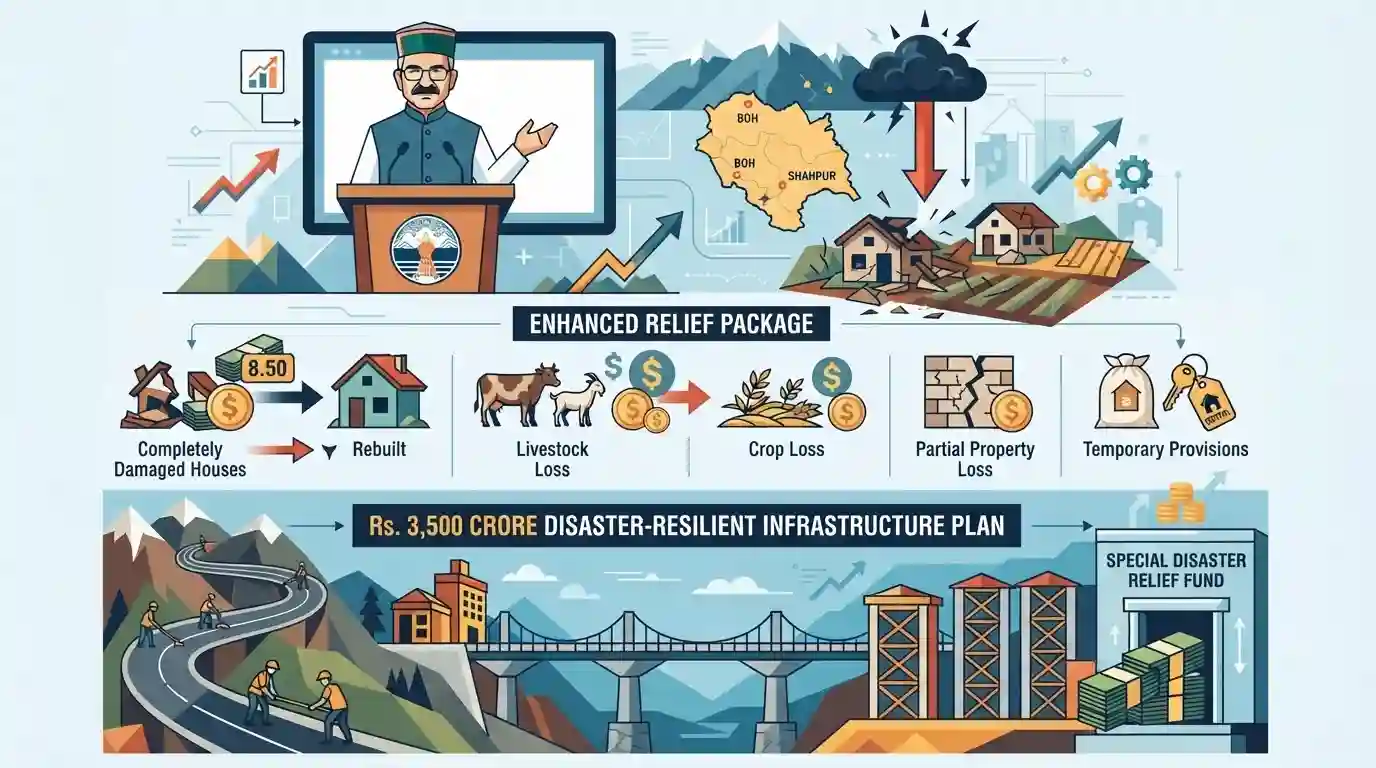
Himachal Pradesh Chief Minister Sukhvinder Singh Sukhu announced an enhanced relief package for cloudburst victims in the Boh area of the Shahpur Assembly Constituency. Recognizing the inadequacy of previous compensation norms, the state government amended its relief manual to increase financial assistance, including Rs. 8.50 lakh for completely damaged houses, alongside higher payouts for livestock, crop, and partial property losses. Additionally, the government announced a Rs. 3,500 crore disaster-resilient infrastructure plan to be funded through a Special Disaster Relief Fund, as well as temporary provisions for free rations and rental assistance.
Key Points
- The Himachal Pradesh government has enhanced compensation for completely destroyed houses from Rs. 1.30 lakh to Rs. 8.50 lakh for cloudburst victims in the Boh area.
- Financial assistance has been substantially increased across several categories, including Rs. 1 lakh for partial house damage, Rs. 55,000 for loss of large cattle, and Rs. 10,000 per bigha for damaged crop land.
- The state is devising a disaster-resilient infrastructure plan worth Rs. 3,500 crore, to be executed under a newly established Special Disaster Relief Fund.
- Affected families will receive free rations until March 2024 and monthly rental assistance of Rs. 5,000 in rural areas and Rs. 10,000 in urban areas.
- Ridkmar Primary Health Centre will be upgraded to a Community Health Centre to improve local medical infrastructure.
Important Terms
Special Disaster Relief Fund

A dedicated financial corpus established by the Himachal Pradesh government to provide prompt interim relief and enhanced compensation to families affected by natural disasters.
UPSC context
GS Paper 3 (Disaster Management). Illustrates state-level fiscal mechanisms and policy innovations addressing climate-induced emergencies.
Disaster-resilient infrastructure
Infrastructure designed and built to withstand natural hazards like floods and landslides, minimizing damage. Himachal Pradesh announced a Rs. 3,500 crore plan to develop such structures.
UPSC context
GS Paper 3 (Infrastructure & Disaster Management). Highlights structural mitigation strategies against severe Himalayan weather events.
Cloudburst
A highly localized, sudden, and extreme rainfall event—often exceeding 100mm per hour—frequent in mountainous terrains and capable of triggering severe flash floods and landslides.
UPSC context
GS Paper 1 (Geography) & GS 3. Crucial for understanding Himalayan ecological vulnerability and extreme weather phenomena.
Relief Manual
The official government rulebook dictating compensation norms, eligibility, and payout structures for disaster-affected citizens. Himachal Pradesh amended its manual to significantly increase financial assistance.
UPSC context
GS Paper 2 (Governance) & GS 3 (Disaster Management). Exemplifies administrative flexibility and responsive state governance during natural crises.
Prelims Trap
"The State Disaster Response Fund (SDRF) is funded 100% by the Central Government for Himalayan states."
SDRF funding is not 100% central. For Himalayan and Special Category states, the Centre-State ratio is 90:10. For general category states, it is 75:25.
Static Concepts Connected
What meteorological conditions define a "cloudburst" according to the IMD?
- IMD Definition: Sudden, intense rainfall exceeding 10 cm/hour over a highly localized geographical area of 20-30 sq km.
- Orographic Lifting: Often triggered when warm, moist air is forced up steep mountain slopes, leading to rapid cooling, condensation, and intense downpours.
- Vulnerability: Predominantly affects mountainous terrains like the Himalayas, leading to catastrophic flash floods and landslides.
How is disaster relief funding structured under the Disaster Management Act, 2005?
- SDRF Legal Basis: Constituted under Section 48(1)(a) of the DM Act, 2005, serving as the primary fund for state-level disaster response; audited by the CAG.
- Fund Bifurcation: Following Finance Commission norms, the overarching SDRMF is split into 80% for Response (SDRF) and 20% for Mitigation (SDMF).
- Cost Sharing: The Centre and State share costs 75:25 for general states, and 90:10 for Himalayan and Special Category states.
Cross-Topic Patterns
Sendai Framework & "Build Back Better"
The Rs 3,500 crore infrastructure plan operationalizes Priority 4 of the Sendai Framework (2015-2030), which advocates using post-disaster recovery to sustainably 'Build Back Better'.
Finance Commission's mitigation shift
The shift from purely response-based funding to earmarking 20% for mitigation (SDMF) reflects the Finance Commission's structural shift toward proactive climate risk reduction.
Himalayan vulnerability & Climate Change
Increased frequency of localized extreme precipitation events in the Himalayas is heavily linked in Mains to shifting Western Disturbance patterns and a warming troposphere.

Expect a Prelims statement combining IMD's cloudburst criteria (>10cm/hr) with the 90:10 Centre-State SDRF ratio for Himalayan states.
Linked PYQs · 2
Linked PYQs · 2
- 2020HPAS_PRELIMSGS1
Consider the given four statements and choose the correct answer from the given options. Select the true statements from the following: 1. Chamba, Kullu and Kinnaur are considered the most susceptible of landslide threat. 2. Una, Bilaspur, Sirmaur, Shimla and Solan are considered as low vulnerable of disaster threats. 3. Hum valley of Una district has hardly any natural drinking water source. 4. As per the study of central water board, Kala Amb valley in Sirmaur district has exploited the least underground water.
- 2024HPAS_PRELIMSGS1
Consider the following statements : (1) Himachal Pradesh Government approved an outlay of 1200 crore rupees for economic services during 2022-23. (2) Himachal Pradesh Government approved an outlay of 267 crore rupees for rural development during 2022-23. (3) Himachal Pradesh Government approved an outlay of 140 crore rupees for Mahatma Gandhi National Employment Guarantee Scheme during 2022-23. (4) Himachal Pradesh Government approved an outlay of 22 crore rupees for Forestry and Wildlife during 2022-23. Choose the correct answer from the options given below :
