Himachal Independence Day Address Highlights New Welfare Initiatives
Source:economic-times ↗
Why It Matters
HPAS Prelims frequently asks direct questions on newly launched state government schemes, their objectives, and their target beneficiaries. Knowledge of these latest initiatives, such as 'Apna Parivar Sukhi Parivar' and the 'Indira Gandhi Matri Shishu Sankalp Yojana', is crucial for the State Specific questions in GS1.
Summary
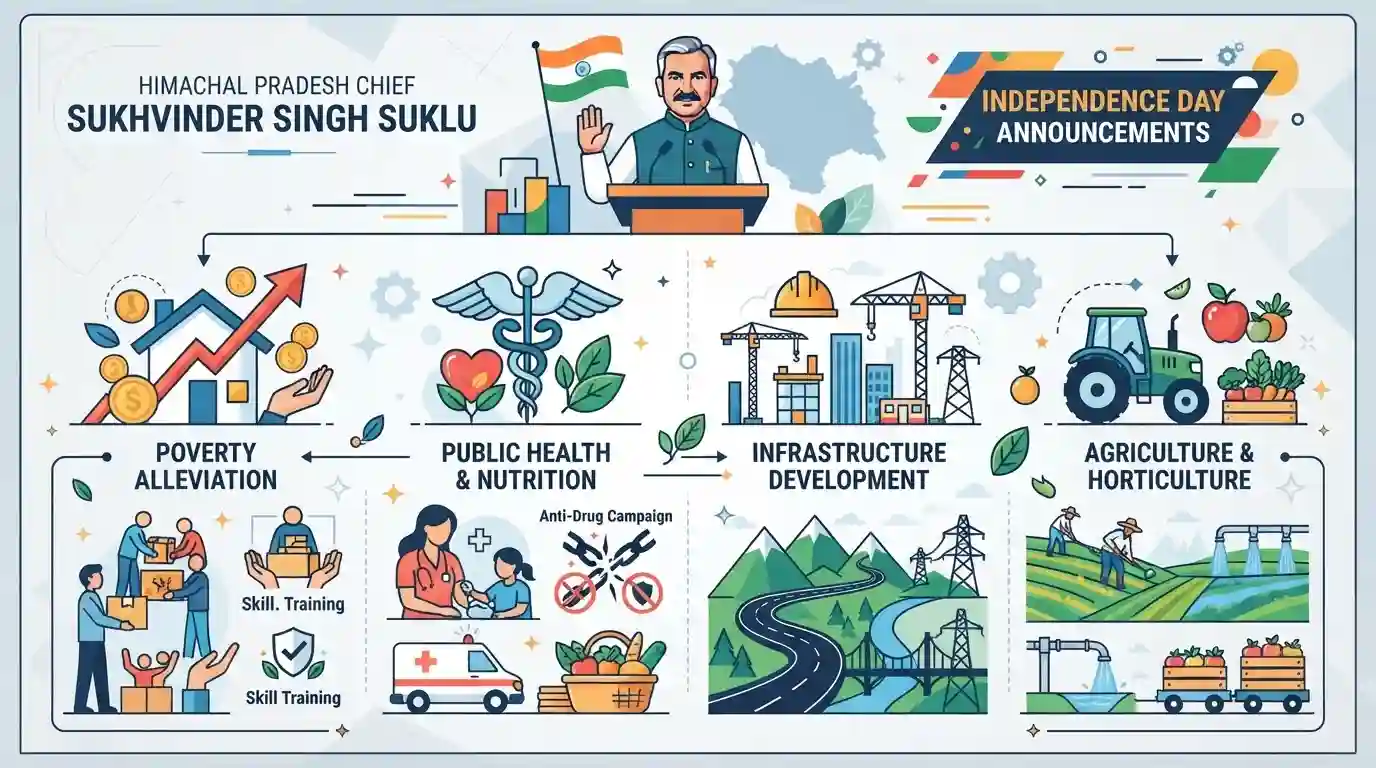
Himachal Pradesh Chief Minister Sukhvinder Singh Sukhu announced major welfare and infrastructure schemes during Independence Day celebrations, focusing on poverty alleviation, maternal health, anti-drug campaigns, and agricultural development.
Key Points
- Himachal Pradesh CM announced the 'Apna Parivar Sukhi Parivar' scheme to lift 1.80 lakh vulnerable families out of poverty over two years.
- The 'Indira Gandhi Matri Shishu Sankalp Yojana' will provide nutritional support, including premix food, milk, or eggs for mothers and children, starting in 21 ICDS blocks.
- The state introduced the 'Chitta-Mukt Himachal Abhiyan' alongside a sports initiative to combat drug abuse among youth.
- Significant infrastructure investments include ₹150 crore for milk processing infrastructure (with a major plant at Daghwar, Kangra), a ₹2,000-crore drinking water scheme, and new ropeways in key religious sites.
Important Terms
Apna Parivar Sukhi Parivar

A state scheme to support ~1.8 lakh ultra-poor families not on the BPL list. Identified through an eight-phase survey, it provides targeted socio-economic support to elevate them financially over a two-year period.
UPSC context
Crucial for HPAS GS Paper 2 (Welfare Schemes). Tests knowledge of poverty alleviation and inclusive governance in Himachal Pradesh.
Indira Gandhi Matri Shishu Sankalp Yojana
A supplementary nutrition scheme providing premix food, hot-cooked meals, eggs, and milk to pregnant/lactating mothers and young children. Launching in 21 ICDS blocks, it combats malnutrition through Anganwadi centres.
UPSC context
Important for HPAS GS 2 (Health and Social Justice) to illustrate the state's intervention in maternal and child health indicators.
Khelo Himachal, Chitta-Mukt Abhiyan
An anti-drug initiative to channel youth energy into constructive avenues. It features state-wide block and district-level sports tournaments, alongside rehabilitation efforts, targeting high-risk areas affected by heroin (Chitta).
UPSC context
Highly relevant for GS Paper 2 & 3 (Internal Security & Social Issues). Tests the state's multi-pronged approach against substance abuse.
AIMSS Chamiyana Hospital
Atal Institute of Medical Super Specialty at Chamiyana is a newly established healthcare facility in Himachal Pradesh, which has begun phased operation of super-speciality OPDs and introduced robotic surgeries.
UPSC context
Important for GS Paper 2 (Health Infrastructure). Showcases the decentralization and modernization of tertiary healthcare in the state.
Prelims Trap
Himachal Pradesh is the second state to implement MSP for milk.
Aspirants might assume leading dairy states like Gujarat implemented it first. HP is actually the first Indian state to implement an MSP specifically for milk.
Static Concepts Connected
What is the significance of the "First 1000 Days" approach?
- Crucial Window: Covers conception to a child's second birthday, acting as the most critical period for cognitive and physical development.
- Cycle Breaker: Adequate nutrition during this phase prevents intergenerational malnutrition, significantly reducing stunting and low-birth-weight incidences.
How does Milk MSP differ from traditional crop MSP?
- Jurisdiction: Standard crop MSPs are recommended centrally by the CACP, whereas the milk MSP is an exclusive, state-funded initiative by the Himachal government.
- Infrastructure Dependence: Unlike grains, milk's highly perishable nature mandates immediate procurement and processing infrastructure, such as the newly announced Daghwar plant.
Cross-Topic Patterns
Dairy MSP & Natural Farming Synergy
HP links milk MSP with natural farming to boost rural livelihoods, blending GS-3 agricultural policies with grassroots poverty alleviation frameworks.
Sports as Anti-Drug Intervention
Pairing the 'Chitta-Mukt Abhiyan' with 'Khelo Himachal' shifts drug policy from pure law-enforcement to socio-behavioral rehabilitation and youth engagement.

Expect a multi-statement question on HP's milk MSP distinction, paired with target demographics of IGMSSY and Apna Parivar schemes.
Linked PYQs · 3
Linked PYQs · 3
- 2020HPAS_PRELIMSGS1
Consider the given four statements and choose the correct answer from the given options. Which of the following statement(s) is / are not correct about the Social Welfare programs of Government of Himachal Pradesh? 1. e-Udyan portal: Where farmers can avail Horticulture farming service benefits while sitting in their home. 2. Vishesh Mahila Uthan Yojna: Scheme formulated for rehabilitation of physically and sexually abused women through technical and vocational training. 3. Medha Protsahan Yojna: Rupees one lakh is provided to the meritorious students to provide guidance at coaching centers. 4. Mukhya Mantri Ek Bigha Scheme: State Government will empower rural women by helping them become self-sufficient and get employment under MGNREGS.
- 2023HPAS_PRELIMSGS1
Match List I with List II : | List-I | List-II | |---|---| | (a) Himachal Pradesh Skill Development Project | (i) 2018 | | (b) Himachal Pradesh Kaushal Vikas Nigam | (ii) 2017 | | (c) Mukhya Mantri Yuva Ajivika Yojana | (iii) 2014 | | (d) Himachal Grhini Suvidha Yojana | (iv) 2019 | Choose the correct answer from the options given below : Code: (a) (b) (c) (d)
- 2023HPAS_PRELIMSGS1
Consider the following statements : (1) The sex ratio in the state is 972 females per 1000 males, which is higher than the national average of 940 females per 1000 males. (2) Service is the primary occupation of people in Himachal Pradesh, with over 90% of the population dependent on it for their livelihood. (3) Himachal Pradesh has a per capita income of Rs. 3,58,369, which is higher than the national average. (4) The state has a high Human Development Index (HDI) of 0.707, which is higher than the national average of 0.640. Choose the correct answer from the options given below :
