Boh Valley disaster victims receive enhanced relief and health upgrade
Source:uniindia ↗
Why It Matters
State-specific disaster relief norms and regional agricultural specialties (like trout farming in Boh Valley) are highly relevant for HPAS Prelims GS1, testing candidates' knowledge of Himachal Pradesh's local geography, economy, and administrative measures.
Summary
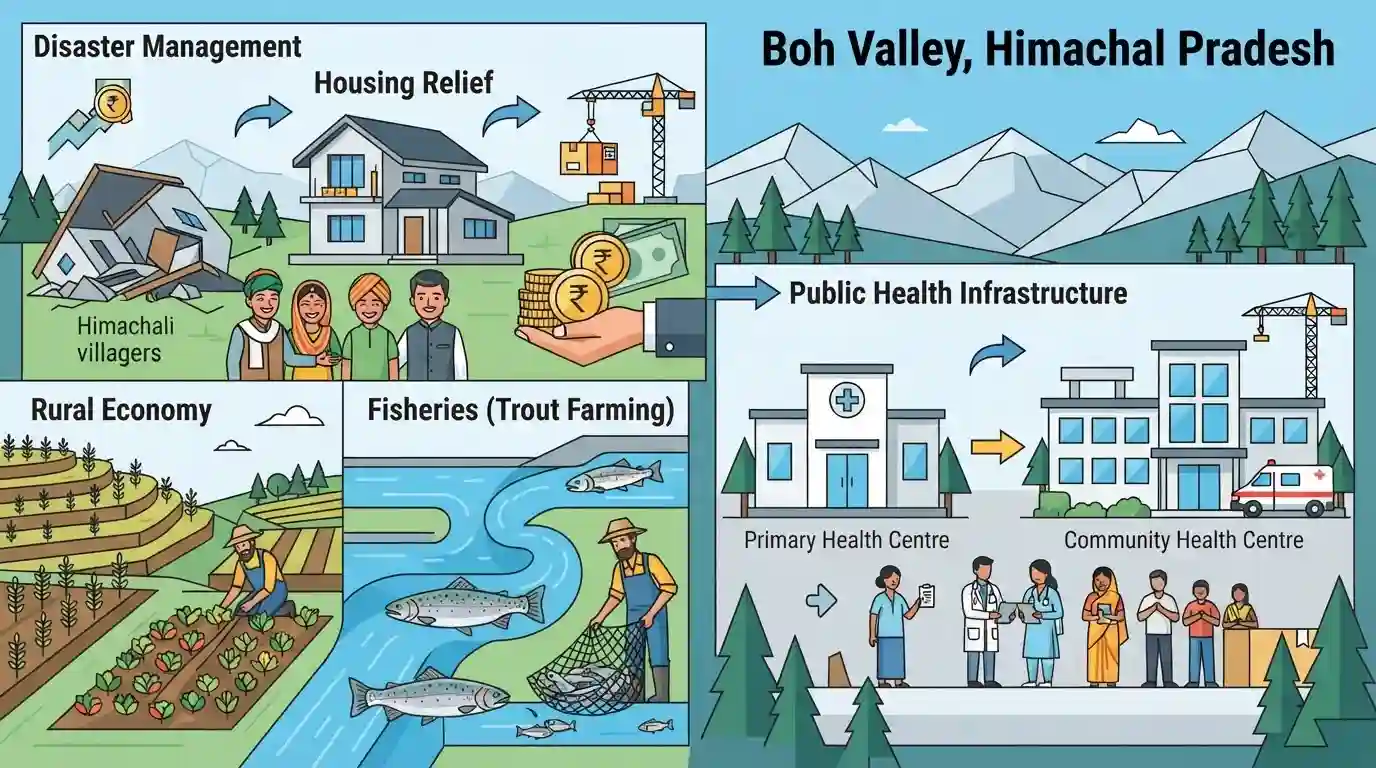
Himachal Pradesh Chief Minister Sukhvinder Singh Sukhu visited the disaster-hit Boh Valley in Shahpur and announced a comprehensive enhanced relief package for affected families. The package substantially raises compensation limits, offering Rs 7.5 lakh for completely destroyed houses (up from Rs 1.30 lakh) and additional financial aid for household goods and livestock losses. Recognizing the valley's rural economy, the CM assured support for farmers and trout fish farmers. Additionally, to bolster public health infrastructure in the region, the Darini Primary Health Centre was announced to be upgraded to a Community Health Centre.
Key Points
- Chief Minister Sukhvinder Singh Sukhu visited the disaster-affected Boh Valley in the Shahpur Assembly constituency, announcing a significantly enhanced relief package.
- Financial assistance for completely destroyed houses was increased from the earlier Rs 1.30 lakh to Rs 7.5 lakh, alongside Rs 1 lakh specifically for replacing clothes, utensils, and household items.
- Compensation for livestock was also raised, with Rs 55,000 for a cow/buffalo and Rs 15,000 for a goat.
- The CM addressed the needs of local farmers, horticulturists, and fish farmers, noting Boh Valley's growing prominence as a trout farming hub.
- To improve local healthcare infrastructure, the Primary Health Centre (PHC) at Darini will be upgraded to a Community Health Centre (CHC).
Important Terms
State Disaster Response Fund (SDRF)

The primary fund under Section 48 of the Disaster Management Act, 2005, for states to respond to notified disasters. Financed 75:25 (Centre:States) for general states and 90:10 for Himalayan/Northeastern states.
UPSC context
GS Paper 3 (Disaster Management) & Paper 2 (Federalism). Tests knowledge of disaster finance mechanisms and Centre-State sharing.
Community Health Centre (CHC)
A 30-bed block-level referral hospital in rural India's three-tier healthcare system, serving a population of 80,000 (hilly/tribal) to 1,20,000 (plains) and staffing specialists like surgeons.
UPSC context
GS Paper 2 (Social Justice/Health). Tests understanding of rural public healthcare architecture and Indian Public Health Standards (IPHS).
Primary Health Centre (PHC)
The first-tier rural health clinic staffed by a medical officer. It covers a population of 20,000 in hilly/tribal areas and 30,000 in plains, acting as a referral link.
UPSC context
GS Paper 2 (Social Justice/Health). Tests knowledge of primary health infrastructure and decentralized health delivery systems.
Boh Valley
A geologically fragile valley in Kangra, Himachal Pradesh, situated on loose alluvial deposits of the Dhauladhar Range, making it highly vulnerable to recurring cloudbursts and debris flows.
UPSC context
GS Paper 3 (Disaster Management) & GS Paper 1 (Geography). Tests case study application of Himalayan geological vulnerability and mountain hazard management.
Himachal Pradesh Disaster Relief Package
A state-specific scheme that enhances standard baseline SDRF norms, offering substantially higher compensation (such as Rs 7.5 lakh for completely destroyed houses) funded from state resources.
UPSC context
GS Paper 3 (Disaster Management). Tests awareness of sub-national policy adaptations, disaster compensation frameworks, and rehabilitation strategies.
Prelims Trap
States cannot exceed SDRF compensation caps, and all disaster packages in Himalayan states are automatically shared 90:10 by the Centre.
Any enhanced relief package exceeding standard SDRF norms must be funded entirely from the state's own exchequer; central 90:10 sharing applies strictly to standard statutory limits.
Static Concepts Connected
What is the State Disaster Response Fund (SDRF) framework?
- Statutory Base: Created under Section 48(1)(a) of the Disaster Management Act, 2005, it is the primary fund available with states for immediate disaster response.
- Funding Share: Contributed by Central and State Governments in a 75:25 ratio for general category, and 90:10 for special category (Himalayan/NE) states.
- Discretionary Allocation: States can use up to 10% of their annual allocation to provide relief for 'state-specific disasters' not on the central list.
How do PHCs and CHCs differ under Indian Public Health Standards?
- Population Norms: PHCs cover 20,000 (hilly/tribal) to 30,000 populations, whereas CHCs act as secondary units covering 80,000 to 1,20,000 people.
- Bed Capacity: PHCs are equipped with 4-6 beds, whereas CHCs function as 30-bed referral centers with specialist doctors (surgeons, pediatricians, gynecologists).
- Referral Flow: A CHC serves as a referral unit for 4 PHCs, acting as the critical middle tier of rural healthcare.
Cross-Topic Patterns
Himalayan ecology + Fiscal federalism
Uniform central disaster compensation norms frequently fall short of high reconstruction costs in fragile terrains, forcing ecologically vulnerable mountain states to deplete their own limited fiscal resources.
Cold-water aquaculture + Climate resilience
Himalayan states are pivoting to high-value trout farming under PMMSY, transforming cold-water fisheries into a key pillar of climate-resilient mountain livelihoods.

UPSC may contrast the statutory limits of SDRF/NDRF with state-funded discretionary relief packages in Federal Finance questions.
Linked PYQs · 3
Linked PYQs · 3
- 2024HPAS_PRELIMSGS1
Consider the following statements : (1) Himachal Pradesh Government approved an outlay of 1200 crore rupees for economic services during 2022-23. (2) Himachal Pradesh Government approved an outlay of 267 crore rupees for rural development during 2022-23. (3) Himachal Pradesh Government approved an outlay of 140 crore rupees for Mahatma Gandhi National Employment Guarantee Scheme during 2022-23. (4) Himachal Pradesh Government approved an outlay of 22 crore rupees for Forestry and Wildlife during 2022-23. Choose the correct answer from the options given below :
- 2024HPAS_PRELIMSGS1
What percent agriculture and its allied industries account for the total Gross State Value Added (GSVA) of Himachal Pradesh ?
- 2025HPAS_PRELIMSGS1
Read the following statements : Statement I : Share of agriculture in total GSDP of Himachal Pradesh has declined from about 75 percent in 1950-51 to little above 20 percent in 2023-24. Statement II : As per economic survey 2024-25 of the state, however, in terms of employment still 54 percent of the state population is engaged in primary sector. In the light of the above statements, choose the most appropriate answer from the options given below :
