Himachal Pradesh sets afforestation target and hikes Van Mitra pay
Source:uniindia ↗
Why It Matters
This highlights state-specific environmental initiatives (afforestation targets) and agricultural reforms (MSP for natural farming), which are essential for the HPAS Prelims section on Himachal Pradesh's geography, economy, and current events. Knowledge of ongoing inter-state issues (like BBMB arrears) is also crucial.
Summary
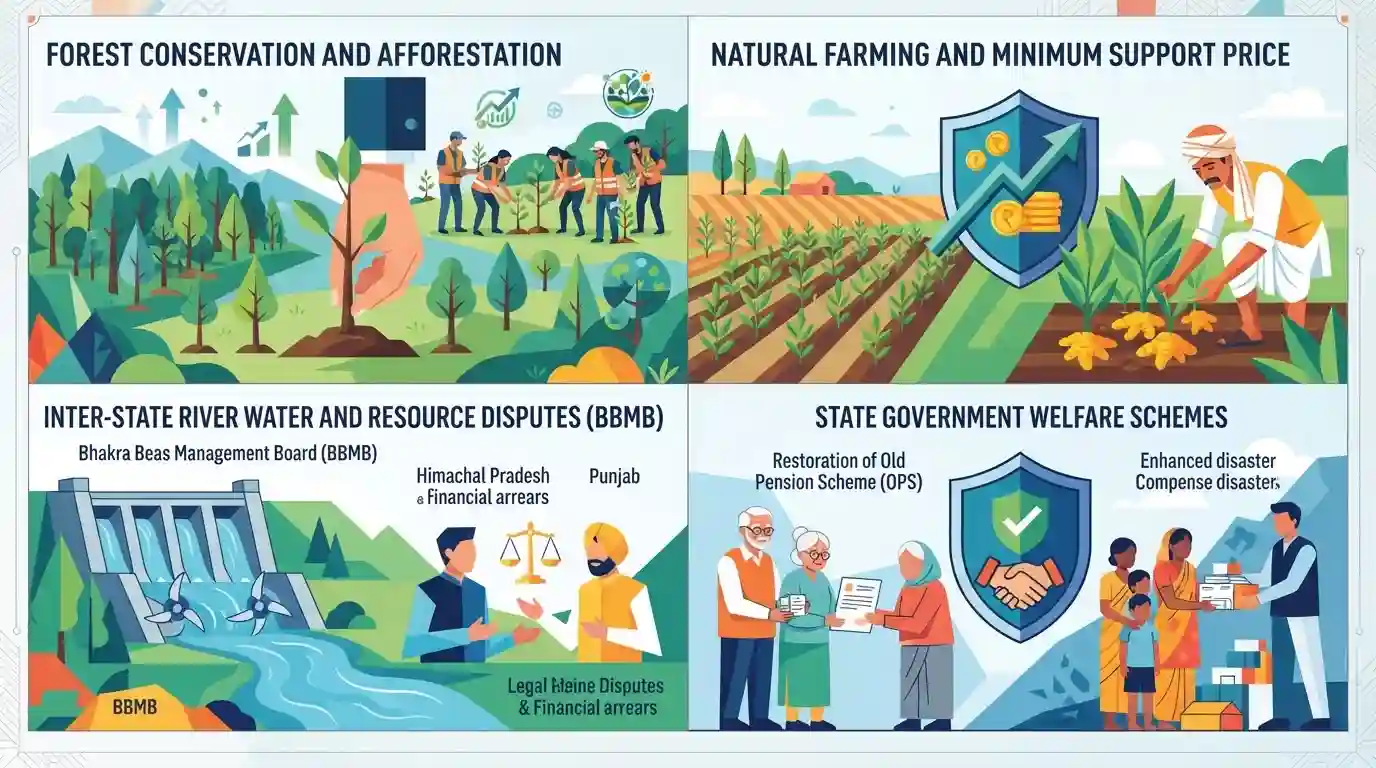
Himachal Pradesh Chief Minister Thakur Sukhvinder Singh Sukhu launched the state-level Van Mahotsav in Bilaspur district, announcing a massive afforestation drive to plant 50 lakh saplings across 7,000 hectares. To strengthen forest conservation, the honorarium for Van Mitras was increased to Rs 12,000. The CM also emphasized the state's focus on natural farming by providing a Minimum Support Price (MSP) for turmeric, a pioneering move. Additionally, he highlighted the state's firm legal stance in retrieving its rightful assets, including a legal victory in the Wildflower Hall case and efforts to recover Rs 7,200 crore in BBMB arrears from Punjab. Welfare measures like the restoration of the Old Pension Scheme and enhanced disaster compensation were also reiterated.
Key Points
- The Himachal Pradesh government launched the 75th state-level Van Mahotsav, setting a target to plant 50 lakh saplings over 7,000 hectares of forest land.
- Chief Minister Thakur Sukhvinder Singh Sukhu announced an increase in the honorarium for Van Mitras from Rs 10,000 to Rs 12,000.
- Himachal Pradesh is promoting natural farming, with the CM highlighting that the state has begun providing Minimum Support Price (MSP) for naturally grown turmeric.
- The state government has secured its property rights in the Rs 450 crore Wildflower Hall case and is fighting for Rs 7,200 crore in BBMB arrears from Punjab.
- Financial relief measures were expanded, including the restoration of the Old Pension Scheme and increasing disaster compensation significantly.
Important Terms
Van Mahotsav

An annual pan-India tree-planting festival observed in July to promote afforestation and ecological balance. Initiated in 1950 by K.M. Munshi, it aims to combat climate change and expand green cover.
UPSC context
Important for GS-3 Environment to highlight afforestation drives, forest conservation, and community-led ecological restoration initiatives.
Minimum Support Price (MSP)
A guaranteed floor price set by the government for select agricultural commodities, ensuring farmers receive remunerative returns and protecting them from severe market price fluctuations.
UPSC context
Crucial for GS-3 Agriculture and Economy, covering farm subsidies, food security, and government procurement policies.
Bhakra Beas Management Board (BBMB)
A statutory body established under the Punjab Reorganisation Act, 1966. It manages and regulates the supply of water and power from the Bhakra-Nangal and Beas projects across several northern states.
UPSC context
Relevant to GS-2 Federalism for understanding inter-state water and power sharing disputes in North India.
Old Pension Scheme (OPS)
A pre-2004 retirement system providing government employees an assured, inflation-linked monthly pension—typically 50% of their last drawn basic salary—entirely funded by the government without employee contributions.
UPSC context
Important for GS-2 and GS-3 Economy regarding state fiscal burdens, welfare policies, and pension reform debates.
Van Mitras
A Himachal Pradesh state initiative that hires local youth on a contractual basis to assist forest officials in protecting forests, preventing illegal felling, and maintaining new plantations.
UPSC context
Useful for GS-3 Environment and GS-2 Governance as a case study for community participation in conservation.
Prelims Trap
Only the Central Government (CCEA) has the authority to declare a Minimum Support Price (MSP) for agricultural commodities in India.
While the Centre declares MSP for 22 mandated crops, states frequently announce their own MSPs or bonuses for regional non-mandated crops to support local farmers.
Static Concepts Connected
How is agricultural pricing authority distributed between the Centre and States?
- Central MSP: The Cabinet Committee on Economic Affairs (CCEA) announces MSP for 22 mandated crops based on CACP recommendations.
- State Prerogatives: States can announce State Advisory Prices (e.g., sugarcane) or set their own localized MSPs for non-mandated crops (e.g., Himachal Pradesh for natural turmeric, Kerala for vegetables).
- Market Intervention Scheme: For perishable or horticultural commodities not covered by MSP, the Centre implements the Market Intervention Scheme (MIS) upon a specific state's request.
What is the statutory basis of the Bhakra Beas Management Board (BBMB)?
- Statutory Origin: Constituted under the Punjab Reorganisation Act, 1966, to regulate the administration, maintenance, and operation of the Bhakra Nangal and Beas projects.
- Participating States: It acts as an administrative resource-sharing mechanism among Punjab, Haryana, Rajasthan, and Himachal Pradesh.
- Distinct Framework: It is a permanent statutory board for joint asset management, which is constitutionally distinct from the ad-hoc tribunals established under Article 262 for inter-state river water disputes.
Cross-Topic Patterns
Natural Farming + State MSPs
Linking state-level MSP directly to naturally grown produce (turmeric) merges agricultural pricing policy with ecological conservation, offering a template for national climate-resilient agriculture schemes.
Colonial Heritage + Legal Disputes
The Wildflower Hall property dispute bridges post-independence asset transitions with Modern Indian History, mapping back to Lord Kitchener's military reforms and the Kitchener-Curzon controversy.

Expect multi-statement 2026 Prelims MCQs contrasting statutory river boards (like BBMB) with Article 262 water dispute tribunals.
Linked PYQs · 3
Linked PYQs · 3
- 2024HPAS_PRELIMSGS1
Match the forest cover area/type with their total area in Himachal Pradesh (2021) : | List I (Density/Total Forest Cover) | List II (Area in sq. kms.) | |---|---| | (a) Very dense forest above 70 percent | (i) 7,100 | | (b) Moderate dense forest 40 to 70 percent | (ii) 5,180 | | (c) Open forest 10 percent to 40 percent | (iii) 15,443 | | (d) Total forest cover | (iv) 3,163 | Choose the correct options : Code: (a) (b) (c) (d)
- 2020HPAS_PRELIMSGS1
'National Mission for Sustainable Agriculture' has been launched to:
- 2024HPAS_PRELIMSGS1
Match List I with List II : | List I (Ramsar Site) | List II (Name of State) | |---|---| | (a) Rudrasagar lake | (i) Punjab | | (b) Harike lake | (ii) Assam | | (c) Deepor Beel lake | (iii) Tripura | | (d) Vembanand wetland | (iv) Kerala | Choose the correct answer from the options given below : Code: (a) (b) (c) (d)
