Himachal Horticulture Wins Top Honour at International Expo
Source:tribuneindia ↗
Why It Matters
Horticulture is a cornerstone of Himachal Pradesh\'s economy. Understanding the state\'s shift toward climate-resilient practices, crop diversification, and micro-irrigation is critical for evaluating agricultural sustainability and rural income generation.
Summary
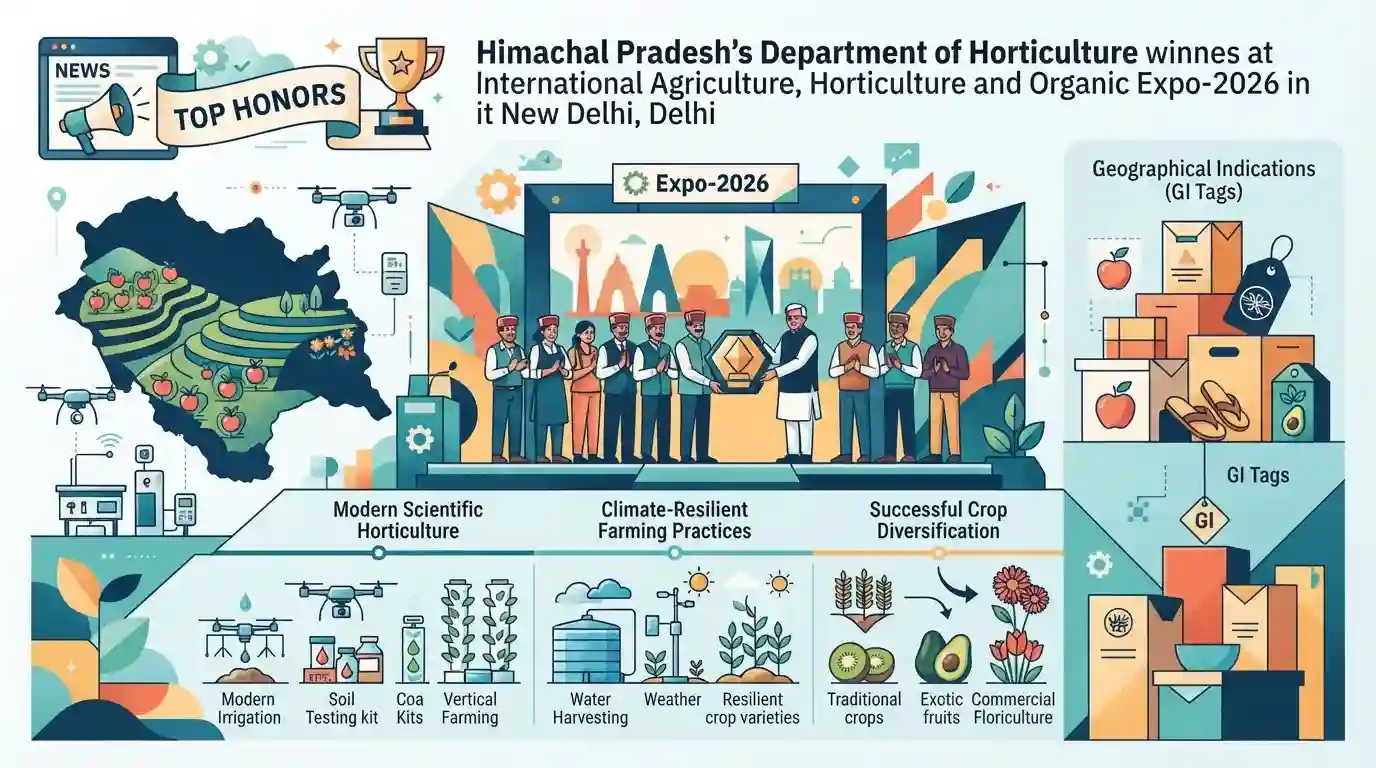
Himachal Pradesh\'s Department of Horticulture secured top honors at the International Agriculture, Horticulture and Organic Expo-2026 in New Delhi. The state was recognized for its pioneering efforts in modern scientific horticulture, climate-resilient farming practices, and successful crop diversification into high-value exotic fruits and commercial floriculture.
Key Points
- Himachal Pradesh\'s Department of Horticulture won the first prize at the International Agriculture, Horticulture and Organic Expo-2026 held at Pragati Maidan, New Delhi.
- The state was recognized for its initiatives in modern scientific horticulture, crop diversification, and the promotion of high-value horticultural crops.
- Key exhibits included exotic crops like dragon fruit, avocado, and blueberry, alongside traditional strengths like the GI-tagged Kinnauri apple and commercial floriculture (lilies from Shimla and Sirmaur).
- The state\'s efforts emphasize climate-resilient agriculture through high-density orcharding, protected cultivation, micro-irrigation, beekeeping, and natural farming.
Important Terms
International Agriculture, Horticulture and Organic Expo-2026

A three-day international exhibition at Pragati Maidan, New Delhi, gathering stakeholders to showcase innovations in scientific horticulture, climate-resilient agriculture, and crop diversification.
UPSC context
Covers GS Paper 3 (Agriculture). Highlights state-level innovations and technology adoption for sustainable farming and food processing.
Crop Diversification
The strategic shift from traditional single-crop dominance to multiple crops or cropping systems, aiming to boost profitability, maintain soil health, and reduce environmental and economic risks.
UPSC context
Key for GS Paper 3 (Cropping Patterns). Essential for sustainable agriculture, climate adaptation, and increasing farmers' income against market shocks.
Climate-Resilient Farming
Adaptive agricultural practices that ensure sustainable food production and minimize vulnerabilities to extreme weather events, changing monsoons, and broader climate change impacts.
UPSC context
Highly relevant for GS Paper 3 (Agriculture & Environment), addressing food security and ecological challenges amidst global warming.
Commercial Horticulture
The large-scale cultivation of high-value crops like exotic fruits, flowers, and vegetables for domestic and international markets to secure better financial returns.
UPSC context
GS Paper 3 (Agriculture). Central to national strategies for doubling farmers' income, boosting agricultural exports, and shifting away from staple cereals.
Geographical Indication (GI) Tag
An intellectual property label applied to products with a specific geographical origin, ensuring that qualities, reputation, and traditional methods (e.g., Kinnauri apple) are legally protected.
UPSC context
Important for GS Paper 3 (IPR). Empowers local agricultural producers, enhances brand value, and prevents unauthorized use of regional heritage.
Prelims Trap
Himachal Pradesh is the largest producer of apples in India.
Jammu & Kashmir is actually the largest producer of apples in India (accounting for over 70% of production), followed by Himachal Pradesh.
Static Concepts Connected
What is High-Density Planting (HDP) in horticulture?
- Definition: Planting a higher number of plants per unit area compared to traditional spacing methods, often utilizing dwarf rootstocks.
- Key Benefits: Increases yield per hectare, improves canopy management, allows for early returns, and makes harvesting easier.
- Resource Needs: Usually requires assured micro-irrigation (drip/sprinkler) and precise nutrient management for success.
What governs Geographical Indication (GI) tags in India?
- Legal Framework: Administered under the Geographical Indications of Goods (Registration and Protection) Act, 1999, which complies with WTO's TRIPS agreement.
- Core Criteria: The product must have a specific geographical origin and possess qualities or a reputation due to that origin (e.g., Kinnauri Apple).
- Validity & Rights: Valid for 10 years, after which it can be renewed. Unlike patents, it protects collective community rights, not individual inventions.
Cross-Topic Patterns
Horticulture & Climate Resilience
Shifting from water-intensive traditional crops to high-value exotic fruits and floriculture acts as a climate adaptation strategy while simultaneously boosting rural farm incomes.
Himalayan Sustainable Agriculture
Integrating natural farming, high-density orcharding, and micro-irrigation in hilly terrains directly aligns with the objectives of the National Mission on Sustainable Agriculture (NMSA).

Expect a Prelims question matching GI-tagged agricultural products to their states, or assessing the benefits of high-density orcharding.
Linked PYQs · 5
Linked PYQs · 5
- 2020HPAS_PRELIMSGS1
'National Mission for Sustainable Agriculture' has been launched to:
- 2014HPAS_PRELIMSGS1
Which one of the following agricultural practices is eco-friendly ?
- 2023HPAS_PRELIMSGS1
Consider the following statements : (1) Manure and fertilizers are the main source of nutrient supply to crops. (2) Inorganic farming is practised with minimal use of fertilisers and pesticides. (3) Growing of different crops on a piece of land in pre-planned succession is called intercropping. (4) Bee-keeping is done to get wax. Choose the correct answer from the options given below :
- 2018HPAS_PRELIMSGS1
'Lanjī', 'Saro' and 'Rajnagar' in Chamba district are the centres for development of the following :
- 2024HPAS_PRELIMSGS1
What percent agriculture and its allied industries account for the total Gross State Value Added (GSVA) of Himachal Pradesh ?
