Legislative Assembly adjourns following dispute over national song
Source:socialnews-xyz ↗
Why It Matters
Understanding the rules and procedures of State Legislative Assemblies and the historical and constitutional significance of national symbols like the national song and national anthem is highly relevant for the Polity and Modern History sections of the HPAS exam.
Summary
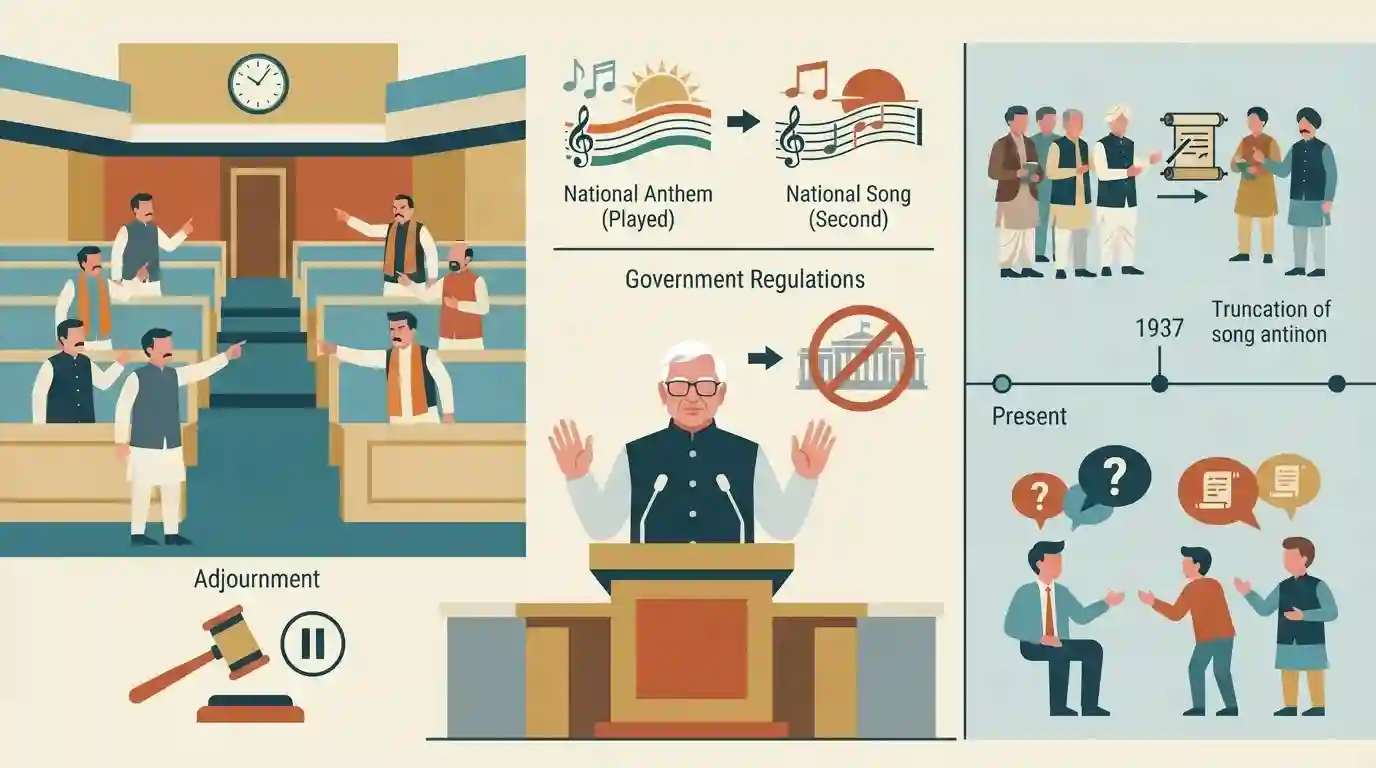
The Himachal Pradesh Legislative Assembly witnessed uproar and subsequent adjournment after BJP members protested the non-rendition of the full national song, 'Vande Mataram', at the beginning of the session. Speaker Kuldeep Singh Pathania clarified that the central government's regulations concerning the song do not apply to state assemblies, noting that tradition dictates starting with the national anthem and ending with the national song. The incident also sparked historical debates, with claims that the song was historically truncated by the Congress in 1937.
Key Points
- The Himachal Pradesh Assembly was adjourned amid protests by BJP members over the incomplete rendition of the national song 'Vande Mataram'.
- Speaker Kuldeep Singh Pathania stated that central guidelines regarding 'Vande Mataram' apply to government functions, not State Legislative Assemblies.
- Traditionally, the Assembly session commences with the national anthem and concludes with the national song.
- The controversy touched upon historical assertions, with BJP's Jairam Thakur alleging that the Congress truncated the song in 1937 to appease the Muslim League.
Important Terms
Himachal Pradesh Legislative Assembly

The unicameral state legislature of Himachal Pradesh, consisting of 68 elected members. It makes state laws and traces its origins to post-independence territorial councils before achieving full statehood in 1971.
UPSC context
Tests GS-II (Polity), focusing on state legislative structures, parliamentary rules of procedure, and the powers of the Speaker.
Bharatiya Janata Party (BJP)
One of India's major political parties, founded in 1980 from the Bharatiya Jana Sangh. It champions cultural nationalism and serves as the principal opposition in the current Himachal Pradesh Assembly.
UPSC context
Relevant for GS-II (Polity & Governance) regarding India's multi-party system, the role of political opposition, and ideological dynamics.
Indian National Congress
Founded in 1885, it is India's oldest political party. In 1937, Congress adopted only the first two stanzas of Vande Mataram for national gatherings to ensure religious inclusivity among communities.
UPSC context
Crucial for GS-I (Modern Indian History) concerning the national movement and GS-II for the role of the ruling party.
All-India Muslim League
A political party formed in 1906. In 1937, it strongly opposed the full rendition of Vande Mataram, arguing the later stanzas were anti-Islamic and idolatrous, which prompted Congress to truncate it.
UPSC context
Key to GS-I (Modern History) focusing on communalism, pre-independence political debates, and the historical seeds of partition.
Prelims Trap
"Under Article 51A, it is a Fundamental Duty to abide by the Constitution and respect its ideals, the National Anthem, and the National Song."
Article 51A(a) only mandates respecting the National Flag and the National Anthem. The term "National Song" is completely absent from the Indian Constitution.
Static Concepts Connected
What is the historical timeline of 'Vande Mataram' in the freedom struggle?
- Origins (1882): Penned by Bankim Chandra Chatterjee in Sanskritized Bengali in his 1882 novel Anandamath, set against the backdrop of the Sanyasi Rebellion.
- Political Debut (1896): First sung politically by Rabindranath Tagore at the 1896 Calcutta session of the Indian National Congress.
- Truncation (1937): The Congress Working Committee restricted its rendition to the first two stanzas to avoid religious imagery that drew objections from the Muslim League.
How do State Legislatures regulate their internal procedures?
- Article 208: Grants State Legislatures the independent power to make rules regulating their own procedure and conduct of business.
- Sovereignty of Rules: Because of this autonomy, Central Government guidelines regarding event protocols do not automatically override established Assembly conventions without the Speaker's consent.
Cross-Topic Patterns
Legislative Autonomy vs Central Directives
The Speaker's use of Article 208 highlights the separation of powers, where state assemblies remain autonomous in their procedural conduct, immune to central executive guidelines on administrative functions.
Cultural Symbols & Nationalist Timelines
The song links the late 18th-century Sanyasi Rebellion (Anandamath) to the 1896 INC session and 1937 Congress appeasement politics, making it a classic timeline anchor for Modern History questions.

Expect a multi-statement question mixing Article 51A (missing National Song mention) with the 1896 INC session and 1937 CWC resolution.
Linked PYQs · 2
Linked PYQs · 2
- 2023HPAS_PRELIMSGS1
Given below are two statements : Statement I : National Flag was adopted by the Constituent Assembly on 22 July, 1947. Statement II : Neelam Sanjiva Reddy has also worked as Speaker, Lok Sabha prior to his election as President of India. In the light of the above statements, choose the most appropriate answer from the options given below :
- 2022HPAS_PRELIMSGS1
The purpose of an adjournment motion is to :
