Climate Change Triggers Altitude Shift In Himachal Apple Economy
Source:himalayaneconomicforum ↗
Why It Matters
Crucial for understanding Himachal Pradesh's agrarian economy, climate vulnerabilities, and geographical shifts in key cash crops like apples, which are frequently tested in HPAS Prelims geography and economy sections.
Summary
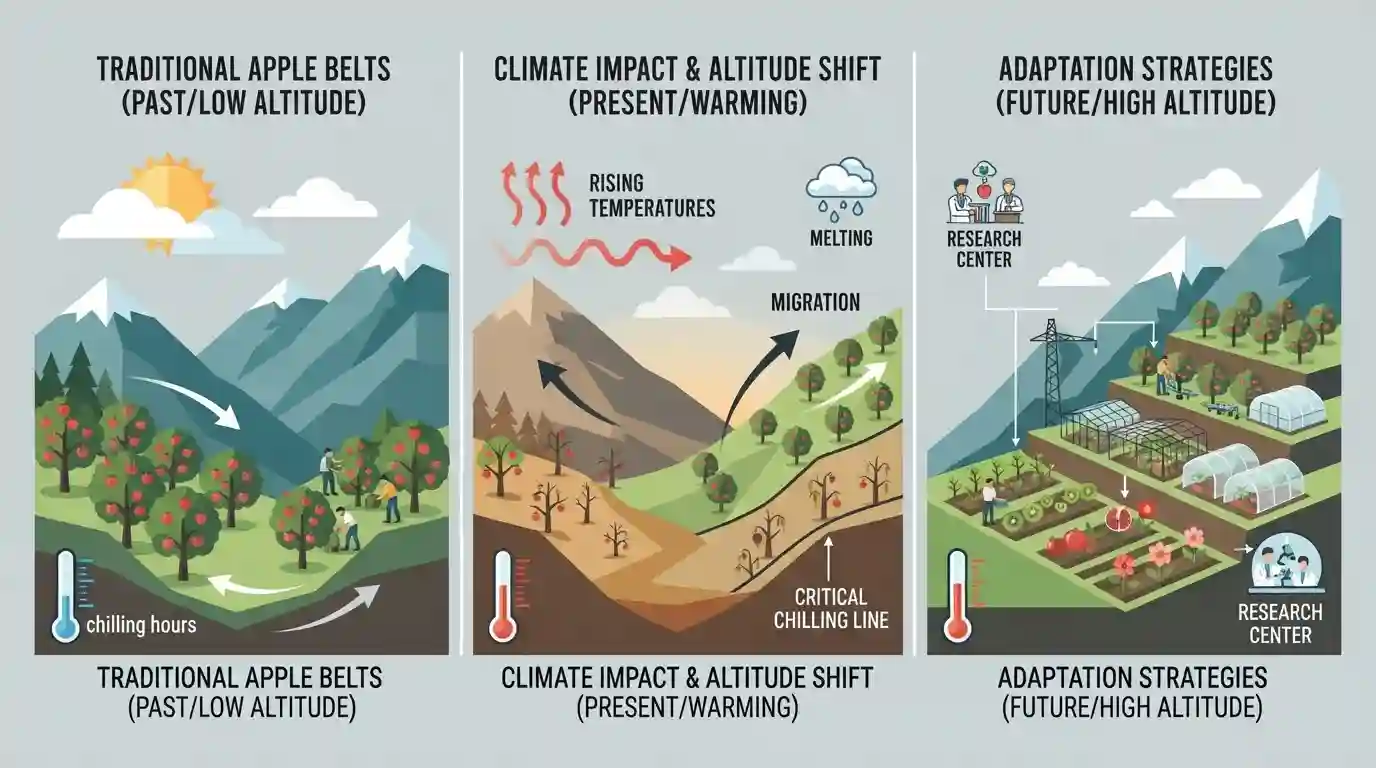
The article discusses the structural shifts in Himachal Pradesh's apple economy driven by climate change and altitude variations, highlighting the impact on traditional growing belts, chilling hours requirements, and adaptation strategies for regional horticulture.
Key Points
- Climate change is driving an altitude shift in Himachal Pradesh's apple economy, requiring higher elevations for optimal chilling hours.
- Traditional apple-growing belts in lower and mid-hills are facing declining yields and quality due to rising temperatures and erratic snowfall.
- Horticultural diversification towards high-value low-chill varieties and alternative fruits is emerging as a critical adaptation strategy for farmers in Himachal Pradesh.
Important Terms
Market Intervention Scheme

A government market intervention tool used in Himachal Pradesh to procure surplus or lower-grade (C-grade) apples at a support price, now fully digitized through the HPMIS portal to ensure transparent direct benefit transfers.
UPSC context
HPAS Paper III (Economy & Agriculture): Tests knowledge of state-level market support mechanisms, horticultural price stabilization, and agricultural digitization.
Dr. Y.S. Parmar University of Horticulture and Forestry
A specialized state university located at Nauni, Solan, dedicated exclusively to research, education, and extension in horticulture and forestry to bolster Himachal Pradesh's agrarian economy.
UPSC context
HPAS Paper II/III (Geography & Agriculture): Important for questions on regional agricultural research, climate adaptation strategies, and institutional support for horticulture in HP.
Himalayan Economic Forum
An economic research and advisory platform monitoring regional development, capital dynamics, and climate-induced structural shifts like altitude migration in mountain economies.
UPSC context
HPAS Paper III (Economic Development & Regional Geography): Tests analytical understanding of mountain economies, climate vulnerability, and land-use shifts.
Static Concepts Connected
What are the key agro-climatic zones and horticultural belts of Himachal Pradesh?
- Zone I (Sub-Tropical): Lower Hill Zone covers sub-tropical regions suited for citrus, mango, and litchi cultivation at altitudes up to 900 meters.
- Zone II (Sub-Temperate): Mid-Hill Zone spans 900 to 1,500 meters, historically prime for stone fruits and early apple varieties.
- Zone IV (Temperate): High Hill Temperate Zone exceeds 1,500 meters, housing the core apple economy including Shimla, Kullu, and Kinnaur.
Cross-Topic Patterns
Horticulture Geography vs. Himalayan Eco-Fragility
Shifting apple cultivation from traditional mid-hills to high-altitude cold deserts like Lahaul-Spiti links horticulture geography directly to fragile Himalayan ecology and climate vulnerability studies.
Horticulture Subsidies and MIS Fiscal Pressures
Market Intervention Scheme (MIS) price support mechanisms face unprecedented fiscal strain as traditional apple belts report structural crop failures due to rising temperatures.

HPAS Prelims often tests specific chilling hour thresholds and altitudinal shifts; expect a matching question on apple varieties and districts.
Linked PYQs · 2
Linked PYQs · 2
- 2025HPAS_PRELIMSGS1
Mountain Soil Zone in Himachal Pradesh is found between :
- 2024HPAS_PRELIMSGS1
Arrange the following climatic zones of Himachal Pradesh according to rainfall amount from lowest to highest : (1) Frigid aridic zone (2) Wet temperate zone (3) Humid sub-tropical zone (4) Sub-humid sub-tropical zone Choose the correct answer from the options given below :
