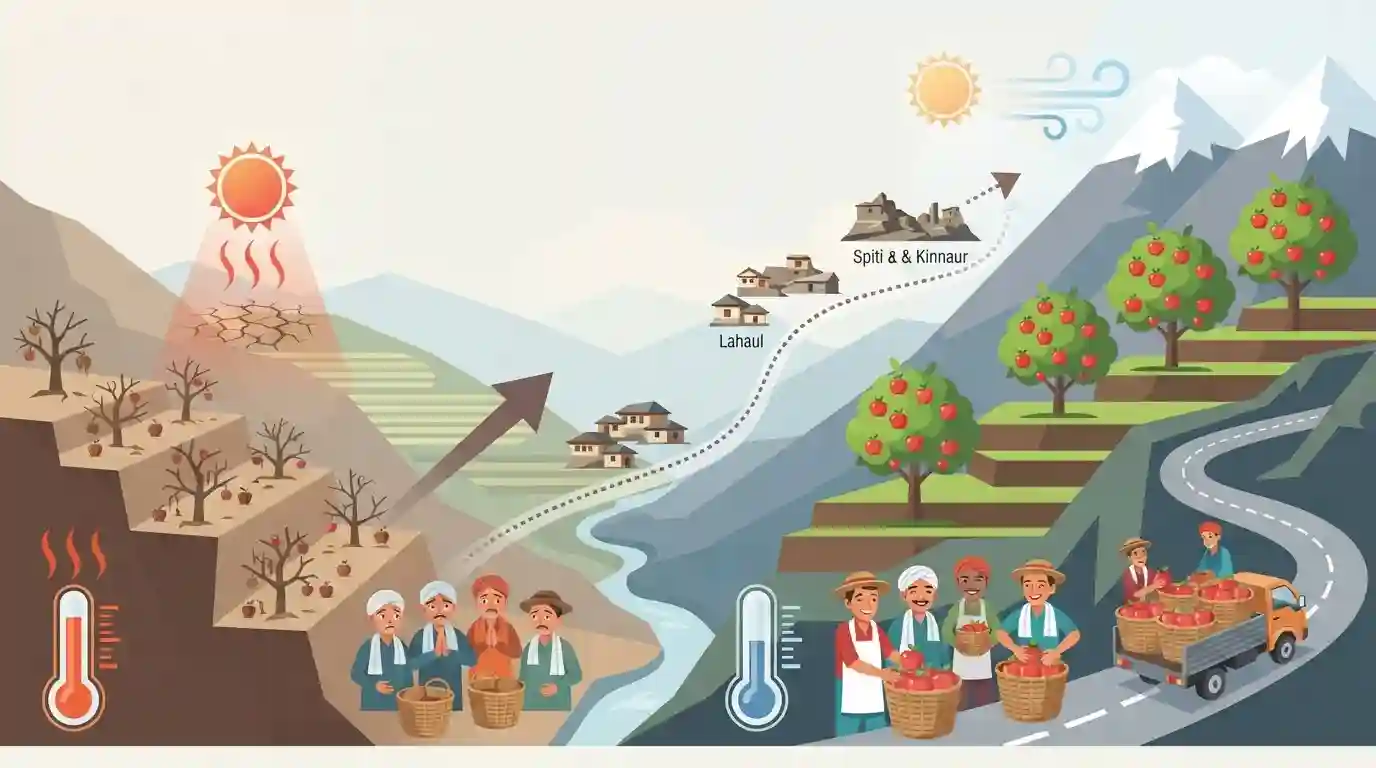
Rising Temperatures Drive Altitude Shift In Himachal Apple Cultivation
Source:himalayaneconomicforum ↗
Why It Matters
Crucial for HPAS aspirants to understand the geographical, economic, and climatic dynamics of Himachal Pradesh's primary horticultural cash crop (apple economy) and the challenges posed by global warming.
Summary
The article discusses the structural shift in Himachal Pradesh's apple economy driven by climate change and rising temperatures, forcing apple cultivation to move towards higher altitudes (such as Lahaul and Spiti and upper Kinnaur) while traditional lower-elevation belts face declining yields.
Key Points
- Climate change is causing a notable altitude shift in Himachal Pradesh's apple economy, pushing production to higher elevations due to rising temperatures and changing chill hour patterns in traditional lower valleys.
- Traditional apple belts at lower elevations (like parts of Kullu and lower Shimla) are witnessing a decline in productivity and quality, prompting farmers to adopt alternative crops or move uphill.
- High-altitude regions such as Lahaul and Spiti and upper Kinnaur are emerging as major hubs for high-density apple orchards and new low-chill/high-chill varieties.
- This shift poses economic sustainability challenges for small and marginal apple growers who lack the capital to migrate or transition to higher-altitude lands.
Important Terms
Himalayan Economic Forum

An independent economic intelligence and collaboration platform that tracks capital, energy, and infrastructure flows in the Himalayan region, publishing research on structural shifts like Himachal's uphill apple migration.
UPSC context
Relevant for HPAS GS Paper III (Economy and Agriculture), testing knowledge of regional think-tanks, economic shifts, and climate-induced agrarian changes in Himachal Pradesh.
Altitude Shift in Apple Economy
The continuous structural relocation of apple cultivation from traditional lower altitudes (like Shimla and Kullu) to higher elevations (such as Lahaul-Spiti and upper Kinnaur) due to rising temperatures.
UPSC context
Crucial for HPAS GS Paper III (Geography & Horticulture), examining the vulnerability of cash-crop horticulture to climate change and warming Himalayan temperatures.
Chilling Hours
The number of cumulative hours below 7°C required during winter for deciduous fruit trees like apples to break dormancy, bloom, and fruit properly.
UPSC context
Important for HPAS agricultural geography, testing understanding of climatic prerequisites for temperate horticulture and how global warming affects crop yields.
Prelims Trap
Lahaul and Spiti has traditionally been the largest apple-producing district in Himachal Pradesh due to its sub-zero temperatures.
Aspirants might assume Lahaul & Spiti has always been a major apple belt, missing that it is a recent climate-driven phenomenon where rising temperatures made traditional cold deserts viable for horticulture.
Static Concepts Connected
What are the key agro-climatic requirements for apple cultivation in Himachal Pradesh?
- Chill Hours: Requires 1,000 to 1,600 chill hours (temperatures below 7°C) during winter for proper dormancy and flowering.
- Rainfall & Temp: Thrives best in temperate zones with annual rainfall of 100-125 cm well-distributed throughout the growing season.
- Soil Type: Deep, well-drained, loamy soils with a pH range of 6.0 to 6.5 are ideal for root development.
Cross-Topic Patterns
Apple Altitude Shift vs. Rural Economy Resilience
Climate-driven agricultural shifts in Himachal directly impact rural livelihoods and land-use patterns, testing state disaster management preparedness and rural development policies under HPAS GS Paper III.

HPAS Mains GS-3 may ask about climate change adaptation strategies in HP’s horticulture sector, focusing on the apple altitudinal migration.
Linked PYQs · 2
Linked PYQs · 2
- 2025HPAS_PRELIMSGS1
Mountain Soil Zone in Himachal Pradesh is found between :
- 2024HPAS_PRELIMSGS1
Arrange the following climatic zones of Himachal Pradesh according to rainfall amount from lowest to highest : (1) Frigid aridic zone (2) Wet temperate zone (3) Humid sub-tropical zone (4) Sub-humid sub-tropical zone Choose the correct answer from the options given below :
