Himachal Pradesh Uniform Water Tariff and Panchayati Raj Devolution
Source:Indian Express ↗
Why It Matters
Water tariff structuring is crucial for both resource conservation and the financial viability of public utilities. The move to empower rural local bodies to decide user charges illustrates practical decentralization, addressing the often-cited reluctance of states to financially and functionally empower local governments.
Summary
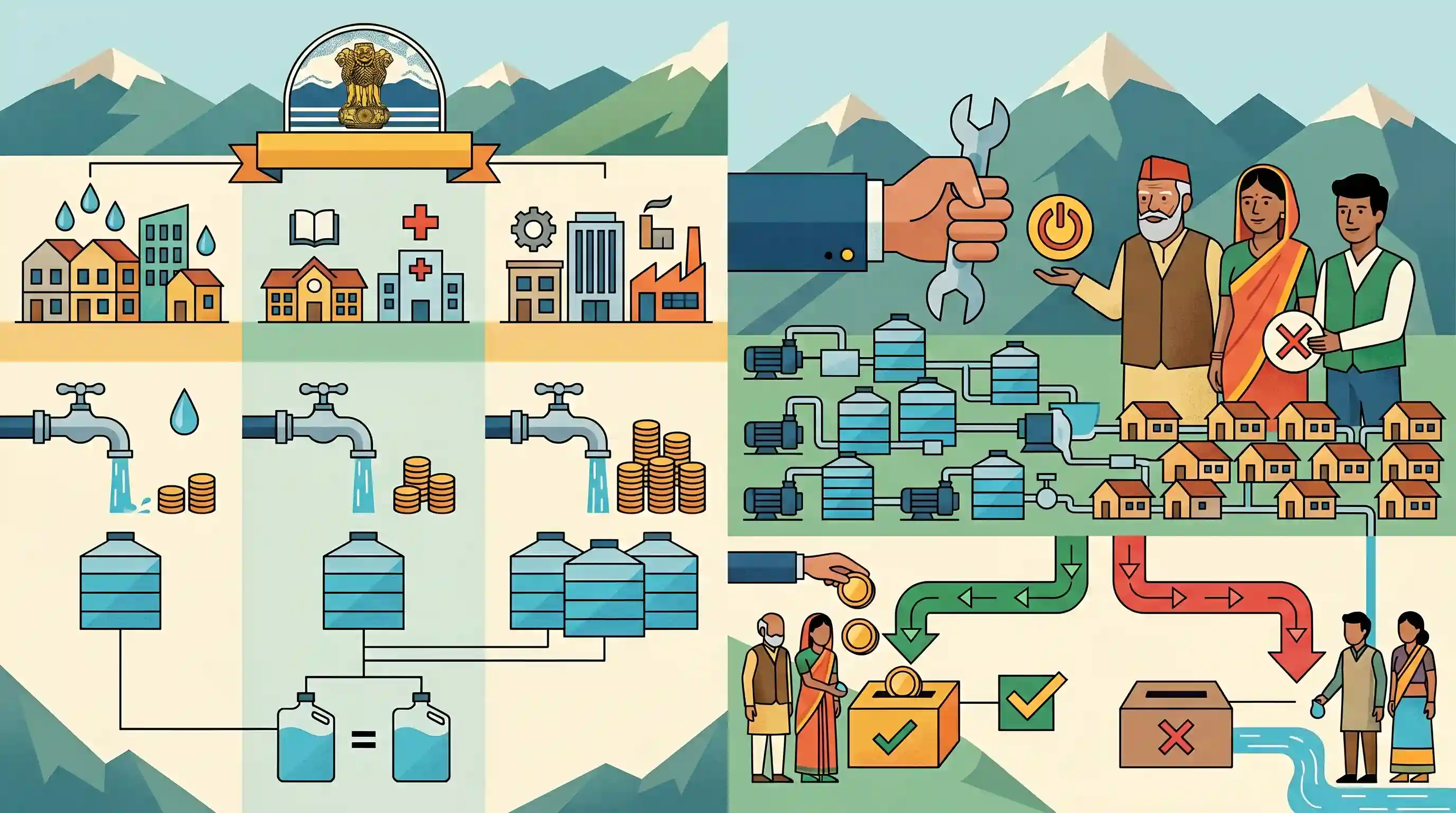
The Himachal Pradesh government has replaced its slab-based water tariff structure with a uniform pricing system. Under the new model, domestic consumers in Urban Local Bodies (ULBs) will pay a flat Rs 14 per kilo litre (kL), significantly streamlining the billing process. Commercial users and non-commercial institutions will be charged Rs 30/kL and Rs 20/kL, respectively. Crucially, the government is devolving power by handing over the operation and maintenance of 563 single-village water schemes to gram panchayats and Village Water and Sanitation Committees (VWSCs), granting them the authority to impose and collect user charges or continue non-billing.
Key Points
- Himachal Pradesh has abolished its slab-based water tariff structure in favor of uniform pricing across different consumer categories.
- Domestic consumers in Urban Local Bodies (ULBs) will now pay a flat rate of Rs 14 per kilo litre (kL).
- Commercial establishments (hotels, restaurants) will be charged Rs 30 per kL, while non-commercial institutions (hospitals, schools) will pay Rs 20 per kL.
- In a move towards decentralization, 563 single-village rural water schemes are being handed over to gram panchayats and VWSCs, allowing them to decide on user charges.
- BPL families, orphanages, destitute homes, and gaushalas remain exempt from water charges.
Important Terms
Urban Local Bodies (ULBs)

Constitutional local self-government institutions for urban areas (Municipal Corporations, Municipalities, Nagar Panchayats) established under the 74th Amendment Act, 1992 to manage civic services like water supply.
UPSC context
GS Paper II: Governance; tests knowledge of the 74th Amendment, functional devolution, and urban service delivery mechanisms.
Gram Panchayats
Village-level constitutional bodies established by the 73rd Amendment Act, 1992, acting as the primary units of rural self-governance responsible for managing local water schemes and resources.
UPSC context
GS Paper II: Local Governance; crucial for questions on democratic decentralization and rural development implementation.
Village Water and Sanitation Committees (VWSCs)
Community-led sub-committees of Gram Panchayats, comprising at least 50% women, responsible for planning, implementing, and maintaining in-village water supply infrastructure under the Jal Jeevan Mission.
UPSC context
GS Paper II & III: Social Justice/Water Resources; tests community-based management and sustainability in drinking water missions.
Jal Shakti Vibhag
The nodal state department (formerly Irrigation and Public Health) responsible for managing drinking water, sanitation, and irrigation infrastructure in Himachal Pradesh.
UPSC context
GS Paper II: Statutory/Executive Bodies; represents the executive wing implementing state-level water policies and infrastructure.
Uniform Water Tariff
A pricing structure that charges a flat rate per unit (e.g., kilolitre) of water consumed, irrespective of total usage, replacing progressive slab-based systems.
UPSC context
GS Paper III: Economic Development/Infrastructure; pertains to resource pricing, utility governance, and the trade-off between simplicity and conservation.
Prelims Trap
Village Water and Sanitation Committees (VWSCs) are autonomous NGOs, independent of the Gram Panchayat structure.
VWSCs (Paani Samitis) are not independent NGOs; they are statutory standing committees of the Gram Panchayat, legally empowered to manage local water infrastructure.
Static Concepts Connected
What is the constitutional basis for Gram Panchayats managing drinking water?
- Article 243G: Empowers state legislatures to endow Panchayats with the authority needed to function effectively as institutions of self-government.
- 11th Schedule: Contains 29 functional items devolved to Panchayats, specifically including "Drinking water" (Item 11) and "Water management" (Item 3).
- Article 243H: Authorizes state legislatures to allow Panchayats to legally levy, collect, and appropriate taxes, duties, tolls, and fees.
What constitutes the Own Source Revenue (OSR) of Gram Panchayats?
- Tax Revenue: Includes mandatory or optional levies such as property tax, profession tax, and taxes on local animal trades.
- Non-Tax Revenue: Encompasses user charges for drinking water, sanitation services, market fees, and income generated from Panchayat-owned properties.
- Current Status: OSR remains critically low nationally (often 1-6% of total receipts), leaving Panchayats heavily dependent on Finance Commission grants.
Cross-Topic Patterns
Jal Jeevan Mission & Panchayat Fiscal Health
Decentralizing water schemes to VWSCs aligns with Jal Jeevan Mission's community-ownership ethos while directly expanding the highly deficient Own Source Revenue (OSR) base of rural local bodies.
Volumetric Pricing & Resource Conservation
Moving from subsidized slabs to standard flat volumetric rates improves utility cost-recovery and disincentivizes water wastage, linking local governance reforms with broader climate adaptation strategies.

Expect a 2026 prelims statement testing the statutory status of VWSCs and the constitutional power of Panchayats to levy water user charges.
Linked PYQs · 3
Linked PYQs · 3
- 2023MainsGS2
“The states in India seem reluctant to empower urban local bodies both functionally as well as financially.” Comment.
- 2024MainsGS2
Analyse the role of local bodies in providing good governance at local level and bring out the pros and cons merging the rural local bodies with the urban local bodies.
- 2020MainsGS3
Suggest measures to improve water storage and irrigation system to make its judicious use under depleting scenario.
