Impact of US Tariff Hikes on Indian Seafood Exports and Aquaculture
Source:The Hindu ↗
Why It Matters
It provides a tangible case study on how global protectionism and tariff wars directly harm India's domestic primary sectors and employment. It also underscores the strategic importance of market diversification and Free Trade Agreements (FTAs) in safeguarding India's export-oriented industries.
Summary
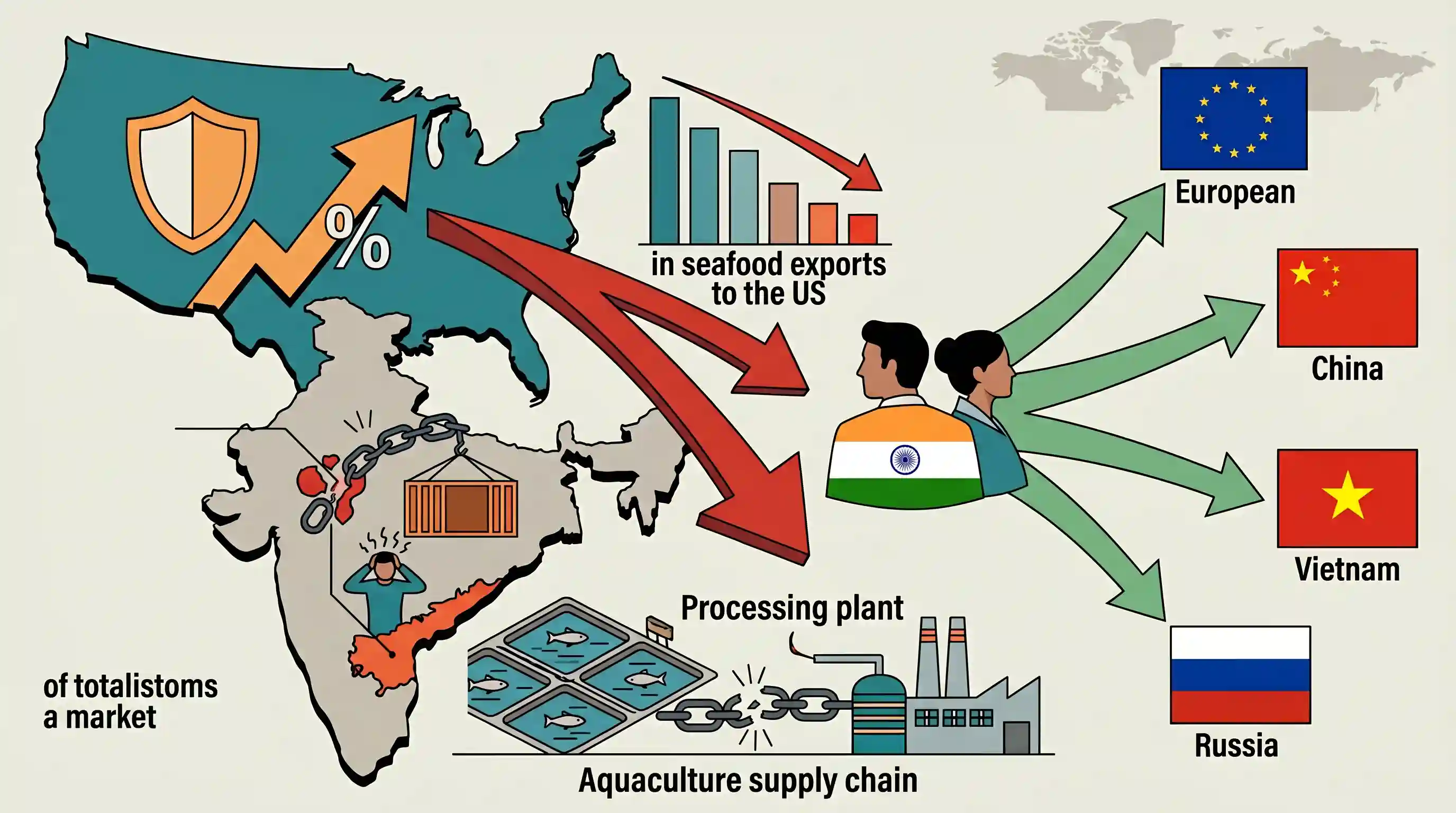
The article examines the adverse economic impact of the U.S. government's decision to hike tariffs on Indian marine products to 50%. This protectionist measure has led to a 25% decline in seafood exports to the U.S., a market that traditionally accounts for 35% of India's total seafood exports. The slump has severely affected Andhra Pradesh, which alone contributes 32% of national seafood exports, causing distress across the aquaculture supply chain. In response, exporters and the Seafood Exporters Association of India (SEAI) are urging the central government to negotiate Free Trade Agreements (FTAs) to diversify market access toward the EU, China, Vietnam, and Russia.
Key Points
- The U.S. increased tariffs on Indian marine products to 50%, resulting in a 25% drop in seafood exports from India to the U.S.
- The U.S. accounts for 35% of total Indian seafood exports, making it a critical market.
- Andhra Pradesh, which contributes 32% of India's seafood exports, is disproportionately impacted, causing distress to aquaculture farmers, hatcheries, and packers.
- Exporters are actively seeking alternative markets in the EU, China, Vietnam, and Russia to compensate for the slump.
- The Seafood Exporters Association of India has urged the Union government to negotiate Free Trade Agreements (FTAs) with other countries to support the aquaculture sector.
Important Terms
Free Trade Agreements (FTAs)

International treaties between countries to reduce or eliminate trade barriers like tariffs and quotas, facilitating easier cross-border movement of goods, services, and investments.
UPSC context
GS Paper 3 (Economy/Trade); relevant for questions on India's trade diversification, bilateral relations, and global value chain integration.
Seafood Exporters Association of India (SEAI)
A premier industry body representing Indian seafood exporters; it facilitates policy advocacy, market research, and quality compliance to enhance the global competitiveness of Indian marine products.
UPSC context
GS Paper 3 (Animal-Rearing/Exports); tests knowledge of institutional support for the marine sector and the role of non-governmental trade organizations.
Marine Products Export Development Authority (MPEDA)
A statutory body under the Ministry of Commerce and Industry (established 1972) responsible for promoting the export of marine products and developing the fisheries industry.
UPSC context
GS Paper 3 (Industry/Trade); critical for understanding statutory bodies that govern India’s export promotion and food safety standards.
Blue Economy
The sustainable use of ocean resources for economic growth, improved livelihoods, and jobs while preserving the health of marine and coastal ecosystems.
UPSC context
GS Paper 3 (Environment/Economy); important for discussions on sustainable development, ocean governance, and coastal livelihood security.
Countervailing Duty (CVD)
Additional import duties imposed by a country to neutralize the negative impact of subsidies provided by the exporting country’s government to its producers.
UPSC context
GS Paper 3 (Economy); tests understanding of WTO-recognized trade remedies and their impact on India’s export competitiveness.
Anti-dumping Duty (ADD)
A protectionist tariff imposed on foreign imports that are priced below the 'fair market value,' intended to prevent injury to the importing country's domestic industry.
UPSC context
GS Paper 3 (Trade/Economy); frequently tested in Prelims and Mains regarding international trade disputes and protectionism.
Prelims Trap
MPEDA functions under the administrative control of the Ministry of Fisheries, Animal Husbandry and Dairying.
MPEDA is a statutory body under the Ministry of Commerce and Industry, not Fisheries. UPSC frequently exploits ministry-jurisdiction overlaps in trade-related bodies.
Static Concepts Connected
Who regulates marine exports and coastal aquaculture in India?
- MPEDA: A statutory body under the Ministry of Commerce and Industry that serves as the nodal agency for promoting seafood exports.
- Coastal Aquaculture Authority: A statutory body under the Ministry of Fisheries, Animal Husbandry and Dairying that regulates farming activities in coastal areas.
- Frozen Shrimp: The most dominant commodity in India's marine export basket, contributing to over two-thirds of the country's total seafood export earnings.
How do developed nations restrict agricultural and marine imports?
- Tariff Barriers: Direct taxes or customs duties on imports (like the recent 50% US hike) used to protect domestic industries from foreign competition.
- SPS Measures: Sanitary and Phytosanitary agreements under WTO, frequently invoked by developed nations (like the US and EU) to reject seafood shipments on health or quality grounds.
- Anti-dumping Duties: Additional duties imposed on products exported below fair market value, historically utilized by the US against Indian shrimp exporters.
Cross-Topic Patterns
Blue Economy vs Global Trade Shocks
PM Matsya Sampada Yojana aims to double exports, but heavy reliance on a single market (US) and single commodity (shrimp) exposes India's Blue Economy to geopolitical trade shocks.
Protectionism driving FTA diversification
US protectionism is forcing India to pivot from traditional Western markets toward FTA negotiations with the EU, China, and Russia, linking trade diplomacy directly to rural aquaculture employment.

US tariff hikes on Indian shrimp make MPEDA's ministry, SPS barriers, and FTA diversification high-probability for a GS3 question.
Linked PYQs · 3
Linked PYQs · 3
- 2025MainsGS3
What are the challenges before the Indian economy when the world is moving away from free trade and multilateralism to protectionism and bilateralism? How can these challenges be met?
- 2018MainsGS3
How would the recent phenomena of protectionism and currency manipulations in world trade affect macroeconomic stability of India?
- 2020PrelimsGS1
With reference to the international trade of India at present, which of the following statements is/are correct? 1. India's merchandise exports are less than its merchandise imports. 2. India's imports of iron and steel, chemicals, fertilisers and machinery have decreased in recent years. 3. India's exports of services are more than its imports of services. 4. India suffers from an overall trade/current account deficit. Select the correct answer using the code given below:
