Himachal Faces Hazardous Pesticide Crisis Requiring Safer Agriculture
Source:downtoearth-org ↗
Why It Matters
Highly relevant for HPAS aspirants focusing on Himachal Pradesh's agrarian challenges, ecological sustainability, and state-level initiatives promoting chemical-free agriculture.
Summary
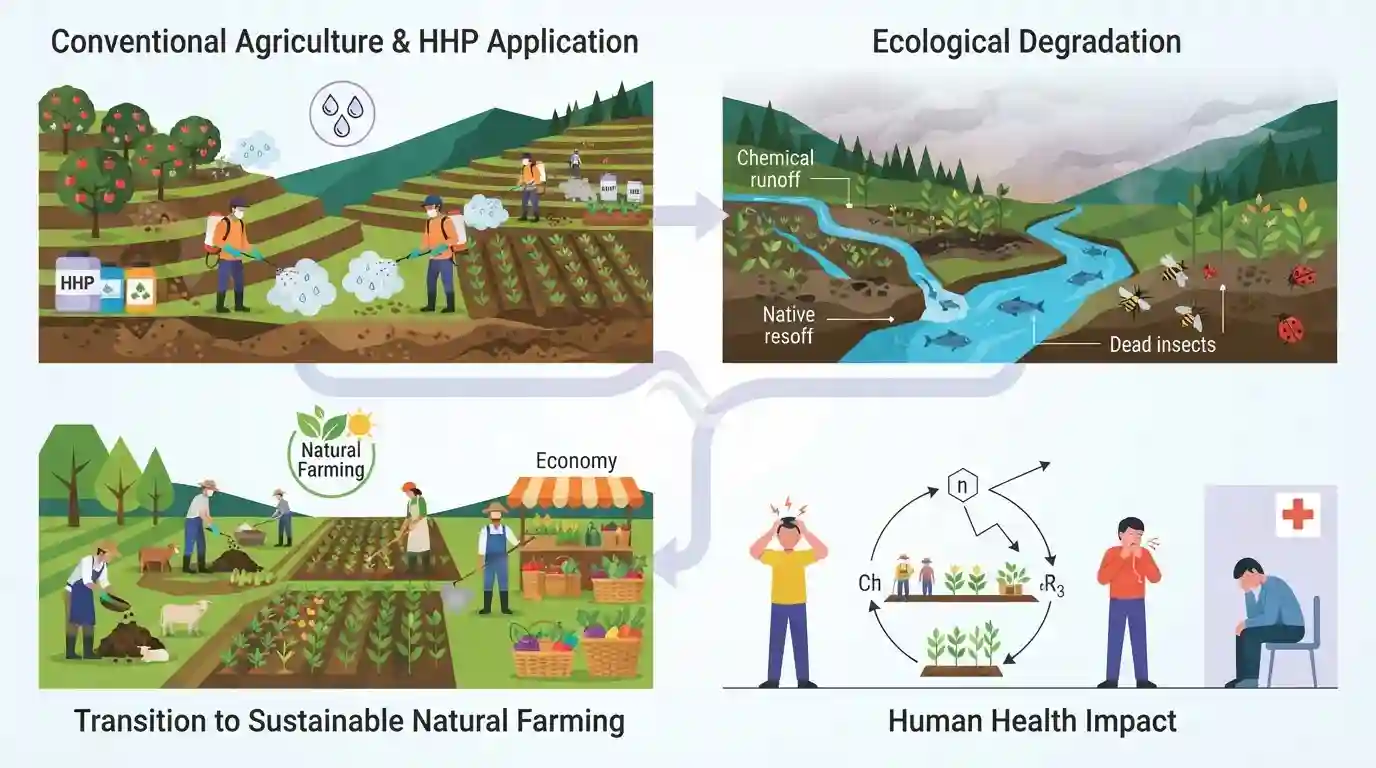
The article discusses the crisis posed by Highly Hazardous Pesticides (HHPs) in Himachal Pradesh, analyzing the impacts on agriculture, ecology, and human health, and underscores the imperative for transitioning to safer agricultural practices and sustainable natural farming initiatives in the state.
Key Points
- Highly Hazardous Pesticides (HHPs) pose severe risks to public health, soil health, and biodiversity in agricultural and horticultural regions like Himachal Pradesh.
- There is an urgent need to transition toward safer chemical alternatives and chemical-free natural farming models (such as natural and organic farming) in Himachal Pradesh.
- Agricultural sustainability in fragile Himalayan ecosystems requires robust regulatory frameworks, strict monitoring of pesticide residues, and farmer capacity building.
Important Terms
Prakritik Kheti Khushhal Kisan Yojana

A flagship Himachal Pradesh government scheme launched to promote chemical-free natural farming, reduce cultivation costs, and eliminate hazardous pesticide reliance using traditional inputs like cow dung and urine.
UPSC context
Crucial for HPAS Mains (Paper II/III - Agriculture & Ecology in Himachal Pradesh), testing state initiatives in sustainable farming and pesticide reduction.
Down To Earth
An influential fortnightly science and environmental magazine published by the Centre for Science and Environment (CSE), covering critical ecological, agricultural, and public health issues in India.
UPSC context
Valuable for HPAS Mains (Environment and Social Issues), testing current awareness on ecological crises, pollution, and sustainable development debates.
Static Concepts Connected
What are the key pillars and objectives of the Prakritik Kheti Khushhal Kisan Yojana (PK3Y) in Himachal Pradesh?
- Launch & Aim: Launched in 2018-19 to promote chemical-free natural farming and reduce high input costs for farmers.
- Core Technique: Promotes Subhash Palekar Natural Farming (SPNF) techniques, eliminating synthetic fertilizers and pesticides.
- Ecological Goal: Protects fragile Himalayan ecology, revives soil microbiology, and ensures consumer health through pesticide-free produce.
- Market Support: Pioneered MSP for natural produce like wheat, maize, and turmeric to provide assured market linkages.
Cross-Topic Patterns
Himalayan Ecology + Sustainable Agriculture Nexus
The ecological fragility of the Himalayan region makes chemical-free farming essential not just for rural livelihoods, but for preserving freshwater systems and endemic biodiversity against toxic agrochemical runoff.
Agrochemical Phase-out + State Market Support
Himachal's pioneering MSP for natural farming produce links agricultural chemical phase-out directly with state-level market intervention and rural economic security.

Expect a multi-statement question combining PK3Y implementation details, Subhash Palekar Natural Farming principles, and HHP risks in HP.
Linked PYQs · 2
Linked PYQs · 2
- 2023HPAS_PRELIMSGS1
Match List I with List II : | List-I | List-II | |---|---| | (a) Himachal Pradesh Skill Development Project | (i) 2018 | | (b) Himachal Pradesh Kaushal Vikas Nigam | (ii) 2017 | | (c) Mukhya Mantri Yuva Ajivika Yojana | (iii) 2014 | | (d) Himachal Grhini Suvidha Yojana | (iv) 2019 | Choose the correct answer from the options given below : Code: (a) (b) (c) (d)
- 2020HPAS_PRELIMSGS1
Consider the given four statements and choose the correct answer from the given options. Which of the following statement(s) is / are not correct about the Social Welfare programs of Government of Himachal Pradesh? 1. e-Udyan portal: Where farmers can avail Horticulture farming service benefits while sitting in their home. 2. Vishesh Mahila Uthan Yojna: Scheme formulated for rehabilitation of physically and sexually abused women through technical and vocational training. 3. Medha Protsahan Yojna: Rupees one lakh is provided to the meritorious students to provide guidance at coaching centers. 4. Mukhya Mantri Ek Bigha Scheme: State Government will empower rural women by helping them become self-sufficient and get employment under MGNREGS.
