Telangana socioeconomic caste survey reveals deep wealth disparities
Source:Indian Express ↗
Why It Matters
The findings serve as a real-world case study for evidence-based policymaking, highlighting the intersection of caste with economic vulnerability, land ownership, and education. It provides empirical data for debates on affirmative action, rural indebtedness, and social integration, relevant for GS-1 (Society) and GS-2 (Social Justice).
Summary
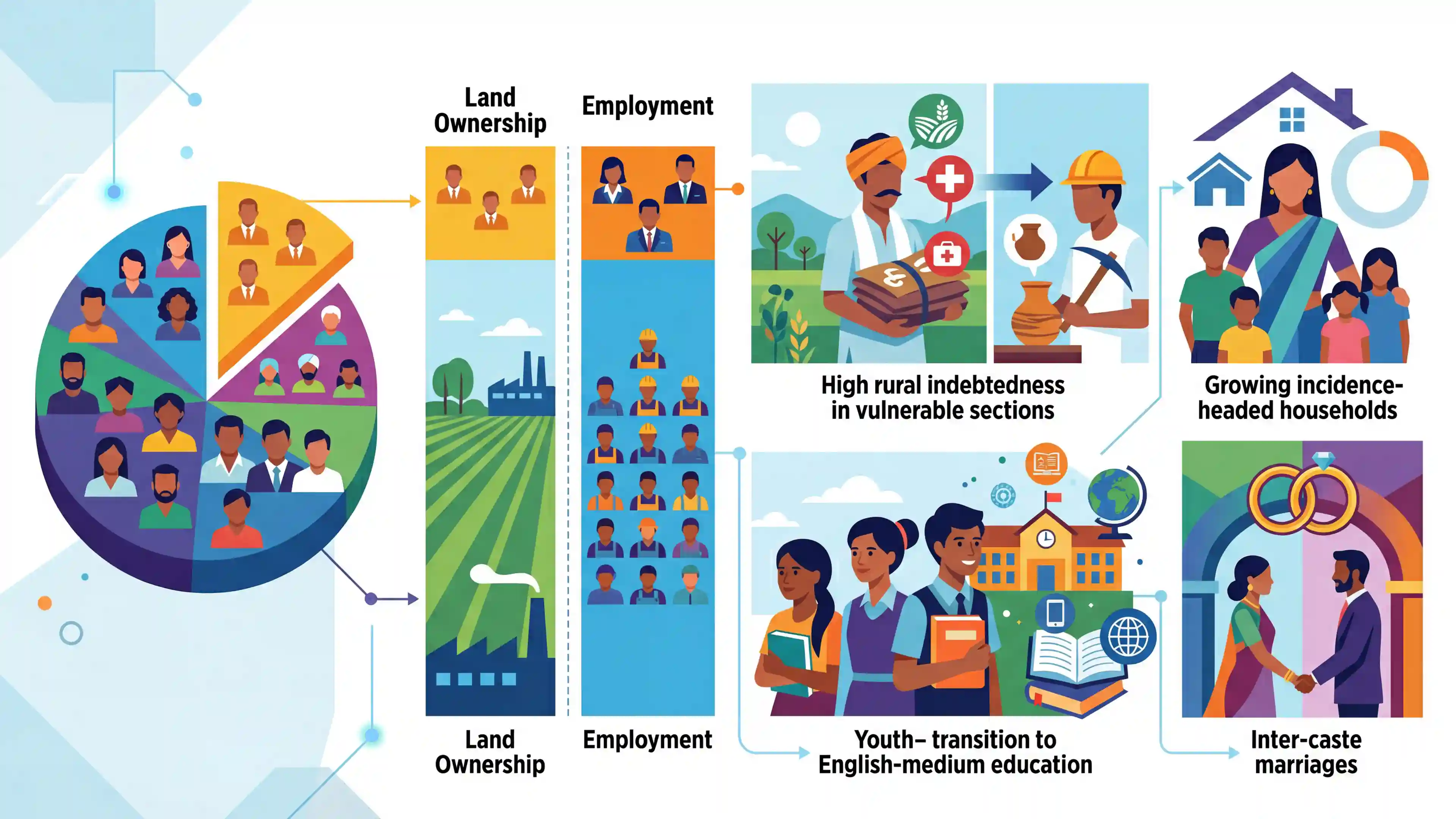
The 2024 Socio, Economic, Educational, Employment, Political and Caste (SEEEPC) survey of Telangana provides critical insights into the state's demographics and inequalities. It reveals that Backward Classes, SCs, and STs together comprise 74.1% of the population, yet face significant economic backwardness compared to the 13.3% Other Castes (OC) who dominate land ownership and employment. The survey highlights key socio-economic trends: high rural indebtedness (largely for agriculture and health), a shift away from traditional occupations towards wage labor, a major transition to English-medium education among the youth, and the growing incidence of female-headed households (25.1%) and inter-caste marriages.
Key Points
- Backward Classes (BCs) form 46.3% of Telangana's population, with SCs at 17.4% and STs at 10.4%.
- Despite making up only 13.3% of the population, the Other Castes (OC) category holds a disproportionate share of wealth, private sector jobs, and land (31.5% ownership).
- There is a significant structural shift in the rural economy, with 64.4% of rural residents no longer practicing traditional occupations.
- 44.4% of households report outstanding loans, driven primarily by agricultural and medical expenses, highlighting economic vulnerability.
- 25.1% of households are headed by women, underscoring a demographic shift towards greater female roles in financial decision-making.
- A generational educational shift has occurred, with 60.5% of individuals aged 6-29 receiving English-medium instruction due to schemes like Mana Vooru Mana Badi.
Important Terms
SEEEPC Survey

A 2024 comprehensive census-like exercise in Telangana to collect socio-economic data across 242 castes, aimed at informing evidence-based affirmative action and targeted welfare policies.
UPSC context
GS Paper II: Social Justice; relevant for debates on caste-based census, reservation quotas, and data-driven governance.
Independent Expert Working Group
A high-level technical body, chaired by Justice B. Sudershan Reddy, tasked with analyzing the SEEEPC data to scientifically determine the relative backwardness of various communities.
UPSC context
GS Paper II: Governance; tests knowledge of expert committees in policy-making and the legal-administrative framework for reservations.
Composite Backwardness Index (CBI)
A metric developed by the IEWG using 42 parameters—including land ownership and living conditions—to quantify deprivation levels across castes rather than relying solely on population share.
UPSC context
GS Paper II: Social Justice; important for understanding scientific tools used to identify 'creamy layer' or sub-categorize backward classes.
Mana Vooru Mana Badi
A Telangana flagship scheme ('Our Village, Our School') focused on upgrading government school infrastructure and introducing English-medium instruction to improve educational equity for rural students.
UPSC context
GS Paper II: Social Sector (Education); relevant for state-led interventions to bridge the digital and linguistic divide.
Female-headed Households
A demographic trend highlighted in the survey where 25.1% of households are managed by women, indicating shifts in rural financial decision-making and the need for gender-sensitive welfare.
UPSC context
GS Paper I: Social Issues; relates to women's empowerment, feminization of agriculture, and changing family structures.
Prelims Trap
"State governments have the constitutional authority to conduct a Caste Census under the Census Act."
Only the Union government can conduct a "Census" (Entry 69, Union List). States conduct "socio-economic surveys" using their executive powers, not under the Census Act of 1948.
Static Concepts Connected
What are the Constitutional provisions backing socio-economic data collection for backward classes?
- Article 340: Empowers the President to appoint a commission to investigate the conditions of socially and educationally backward classes.
- Article 16(4): Permits the State to make provisions for the reservation of appointments if backward classes are not adequately represented, requiring empirical data to justify such quotas.
- Seventh Schedule: Places 'Census' exclusively under Entry 69 of the Union List, meaning only Parliament can legislate on formal census exercises.
What drives the 'feminization' of rural poverty and agriculture?
- Male Out-migration: Men migrate to urban centers or abroad (e.g., Gulf countries) for better wages, leaving women as the primary heads of rural households.
- Lack of Land Titles: Women perform most agricultural labor but rarely hold land titles, restricting their access to institutional credit and government subsidies.
- Wage Disparity: Female casual laborers consistently receive significantly lower daily wages compared to male counterparts for similar manual work.
Cross-Topic Patterns
Caste data and SC sub-categorization
Telangana's empirical data on economic disparities within marginalized groups provides the exact evidence base required by the recent Supreme Court ruling permitting sub-classification of Scheduled Castes.
OOPE driving rural debt traps
The survey links rural loans directly to medical expenses, reinforcing the Economic Survey's persistent concern over high Out-of-Pocket Expenditure (OOPE) pushing vulnerable families back into poverty.

Expect a Prelims question distinguishing a Union 'Census' (Entry 69) from state 'Socio-Economic Surveys' alongside Article 340 provisions.
Linked PYQs · 5
Linked PYQs · 5
- 2022MainsGS2
Discuss the role of the National Commission for Backward Classes in the wake of its transformation from a statutory body to a constitutional body.
- 2024MainsGS1
Intercaste marriages between castes which have socio-economic parity have increased, to some extent, but this is less true of interreligious marriages. Discuss.
- 2023MainsGS3
State the objectives and measures of land reforms in India. Discuss how land ceiling policy on landholding can be considered as an effective reform under economic criteria.
- 2016MainsGS3
Discuss the role of land reforms in agricultural development. Identify the factors that were responsible for the success of land reforms in India.
- 2021MainsGS2
Has digital illiteracy, particularly in rural areas, coupled with lack of Information and Communication Technology (ICT) accessibility hindered socio-economic development? Examine with justification.
