BSF Operation Sindoor and border security vigil in Jammu sector
Source:Indian Express ↗
Why It Matters
Understanding the operational strategies of border guarding forces like the BSF and specific initiatives like 'Operation Sindoor' is crucial for GS Paper 3 (Internal Security). It highlights the practical challenges of border management, particularly the contemporary threat of drone-assisted smuggling of narcotics and weapons along the India-Pakistan border.
Summary
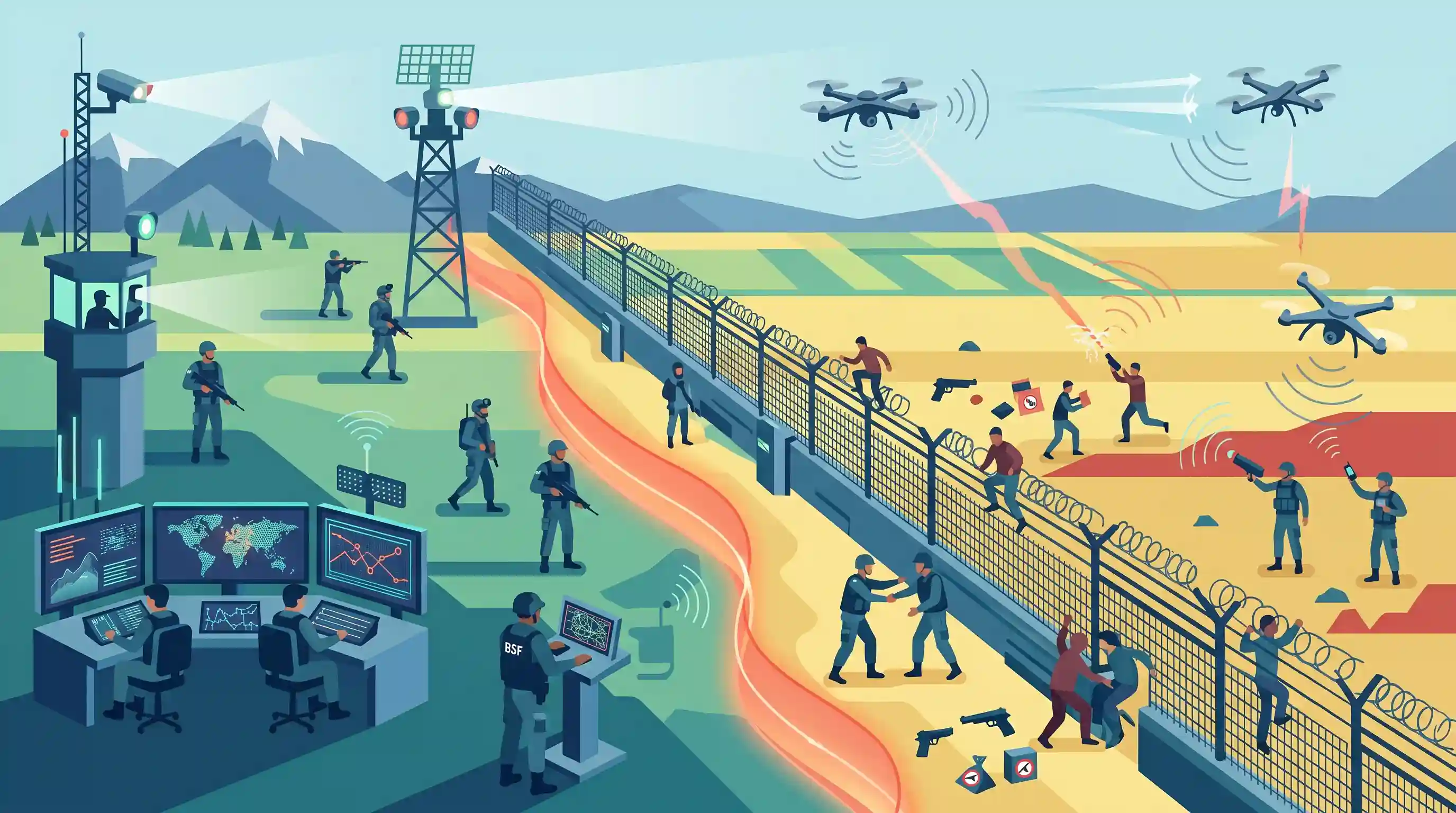
The Border Security Force (BSF) is maintaining maximum vigilance along the International Border in the Jammu region under the ongoing 'Operation Sindoor'. According to BSF IG Shashank Anand, the operation is geared towards neutralizing threats such as cross-border infiltration and the smuggling of arms and narcotics. A major focus is on countering the emerging challenge of drone-based droppings from across the border, utilizing advanced surveillance and robust troop deployment to ensure zero infiltration.
Key Points
- The Border Security Force (BSF) has intensified its security grid and is maintaining the highest possible vigil along the International Border in Jammu.
- This heightened state of alert is being maintained under 'Operation Sindoor', an ongoing initiative to secure the border against infiltration and smuggling.
- Security forces are actively countering multi-dimensional threats, including the cross-border smuggling of narcotics, arms, and ammunition, frequently facilitated by drones.
- The operation involves coordinated efforts, advanced surveillance, and robust troop deployment to thwart any adversarial designs from across the border.
Important Terms
Operation Sindoor

A 2025 counter-terror operation launched after the Pahalgam attack to dismantle terror launchpads and infrastructure across the border while maintaining high vigilance against infiltration.
UPSC context
GS Paper 3: Internal Security; tests knowledge of specific security operations and evolving counter-terrorism doctrines.
Border Security Force (BSF)
A Central Armed Police Force established in 1965, mandated to guard India's International Borders with Pakistan and Bangladesh during peacetime.
UPSC context
GS Paper 3: Security Forces and their mandate; essential for understanding border management and internal security architecture.
International Border (IB)
The internationally recognized legal boundary between sovereign states; in Jammu, the BSF guards this stretch, which is distinct from the disputed Line of Control.
UPSC context
GS Paper 3: Border Management; tests the ability to distinguish between different types of territorial boundaries.
Narco-Terrorism
The cross-border nexus where narcotics smuggling is used to fund and sustain terrorist activities, posing a complex internal security challenge.
UPSC context
GS Paper 3: Linkages of organized crime with terrorism; a critical theme for internal security and drug policy.
Anti-Drone Technology
Specialized surveillance and neutralization systems (like jammers and sensors) deployed to counter rogue drones used for smuggling arms and drugs across borders.
UPSC context
GS Paper 3: Science and Tech in Security; tests understanding of technological solutions to asymmetric security threats.
Line of Control (LoC)
The de facto military control line in Jammu and Kashmir established by the 1972 Simla Agreement, separating Indian and Pakistani administered territories.
UPSC context
GS Paper 3: Border Management; central to understanding Indo-Pak relations and conflict zones.
Prelims Trap
"Operation Sindoor is an Indian Army initiative deployed along the Line of Control (LoC)."
Operation Sindoor is conducted by the Border Security Force (BSF) along the International Border (IB) in Jammu, not by the Indian Army on the LoC.
Static Concepts Connected
Which forces guard India's land borders under the 'One Border One Force' principle?
- BSF & ITBP: BSF guards the Pakistan and Bangladesh borders; ITBP secures the high-altitude China border (LAC).
- SSB & Assam Rifles: Sashastra Seema Bal (SSB) manages Nepal and Bhutan borders; Assam Rifles guards the Myanmar border.
How does the Comprehensive Integrated Border Management System (CIBMS) enhance security?
- Sensor Networks: Deploys thermal imagers, underground sensors, radar, and fiber-optic alarms to detect physical and low-level aerial intrusions.
- Command & Control: Integrates real-time sensor data into a unified command architecture, allowing for rapid troop deployment and counter-measures.
Cross-Topic Patterns
Narcoterrorism + Golden Crescent
Drone-dropped narcotics across the IB in Jammu and Punjab highlight the strategic weaponization of the Golden Crescent drug trade to fund domestic terror networks.
Tech integration + Border Management
The shift from physical fencing to anti-drone grids (like BSF's new drone squadron) reflects the changing nature of asymmetric warfare and border management.

Expect a 2026 prelims statement testing CAPF mandates (BSF vs Army on IB/LoC) paired with anti-drone technology on western borders.
Linked PYQs · 3
Linked PYQs · 3
- 2020MainsGS3
Analyze internal security threats and transborder crimes along Myanmar, Bangladesh and Pakistan borders including Line of Control (LoC). Also discuss the role played by various security forces in this regard.
- 2023MainsGS3
The use of unmanned aerial vehicles (UAVs) by our adversaries across the borders to ferry arms/ammunitions, drugs, etc., is a serious threat to the internal security. Comment on the measures being taken to tackle this threat.
- 2023PrelimsGS1
With reference to Home Guards, consider the following statements: 1. Home Guards are raised under the Home Guards Act and Rules of the Central Government. 2. The role of the Home Guards is to serve as an auxiliary force to the police in maintenance of internal security. 3. To prevent infiltration on the international border/coastal areas, the Border Wing Home Guards Battalions have been raised in some States. How many of the above statements are correct?
