Top Maoist Leader Devuji Surrender in Telangana
Source:Indian Express ↗
Why It Matters
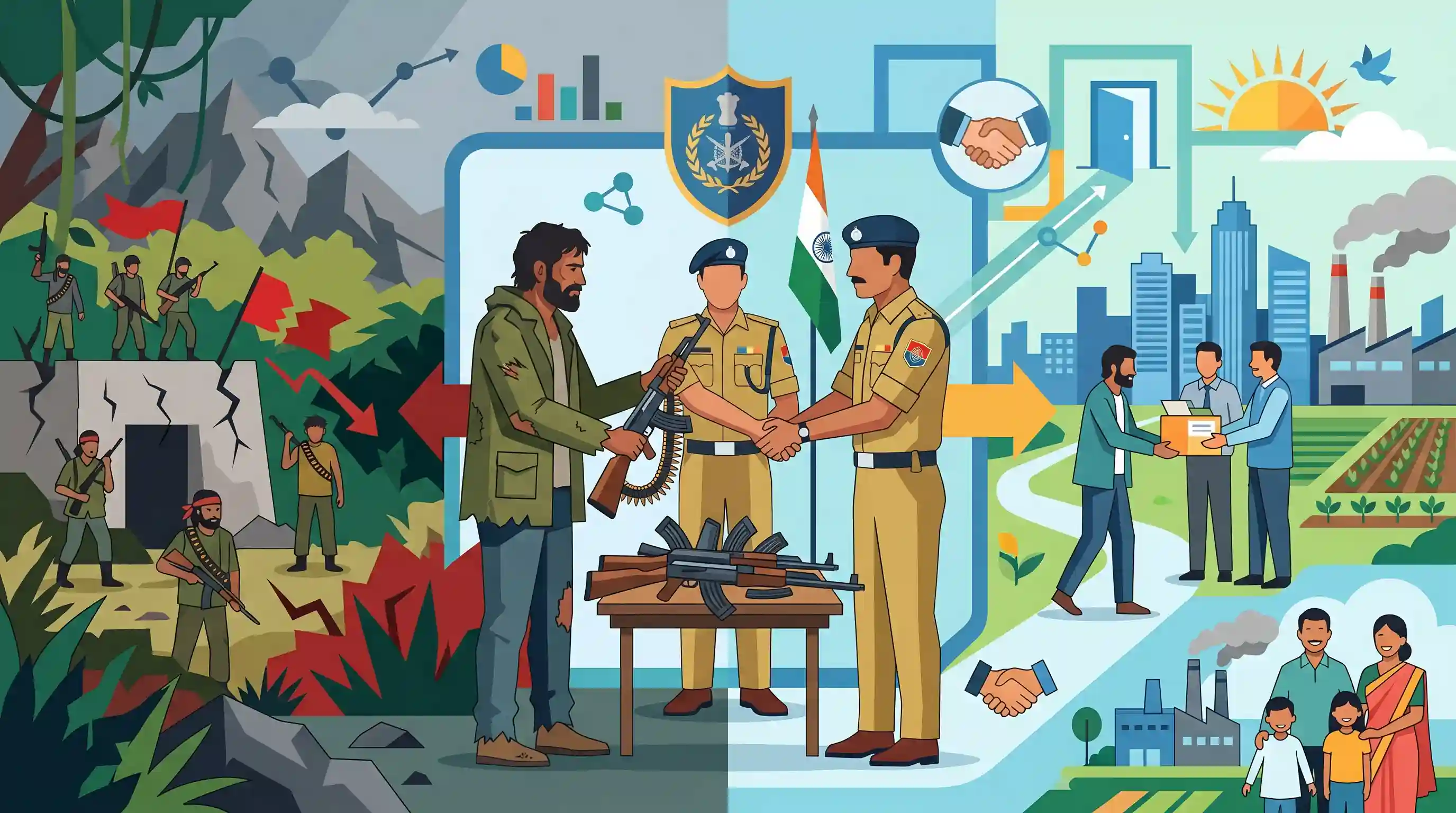
Left Wing Extremism remains a critical internal security challenge for India. The surrender of a top-tier guerrilla leader provides crucial insights into the weakening of the Maoist command structure and highlights the importance of surrender and rehabilitation policies as a non-kinetic tool to dismantle insurgencies.
Summary
Thippiri Tirupathi, alias Devuji, recognized as the highest-ranking Maoist leader to ever surrender, recently laid down his arms in Telangana. Known for establishing a significant Maoist guerrilla force, his surrender represents a major victory for security forces and a severe blow to the operational capabilities and morale of the Left Wing Extremism (LWE) movement. This high-profile defection underscores the effectiveness of India\'s current counter-insurgency strategies, particularly the appeal of state surrender and rehabilitation policies designed to integrate extremists back into the mainstream.
Key Points
- Thippiri Tirupathi, alias Devuji, recognized as the highest-ranking Maoist leader to surrender in the history of the insurgency, has laid down his arms in Telangana.
- He was a key figure responsible for setting up and directing a significant Maoist guerrilla force.
- His surrender is considered a severe operational and psychological blow to the Left Wing Extremism (LWE) movement.
- The event underscores the success of the state\'s multi-pronged counter-insurgency approach, particularly its surrender and rehabilitation policies aimed at mainstreaming extremists.
Important Terms
Left Wing Extremism (LWE)

Armed insurgency by Maoist/Naxalite groups aiming to overthrow the Indian state through violent revolution, primarily fueled by socio-economic grievances in tribal regions.
UPSC context
GS Paper 3 (Internal Security); tests knowledge of developmental challenges and the role of non-state actors in domestic instability.
CPI (Maoist)
A banned far-left militant organization formed in 2004; it is the primary entity leading the Maoist insurgency and is designated under the UAPA.
UPSC context
GS Paper 3; fundamental to identifying the organizational structure and ideological roots of India's internal security threats.
People's Liberation Guerrilla Army (PLGA)
The armed wing of the CPI (Maoist) that employs guerrilla tactics, such as ambushes and sabotage, to challenge state authority in forested terrains.
UPSC context
GS Paper 3 (Security); tests awareness of insurgent military capabilities and the nature of jungle warfare.
Surrender and Rehabilitation Policy
A multi-pronged policy offering financial aid, vocational training, and legal leniency to encourage extremists to abandon violence and reintegrate into society.
UPSC context
GS Paper 3 (Internal Security); evaluates soft-power strategies and non-kinetic measures used to dismantle extremist networks.
Central Committee (Maoist)
The highest decision-making body of the CPI (Maoist), responsible for steering political ideology and military operations across the country.
UPSC context
GS Paper 3; critical for analyzing leadership crises and the impact of top-tier surrenders on movement morale.
SAMADHAN Doctrine
India's comprehensive counter-insurgency framework for LWE, integrating Smart leadership, Aggressive strategy, Motivation, Actionable intelligence, Dashboard results, Harnessing technology, and ending finance.
UPSC context
GS Paper 3 (Security Policy); essential for discussing current government initiatives to eliminate Naxalism by 2026.
Prelims Trap
The Surrender and Rehabilitation scheme for Naxals is exclusively funded by State Governments.
While S&R policies are implemented by state police, the Central Government reimburses the expenditure incurred on surrendered LWE cadres under the Security Related Expenditure (SRE) Scheme.
Static Concepts Connected
What are the key specialized Anti-Naxal forces at the State and Central levels?
- Central Level: CoBRA (Commando Battalion for Resolute Action), a specialized unit of the CRPF designed for jungle/guerrilla warfare.
- Telangana/AP: Greyhounds, an elite anti-Naxalite commando force known for intelligence-led tactical hits in the region.
- Chhattisgarh: District Reserve Guard (DRG), raised primarily from local tribal youth to leverage local intelligence and terrain familiarity.
What are the core elements of the Central Govt's Surrender-cum-Rehabilitation policy for LWE cadres?
- Immediate Grant: A substantial immediate grant is provided to the surrendered cadre, with higher amounts for top-ranking leaders.
- Monthly Stipend: A monthly stipend is given for up to 3 years while the individual undergoes vocational training for mainstreaming.
- Weapon Incentives: Additional, fixed cash incentives are provided for surrendering specific firearms, ammunition, and communication equipment (e.g., AK-47s, LMGs).
Cross-Topic Patterns
LWE & Aspirational Districts Programme
Security successes are deeply tied to the Aspirational Districts Programme (GS2), which targets infrastructural and developmental deficits in the rapidly shrinking 'Red Corridor'.
Land Reforms & Extremism Roots
Offering agricultural land as a surrender incentive directly tackles the historical root cause of Naxalism (GS1/GS3)—land alienation and deprivation among tribal populations.

With the Govt's March 2026 LWE elimination deadline, expect Mains GS3 to test the evolution from 'protracted war' to SAMADHAN doctrine.
Linked PYQs · 3
Linked PYQs · 3
- 2022MainsGS3
Naxalism is a social, economic and developmental issue manifesting as a violent internal security threat. In this context, discuss the emerging issues and suggest a multilayered strategy to tackle the menace of Naxalism.
- 2018MainsGS3
Left Wing Extremism (LWE) is showing a downward trend, but still affects many parts of the country. Briefly explain the Government of India's approach to counter the challenges posed by LWE.
- 2025MainsGS3
The Government of India recently stated that Left Wing Extremism (LWE) will be eliminated by 2026. What do you understand by LWE and how are the people affected by it? What measures have been taken by the government to eliminate LWE?
