Record FPI Outflows and Macroeconomic Challenges in Indian Markets
Source:The Hindu ↗
Why It Matters
This article provides a critical, holistic assessment of India's current economic health, linking capital market volatility (FPI outflows) directly to broader macroeconomic realities (private capex, household savings, and FDI). It is highly relevant for GS-3 answers on economic growth paradigms, the middle-income trap, and the challenges of attracting foreign investment.
Summary
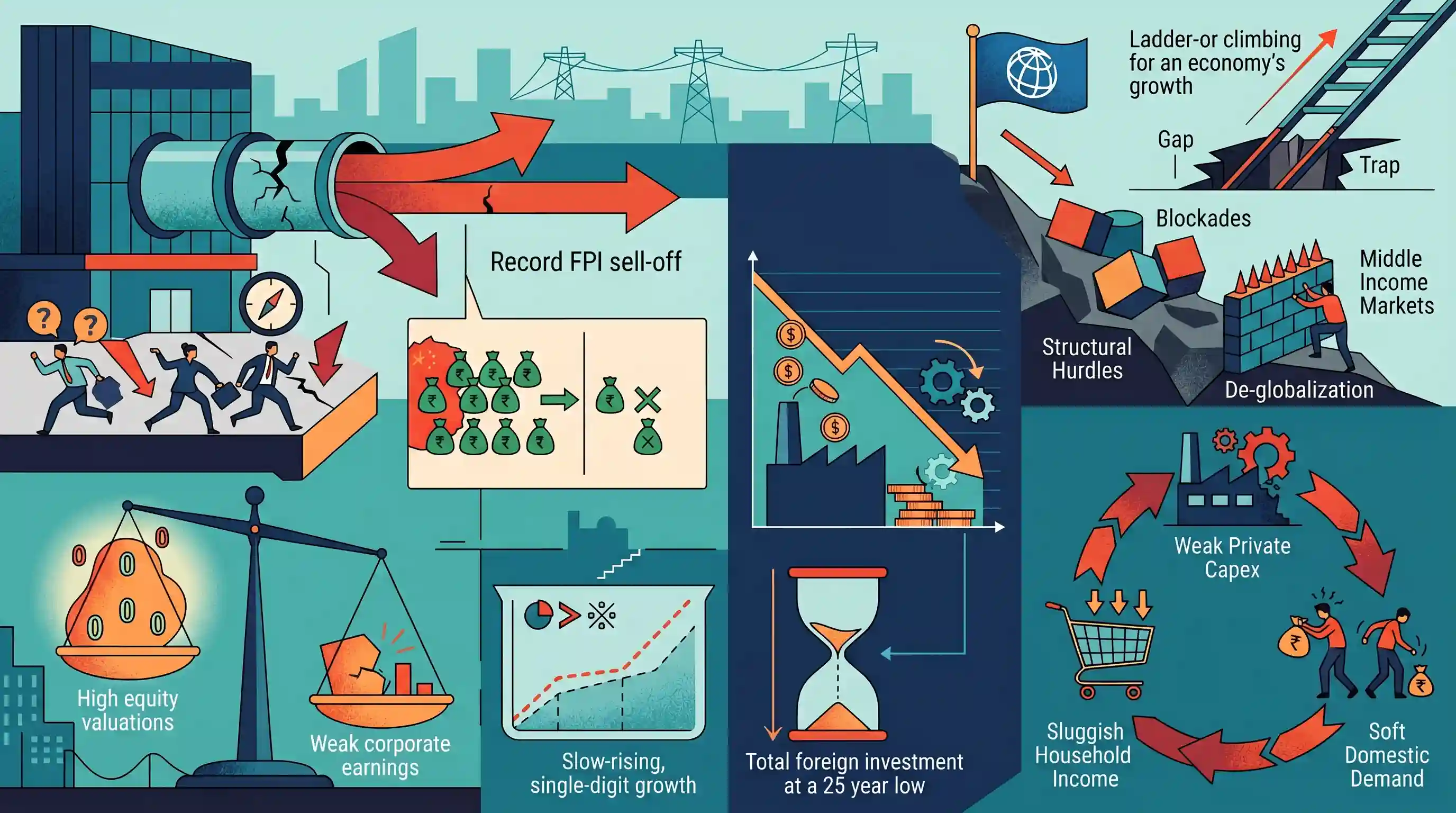
A record Foreign Portfolio Investment (FPI) sell-off of ₹1.5 lakh crore underscores waning global investor confidence in the Indian economy. The initial capital surge driven by an exodus from Chinese markets has faded, exposing structural concerns: high equity valuations unbacked by strong corporate earnings, and single-digit nominal GDP growth. Compounding this, Foreign Direct Investment (FDI) has steadily declined, dragging total foreign investment to a 25-year low. Domestically, the economy is struggling with an interrelated cycle of weak private capital expenditure, sluggish household income growth, and soft domestic demand. Furthermore, the World Bank warns of the "Middle Income Trap," suggesting that developing economies like India face significant structural and de-globalization hurdles that could derail long-term growth.
Key Points
- Foreign portfolio investors (FPIs) pulled out a record ₹1.5 lakh crore by late 2025, signaling fading benefits from the "China Plus One" reallocation strategy.
- Indian market valuations remain expensive (high Price-to-Earnings ratios) despite tepid corporate profitability and single-digit nominal GDP growth.
- Total foreign investment fell to a 25-year low in FY25, alongside a persistent slowdown in long-term Foreign Direct Investment (FDI).
- Domestic structural challenges persist, including elusive private capital expenditure and slowing household incomes, which constrain private demand and credit growth.
- The World Bank's World Development Report 2024 highlights the threat of the "Middle Income Trap," warning that structural roadblocks and global de-globalization could stall India's trajectory to high-income status.
Important Terms
Foreign Portfolio Investment (FPI)

Investment by non-residents in Indian financial assets like shares and bonds. Unlike FDI, it involves no management control and is often volatile ('hot money'), sensitive to global interest rate shifts.
UPSC context
GS Paper III: Capital Markets. Tests understanding of external sector stability and the impact of capital outflows on the Rupee.
Foreign Direct Investment (FDI)
Long-term capital investment by a foreign entity into an Indian business, typically involving a stake of 10% or more and management control, aimed at building productive capacity.
UPSC context
GS Paper III: Investment Models. Crucial for questions on long-term growth, technology transfer, and 'Ease of Doing Business.'
Middle Income Trap
An economic stage where a country reaches middle-income status but stagnates, unable to compete with low-wage producers or transition to high-value, innovation-led growth.
UPSC context
GS Paper III: Growth and Development. Relevant for analyzing India's long-term structural hurdles and transition to a developed economy.
World Development Report 2024
The 2024 edition of the World Bank's flagship report, specifically titled 'The Middle-Income Trap,' which outlines strategies (Investment, Infusion, Innovation) for developing nations to reach high-income status.
UPSC context
GS Paper III: International Institutions. A key reference for Mains answers regarding global economic trends and developmental roadblocks.
Nominal GDP
The total value of all goods and services produced within a country at current market prices, without adjusting for the effects of inflation.
UPSC context
GS Paper III: National Income. Important for understanding the 'real' vs 'nominal' growth gap and its implications for debt sustainability.
Capital Expenditure (Capex)
Funds used by the government or private sector to acquire, maintain, or improve physical assets like infrastructure and machinery to increase future productive capacity.
UPSC context
GS Paper III: Indian Economy and Budgeting. Tests knowledge of the 'multiplier effect' and the drivers of private investment.
Prelims Trap
"Record FPI sell-offs will directly reduce India's Gross Fixed Capital Formation and technology transfer."
FPI is short-term 'hot money' in financial assets. It is FDI, not FPI, that contributes directly to physical capital formation (GFCF) and brings technology transfers.
Static Concepts Connected
What distinguishes Foreign Direct Investment (FDI) from Foreign Portfolio Investment (FPI)?
- Nature of Investment: FDI builds physical assets and brings technology; FPI is purely financial investment in stocks and bonds (often termed 'hot money').
- Management Control: FDI usually entails an equity stake greater than 10% with management voting rights; FPI involves less than a 10% stake with no control.
- Liquidity & Volatility: FPI is highly volatile and easily liquidated during market panics; FDI is a long-term commitment that is much harder to liquidate.
What is the "Middle Income Trap" in development economics?
- Core Definition: A situation where a developing economy rapidly reaches middle-income levels but then stagnates, failing to transition into a high-income, advanced economy.
- Primary Cause: It occurs when an economy loses its competitive advantage in low-wage manufacturing before it acquires the capacity for high-value technological innovation.
- World Bank Solution: The World Bank (WDR 2024) prescribes a '3i' strategy to escape it: foundational Investment, Infusion of global technologies, and domestic Innovation.
Cross-Topic Patterns
FPI flight + Rupee Depreciation
Massive FPI pullouts drain forex reserves, putting depreciating pressure on the Rupee. This forces RBI intervention, impacts bond yields, and increases imported inflation risks.
China Plus One + PLI Schemes
The fading "China Plus One" capital surge highlights that geopolitical positioning and PLI schemes cannot succeed without resolving domestic structural bottlenecks like weak private capex and sluggish demand.

Expect a 2026 Prelims question linking the 'Middle Income Trap' (World Development Report) with India's FDI/FPI trends and demographics.
Linked PYQs · 5
Linked PYQs · 5
- 2016MainsGS3
Justify the need for FDI for the development of the Indian economy. Why there is gap between MOUs signed and actual FDIs? Suggest remedial steps to be taken for increasing actual FDIs in India.
- 2020MainsGS3
Define potential GDP and explain its determinants. What are the factors that have been inhibiting India from realizing its potential GDP?
- 2017MainsGS3
Among several factors for India's potential growth, savings rate is the most effective one. Do you agree? What are the other factors available for growth potential?
- 2020MainsGS3
Explain the meaning of investment in an economy in terms of capital formation. Discuss the factors to be considered while designing a concession agreement between a public entity and a private entity.
- 2021PrelimsGS1
Consider the following : 1. Foreign currency convertible bonds 2. Foreign institutional investment with certain conditions 3. Global depository receipts 4. Non-resident external deposits Which of the above can be included in Foreign Direct Investments?
