EPFO Higher Pension Liability and Fiscal Impact on Social Security
Source:The Hindu ↗
Why It Matters
The case illustrates the massive fiscal liabilities associated with judicial mandates on social security schemes, offering vital lessons for public expenditure and inclusive growth in GS3.
Summary
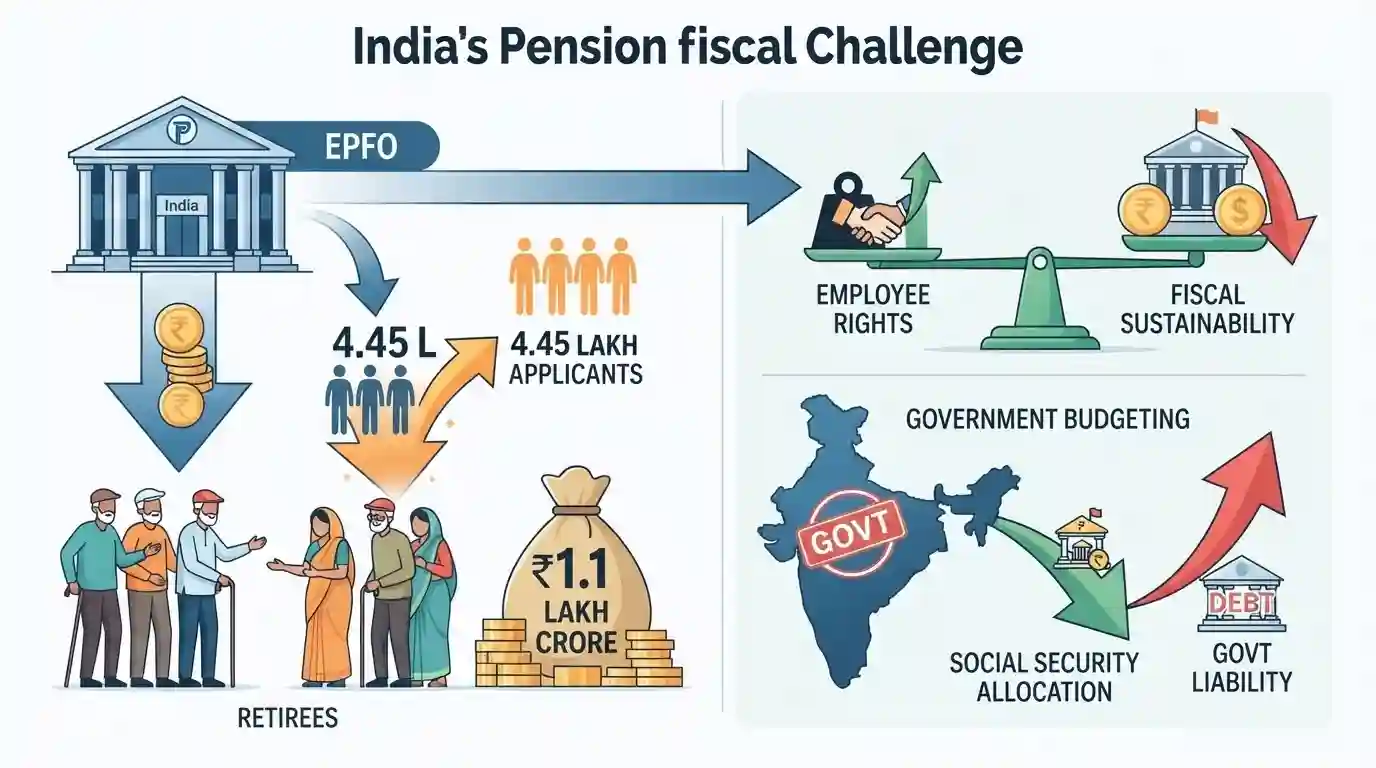
The Employees Provident Fund Organisation (EPFO) faces a substantial financial burden estimated at ₹1.1 lakh crore to disburse higher pensions to 4.45 lakh applicants who opted for higher pension options following judicial directives. This fiscal challenge underscores critical issues in India's social security architecture, balancing employee rights with long-term fiscal sustainability.
Key Points
- Providing higher pensions to 4.45 lakh eligible applicants under the Employees Provident Fund Organisation (EPFO) could cost approximately ₹1.1 lakh crore.
- The high financial implication highlights structural challenges in managing long-term social security and pension liabilities in India.
- Balances fiscal prudence against statutory obligations for inclusive growth and social welfare.
Important Terms
Employees Provident Fund Organisation (EPFO)

A premier statutory social security body in India under the Ministry of Labour and Employment that administers provident fund, pension, and insurance schemes for the formal workforce.
UPSC context
UPSC Mains GS Paper II (Governance/Social Security) and Prelims; tests knowledge of statutory bodies, labour administration, and social security frameworks.
Employees Provident Fund and Miscellaneous Provisions Act
A foundational 1952 Indian labour legislation that mandates the establishment of provident funds, pension schemes, and insurance for employees in specified establishments across the country.
UPSC context
UPSC Mains GS Paper II & III (Social Security, Inclusive Growth, Labour Laws); tests understanding of statutory welfare architectures in India.
Static Concepts Connected
What are the core financing mechanisms and contribution structures of the Employees' Pension Scheme (EPS) 1995?
- Employer Contribution: Employer share: Employers contribute 8.33% of the employee's monthly salary towards the EPS, routed from the total 12% EPF contribution.
- Central Subsidy: Government subsidy: The Central Government contributes a subsidy of 1.16% of wages up to the statutory wage ceiling (currently ₹15,000 per month).
- Scheme Nature: Defined benefit: EPS-95 is a defined-benefit, social security scheme managed by the EPFO, providing superannuation, retirement, disability, and widow pensions.
Cross-Topic Patterns
Judiciary vs. Actuarial Deficits in Social Security
Judicial rulings expanding welfare benefits frequently collide with actuarial deficits in statutory funds, testing executive fiscal federalism and budgetary allocations.

EPS 1995 higher pension liabilities vs. government budgetary support will feature in fiscal deficit and social security prelim statements.
Linked PYQs · 3
Linked PYQs · 3
- 2024MainsGS3
Examine the pattern and trend of public expenditure on social services in the post-reforms period in India. To what extent this has been in consonance with achieving the objective of inclusive growth?
- 2024PrelimsGS1
With reference to the Pradhan Mantri Shram Yogi Maan-dhan (PM-SYM) Yojana, consider the following statements : 1. The entry age group for enrolment in the scheme is 21 to 40 years. 2. Age specific contribution shall be made by the beneficiary. 3. Each subscriber under the scheme shall receive a minimum pension of ₹ 3,000 per month after attaining the age of 60 years. 4. Family pension is applicable to the spouse and unmarried daughters. Which of the statements given above is/are correct?
- 2021PrelimsGS1
With reference to casual workers employed in India, consider the following statements : 1. All casual workers are entitled for Employees Provident Fund coverage. 2. All casual workers are entitled for regular working hours and overtime payment. 3. The government can by a notification specify that an establishment or industry shall pay wages only through its bank account. Which of the above statements are correct?
