Excise Duty Exemption on High Ethanol Blends Supports Biofuel Policy
Source:The Hindu ↗
Why It Matters
Understanding the taxation friction between the GST regime and the legacy excise duty system is crucial for evaluating India's energy transition policies, specifically how fiscal tools are used to promote the Ethanol Blended Petrol (EBP) programme and address energy security.
Summary
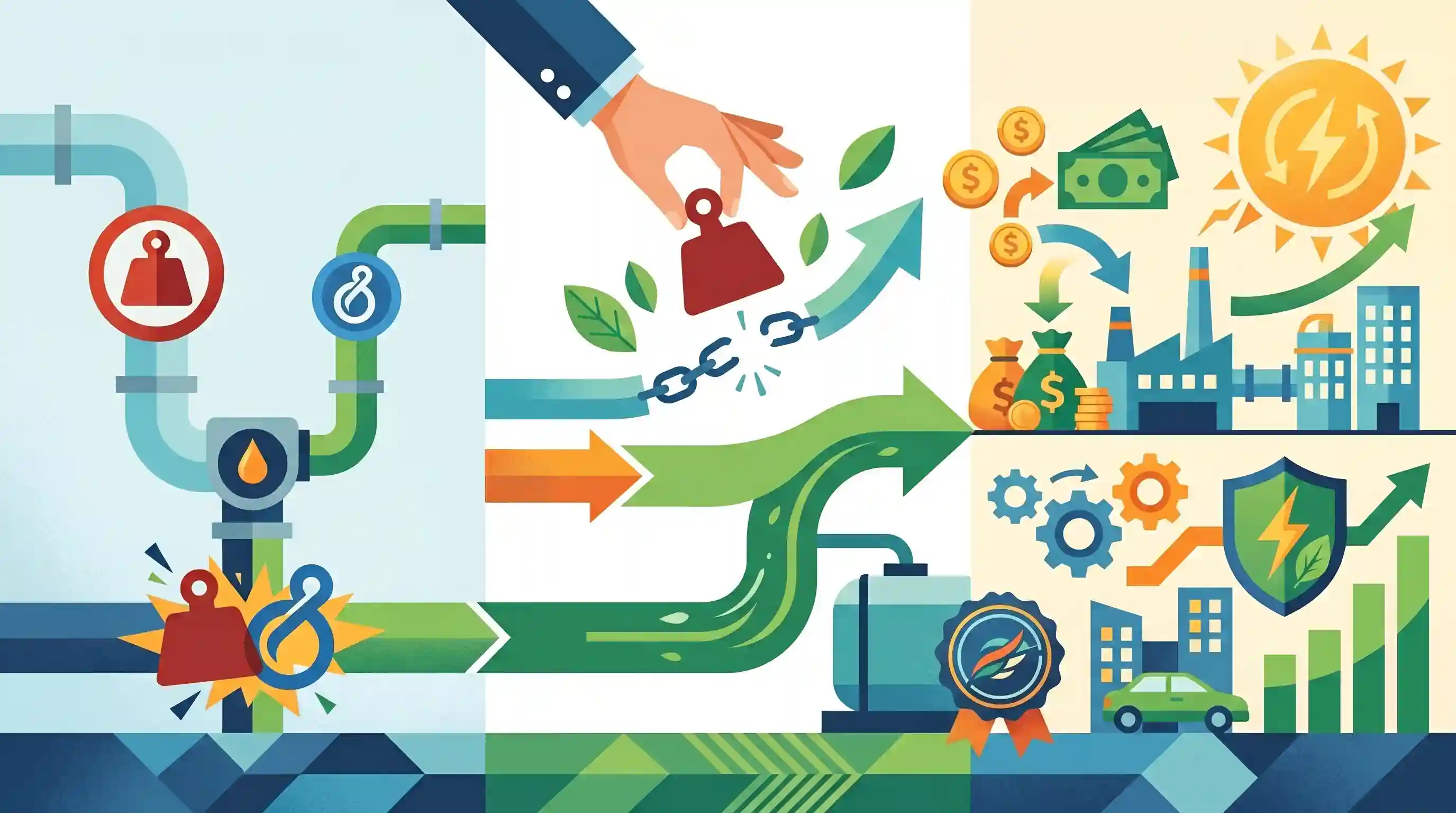
To prevent double taxation and encourage the uptake of biofuels, the Finance Ministry has exempted higher ethanol blended petrol (containing 22% to 30% ethanol) from central excise duty. Currently, petrol is subject to central excise duty while ethanol falls under the Goods and Services Tax (GST) regime, creating a dual levy scenario for blended fuels. The exemption, which builds upon the existing relief for E-20 (20% blended petrol), provides policy certainty for investments in the ethanol value chain and supports the transition towards higher blends like E85, for which the Bureau of Indian Standards (BIS) has already released specifications.
Key Points
- The Finance Ministry has exempted petrol blended with 22-30% ethanol from central excise duty to prevent double taxation, as petrol incurs excise duty while ethanol is taxed under GST.
- This move provides policy stability for investments across the ethanol value chain, encouraging sugar mills and distilleries to scale up production.
- The exemption covers E-20 to E-85 variants, promoting a higher uptake of biofuels in alignment with India's energy transition goals.
- The Bureau of Indian Standards (BIS) has already issued specifications for high-ethanol blends like E85 and E100 to standardise fuel quality.
Important Terms
Ethanol Blended Petrol (EBP) Programme

A policy initiative launched to blend ethanol with petrol, aiming to enhance energy security, reduce crude oil imports, and lower vehicular carbon emissions.
UPSC context
GS Paper III (Energy/Environment); covers Atmanirbhar Bharat and India's Net Zero 2070 climate commitments.
Central Board of Indirect Taxes and Customs (CBIC)
A statutory body under the Ministry of Finance responsible for formulating and administering policies related to Customs, Central Excise, and the Goods and Services Tax (GST).
UPSC context
GS Paper II (Statutory Bodies); tests executive oversight in indirect taxation and regulatory policy.
Bureau of Indian Standards (BIS)
India's National Standards Body responsible for the development of quality specifications and certification, such as the IS 19850 standards for higher ethanol fuel blends.
UPSC context
GS Paper II/III; highlights the role of technical standards in enabling the transition to sustainable biofuels.
Central Excise Act
The primary legislation governing the levy of duties on goods manufactured within India; blending ethanol is technically treated as 'manufacturing' under this Act.
UPSC context
GS Paper III (Economy); tests knowledge of tax structures and the prevention of dual taxation on processed fuels.
Goods and Services Tax (GST)
A comprehensive, destination-based indirect tax that applies to ethanol (at 5%), whereas petrol remains under the older central excise and state VAT regimes.
UPSC context
GS Paper III (Economy); essential for understanding the tax disparity between biofuels and conventional fossil fuels.
Finance Ministry
The nodal ministry responsible for India's fiscal policy, government spending, and the administration of the Department of Revenue, which issued the excise exemptions.
UPSC context
GS Paper II (Executive); tests understanding of the institutional framework for India's economic and fiscal governance.
Prelims Trap
"Ethanol is excluded from the GST regime alongside petrol to maintain uniform taxation."
Ethanol is actually taxed under GST (at 5%), while petrol is outside GST (attracting Central Excise and State VAT). This difference creates the 'dual levy'.
Static Concepts Connected
Which specific petroleum products are currently kept outside the GST framework?
- The "Big Five": Crude oil, Natural Gas, Aviation Turbine Fuel (ATF), High-Speed Diesel, and Petrol (Motor Spirit).
- Applicable Taxes: These specific products attract Central Excise Duty levied by the Centre and Value Added Tax (VAT) levied by States.
- Constitutional Provision: Article 279A empowers the GST Council to decide the specific date from which these products will be brought under the GST regime.
What are the generations of biofuels based on their feedstocks?
- First Gen (1G): Produced directly from food crops grown on arable land, such as sugarcane juice, molasses, corn, and surplus rice.
- Second Gen (2G): Derived from non-food biomass, agricultural waste, and lignocellulosic materials (e.g., rice stubble, wheat straw), resolving the food-vs-fuel debate.
- 3G and 4G: 3G uses specially engineered algal biomass. 4G uses genetically engineered crops/algae optimized for high yield alongside carbon capture and storage (CCS).
Cross-Topic Patterns
Ethanol Push vs Food Security Debate
Diverting surplus grains and sugarcane to distilleries sparks a classic GS-3 debate between achieving energy security and risking food inflation/water stress.
Flex-Fuel Vehicles + Auto PLI Scheme
Adopting higher ethanol blends (E85) requires Flex-Fuel Vehicles (FFVs). This links environmental targets directly to engine manufacturing upgrades under the Automobile PLI scheme.

Expect a multi-statement 2026 Prelims question mixing GST exclusions (petrol vs ethanol) with India's E20+ blending roadmap.
Linked PYQs · 5
Linked PYQs · 5
- 2025MainsGS3
How can India achieve energy independence through clean technology by 2047? How can biotechnology can play a crucial role in this endeavour?
- 2025PrelimsGS1
Consider the following substances: I. Ethanol II. Nitroglycerine III. Urea Coal gasification technology can be used in the production of how many of them?
- 2023PrelimsGS1
With reference to green hydrogen, consider the following statements: 1. It can be used directly as a fuel for internal combustion. 2. It can be blended with natural gas and used as fuel for heat or power generation. 3. It can be used in the hydrogen fuel cell to run vehicles. How many of the above statements are correct?
- 2017PrelimsGS1
What is/are the most likely advantages of implementing 'Goods and Services Tax (GST)'? 1. It will replace multiple taxes collected by multiple authorities and will thus create a single market in India. 2. It will drastically reduce the 'Current Account Deficit' of India and will enable it to increase its foreign exchange reserves. 3. It will enormously increase the growth and size of economy of India and will enable it to overtake China in the near future. Select the correct answer using the code given below:
- 2019MainsGS3
Enumerate the indirect taxes which have been subsumed in the Goods and Services Tax (GST) in India. Also, comment on the revenue implications of the GST introduced in India since July 2017.
