Bureaucratic Reshuffle and Administrative Accountability Mechanisms
Source:Indian Express ↗
Why It Matters
This article highlights the operational role of the Appointments Committee of the Cabinet (ACC) and how executive authority utilizes administrative reassignments to enforce accountability during critical governance crises (such as paper leaks under the NTA and CBSE). It represents a classic case study of civil services' accountability, administrative reforms, and crisis management.
Summary
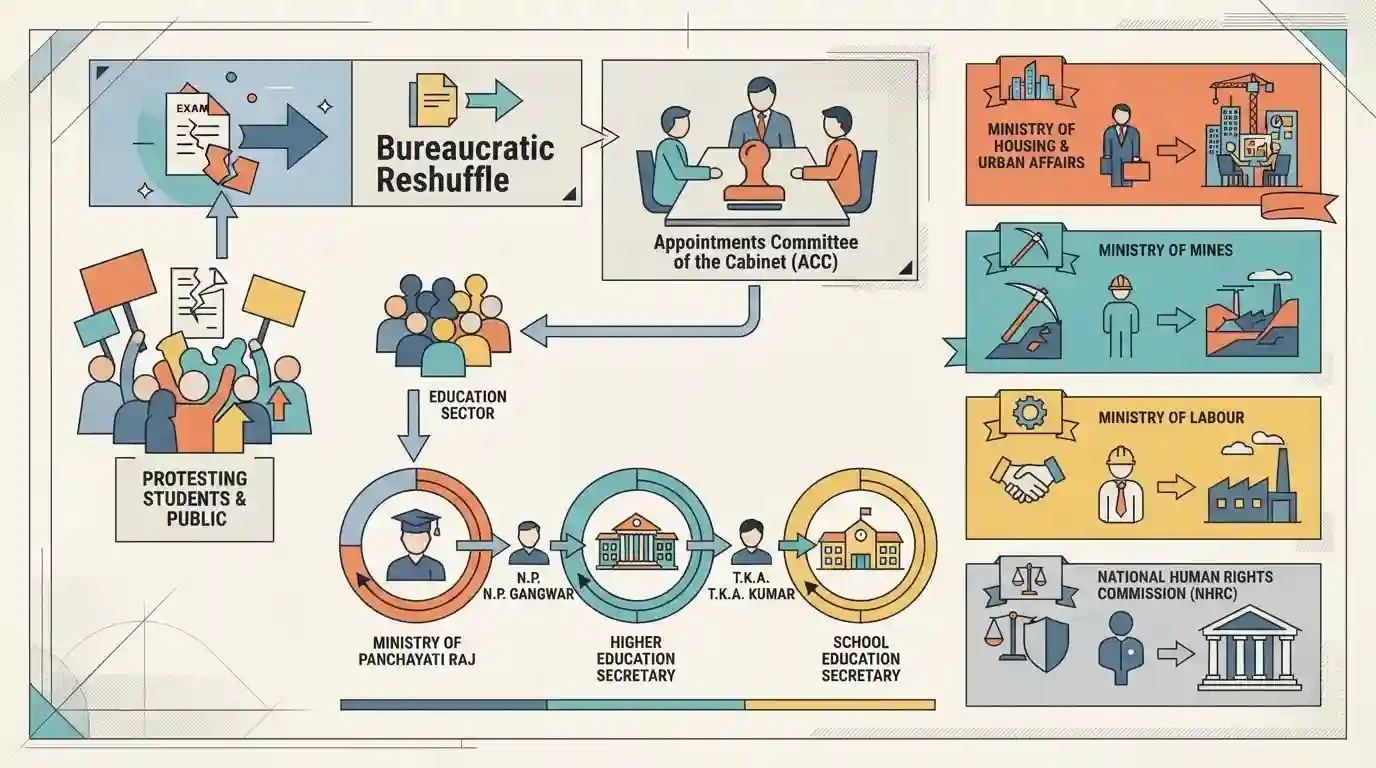
Amid intense public and student protests over exam irregularities and paper leaks in the NEET-UG examination, the central government executed a major bureaucratic reshuffle. Higher Education Secretary Vineet Joshi has been shifted to the Ministry of Panchayati Raj. He is replaced by Naresh Pal Gangwar as the Higher Education Secretary, and T K Anil Kumar is appointed as the School Education Secretary. The reshuffle, approved by the Appointments Committee of the Cabinet (ACC), also included senior secretary-level postings across the Ministry of Housing & Urban Affairs, Ministry of Mines, Ministry of Labour, and the National Human Rights Commission (NHRC).
Key Points
- In a major bureaucratic reshuffle, the central government has shifted Higher Education Secretary Vineet Joshi to the Ministry of Panchayati Raj amid public anger and protests over exam paper leaks (including NEET-UG) and CBSE evaluation irregularities.
- Naresh Pal Gangwar has been appointed as the new Higher Education Secretary, while T K Anil Kumar takes over as Secretary of the Department of School Education and Literacy.
- A newly created Department of Capital Development within the Ministry of Housing & Urban Affairs will be headed by D Thara, while Satyendra Singh is the new Secretary of the Department of Urban Development.
- Other high-profile bureaucratic shifts include Katikithala Srinivas moving to the Ministry of Development of North Eastern Region (DoNER), Chandra Bhushan Kumar becoming the new Labour Secretary, and Piyush Goyal (Mines Secretary) taking charge as Secretary of the National Human Rights Commission (NHRC).
- The central administrative reshuffle was approved by the Appointments Committee of the Cabinet (ACC), which is headed by Prime Minister Narendra Modi and includes Home Minister Amit Shah.
Important Terms
Appointments Committee of the Cabinet

A high-level, two-member standing committee of the Union Cabinet responsible for approving senior administrative, civil, and regulatory appointments in the Government of India.
UPSC context
GS Paper II (Polity & Governance). Tests cabinet committees structure and executive decision-making.
National Testing Agency
An autonomous, self-sustained testing organization under the Ministry of Education that conducts transparent and standardized national-level entrance examinations for higher education admissions.
UPSC context
GS Paper II (Education/Governance). Tests governance reforms, educational management, and statutory/autonomous bodies.
National Human Rights Commission
An independent statutory body established under the Protection of Human Rights Act, 1993, to promote and protect rights relating to life, liberty, equality, and dignity.
UPSC context
GS Paper II (Polity & Governance). Tests understanding of statutory bodies and human rights protection frameworks.
University Grants Commission
A statutory organization established in 1956 to coordinate, determine, and maintain standards of higher education and provide funding to universities across India.
UPSC context
GS Paper II (Education). Tests statutory regulatory frameworks and higher education policy implementation.
Ministry of Education
The central ministry responsible for formulating education policies, managing school and higher education departments, and implementing flagship development schemes.
UPSC context
GS Paper II (Social Sector/Education). Tests educational policies, institutional planning, and social schemes.
Ministry of Panchayati Raj
A Union-level ministry created in 2004 to oversee, advocate for, and monitor the process of local self-governance and democratic decentralization in India.
UPSC context
GS Paper II (Polity & Governance). Tests democratic decentralization and Panchayati Raj Institutions (PRIs).
Prelims Trap
The Appointments Committee of the Cabinet (ACC) is a multi-member body containing the Ministers of Personnel, Finance, and Home Affairs.
The ACC uniquely consists of only two members: the PM and the Minister of Home Affairs. Candidates wrongly assume a larger committee or separate Personnel/Finance representation.
Static Concepts Connected
What is the composition and role of the Appointments Committee of the Cabinet (ACC)?
- Composition: Consists strictly of only two members: the Prime Minister (serving as Chairman) and the Union Minister of Home Affairs.
- Mandate: Serves as the final approving authority for senior-level postings, transfers, and appointments of joint secretaries and above in central ministries.
- Nodal Machinery: Operates under the administrative ambit of the Ministry of Personnel, Public Grievances and Pensions (Establishment Officer's division).
How did the 2019 amendment change the administrative structure of the NHRC?
- Secretary-General as CEO: Functions as the Chief Executive Officer (CEO) of the Commission, bringing a corporate-style efficiency to human rights administration.
- Financial Devolution: Delegated all administrative and financial powers to the Secretary-General, leaving judicial powers and regulation-making strictly with the Chairperson/Commission.
Cross-Topic Patterns
Bureaucratic transfers and public accountability
Immediate reshuffling of top education secretaries during public outcries demonstrates how civil service transfers are deployed as administrative tools to restore trust and manage political crises.
MDoNER and territorial budgeting compliance
The unique spatial mandate of the North Eastern Ministry enforces a 10% non-lapsable budget pool across 54 central departments, showcasing targeted regional planning.

Cabinet Committee compositions and the 2019 statutory amendments to NHRC's administrative structure remain prime targets for comparative MCQ statements.
Linked PYQs · 2
Linked PYQs · 2
- 2024MainsGS2
The Doctrine of Democratic Governance makes it necessary that the public perception of the integrity and commitment of civil servants becomes absolutely positive. Discuss.
- 2020MainsGS2
Institutional quality is a crucial driver of economic performance". In this context suggest reforms in Civil Service for strengthening democracy.
