New criminal laws will push conviction rate to eighty percent
Source:The Hindu ↗
Why It Matters
The article touches upon critical internal security milestones (eradication of LWE) and highlights the practical impacts of the new criminal laws on conviction rates. It also demonstrates the use of AI in urban policing (Safe City project), a relevant theme for technology and security in GS3.
Summary
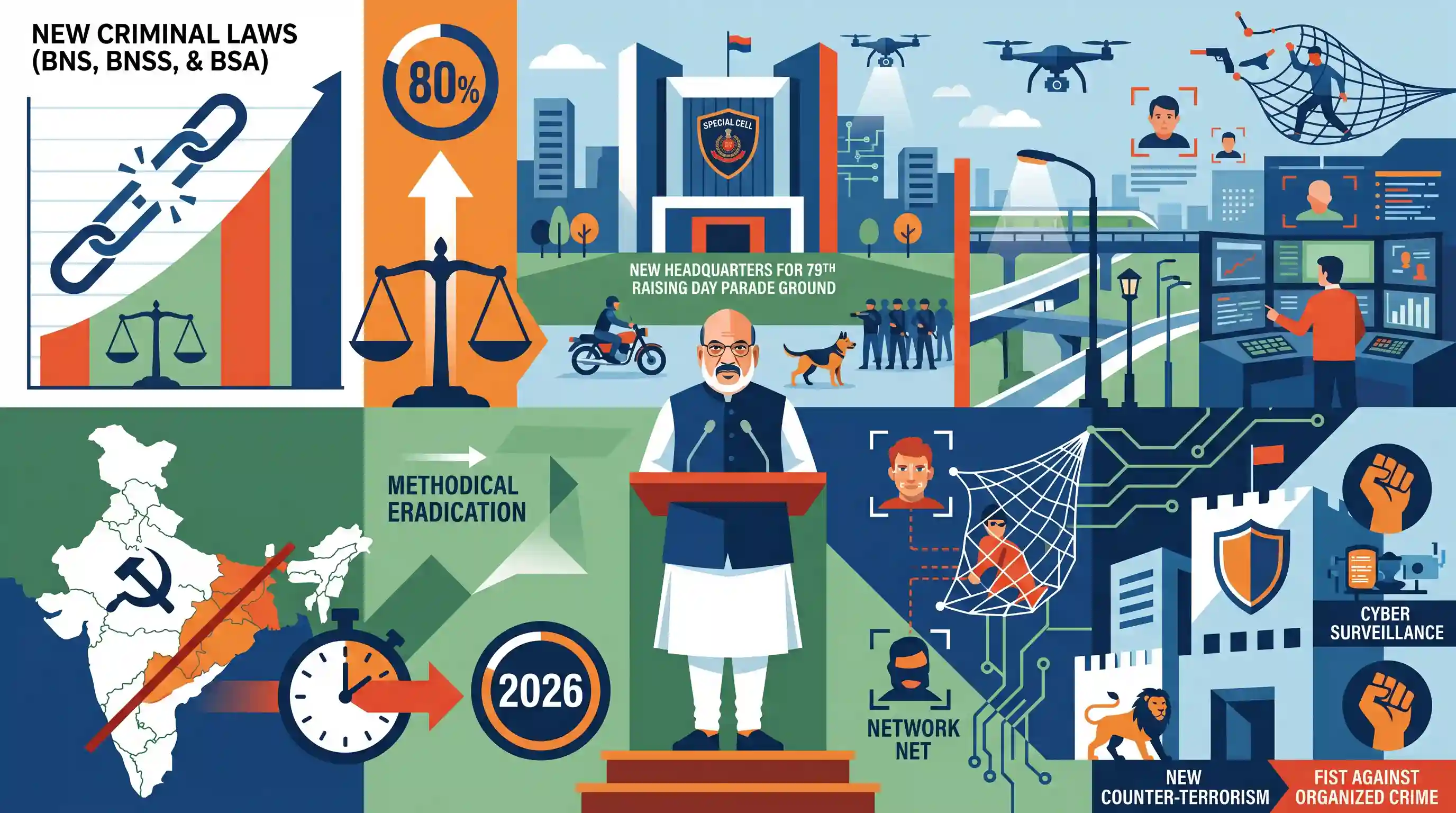
Union Home Minister Amit Shah, addressing the 79th Raising Day Parade of the Delhi Police, expressed confidence that the new criminal laws (BNS, BNSS, and BSA) will increase India's conviction rate to 80%. He also set a deadline of March 2026 for the complete eradication of Maoist violence. Additionally, he launched modern policing infrastructure, including the first phase of the AI-integrated Safe City project and a new headquarters for the Delhi Police Special Cell to counter organized crime and terrorism.
Key Points
- Union Home Minister Amit Shah stated that the full implementation of the three new criminal laws will increase the conviction rate in the country to 80%.
- He announced that the fight against Maoist violence is in its final phase and will be eradicated by March 2026.
- The new criminal laws (BNS, BNSS, and BSA) replaced the IPC, CrPC, and the Indian Evidence Act on July 1, 2024.
- He launched the first phase of the Safe City project in Delhi, which involves AI-enabled CCTV cameras, and inaugurated a new integrated headquarters for the Special Cell to tackle terrorism and organized crime.
Important Terms
Bharatiya Nyaya Sanhita (BNS)

The substantive criminal code replacing the IPC, modernizing offenses like terrorism and organized crime while introducing punishments like community service.
UPSC context
GS Paper II (Governance/Constitution) & GS Paper III (Internal Security). Tests understanding of legislative reforms and substantive law changes.
Bharatiya Nagarik Suraksha Sanhita (BNSS)
The procedural law replacing the CrPC, mandating technology-driven investigations, time-bound trials, and compulsory forensic evidence for serious crimes.
UPSC context
GS Paper II (Judiciary/Governance). Tests knowledge of procedural safeguards, police accountability, and judicial efficiency.
Bharatiya Sakshya Adhiniyam (BSA)
The new law replacing the Indian Evidence Act, explicitly recognizing digital and electronic records as primary evidence to suit the modern technological landscape.
UPSC context
GS Paper II. Relevant for topics on technology in governance and the evolution of the Indian legal framework.
Safe City Project
An AI-integrated initiative by Delhi Police, funded by the Nirbhaya Fund, utilizing facial recognition, gunshot detectors, and real-time analytics to enhance urban safety.
UPSC context
GS Paper III (Internal Security/Technology). Tests awareness of smart policing, women's safety measures, and AI application in law enforcement.
Delhi Police Special Cell
The specialized counter-terrorism unit of the Delhi Police, responsible for tackling organized crime, terror syndicates, and threats to national security.
UPSC context
GS Paper III (Internal Security). Important for understanding specialized security agencies and their role in countering unconventional threats.
Prelims Trap
The Bharatiya Nyaya Sanhita (BNS) applies retrospectively to ongoing criminal trials to ensure an 80% conviction rate.
Article 20(1) of the Constitution prohibits retrospective criminal legislation (ex post facto laws). Crimes committed before July 1, 2024, continue to be tried under the IPC.
Static Concepts Connected
What are the core pillars of India's anti-LWE strategy?
- SAMADHAN Doctrine: A holistic doctrine covering Smart Leadership, Aggressive Strategy, Motivation, Actionable Intelligence, Dashboard KPIs, Harnessing Technology, Action plan, and No access to financing.
- Development Push: Special Central Assistance (SCA) for most affected districts to build roads (RRCP), mobile towers, and Eklavya Model Residential Schools.
- Security Related Expenditure: A scheme reimbursing states for anti-Naxal operations, training of police forces, and ex-gratia payments to victims.
How is the Safe City Project funded and structured?
- Nirbhaya Fund: It is centrally sponsored and heavily funded under the Nirbhaya Fund framework to enhance the safety of women in urban public spaces.
- 8 Mega Cities: Phase-I is being implemented in 8 major metropolitan cities, including Delhi, Mumbai, Chennai, Bengaluru, and Kolkata.
- Tech Integration: Focuses on technology rather than just manpower, utilizing AI-based video analytics, drones, and integrated command centers.
Cross-Topic Patterns
Predictive Policing vs. Puttaswamy Privacy
AI-enabled CCTVs in Safe City projects raise GS2 constitutional concerns regarding mass surveillance proportionality and the fundamental Right to Privacy outlined in the Puttaswamy judgment.
New Criminal Laws & Federalism
While criminal law is Concurrent, 'Police' and 'Public Order' are State subjects. Implementing the new BNS mandates massive state-level infrastructure upgrades, straining federal fiscal dynamics.

Expect a 2026 GS3 question evaluating if the March 2026 LWE eradication deadline relies more on kinetic operations or tribal welfare.
Linked PYQs · 3
Linked PYQs · 3
- 2022MainsGS3
Naxalism is a social, economic and developmental issue manifesting as a violent internal security threat. In this context, discuss the emerging issues and suggest a multilayered strategy to tackle the menace of Naxalism.
- 2018MainsGS3
Left Wing Extremism (LWE) is showing a downward trend, but still affects many parts of the country. Briefly explain the Government of India's approach to counter the challenges posed by LWE.
- 2023MainsGS3
Introduce the concept of Artificial Intelligence (AI). How does Al help clinical diagnosis? Do you perceive any threat to privacy of the individual in the use of Al in healthcare?
