High-Level Committee Formed on Demographic Shifts and Immigration
Source:Indian Express ↗
Why It Matters
Demographic shifts and illegal transborder migration are critical internal security concerns. The establishment of the HLCDC provides UPSC candidates with a concrete government initiative to cite in mains answers regarding border management challenges (GS3) and demographic governance (GS1/GS2).
Summary
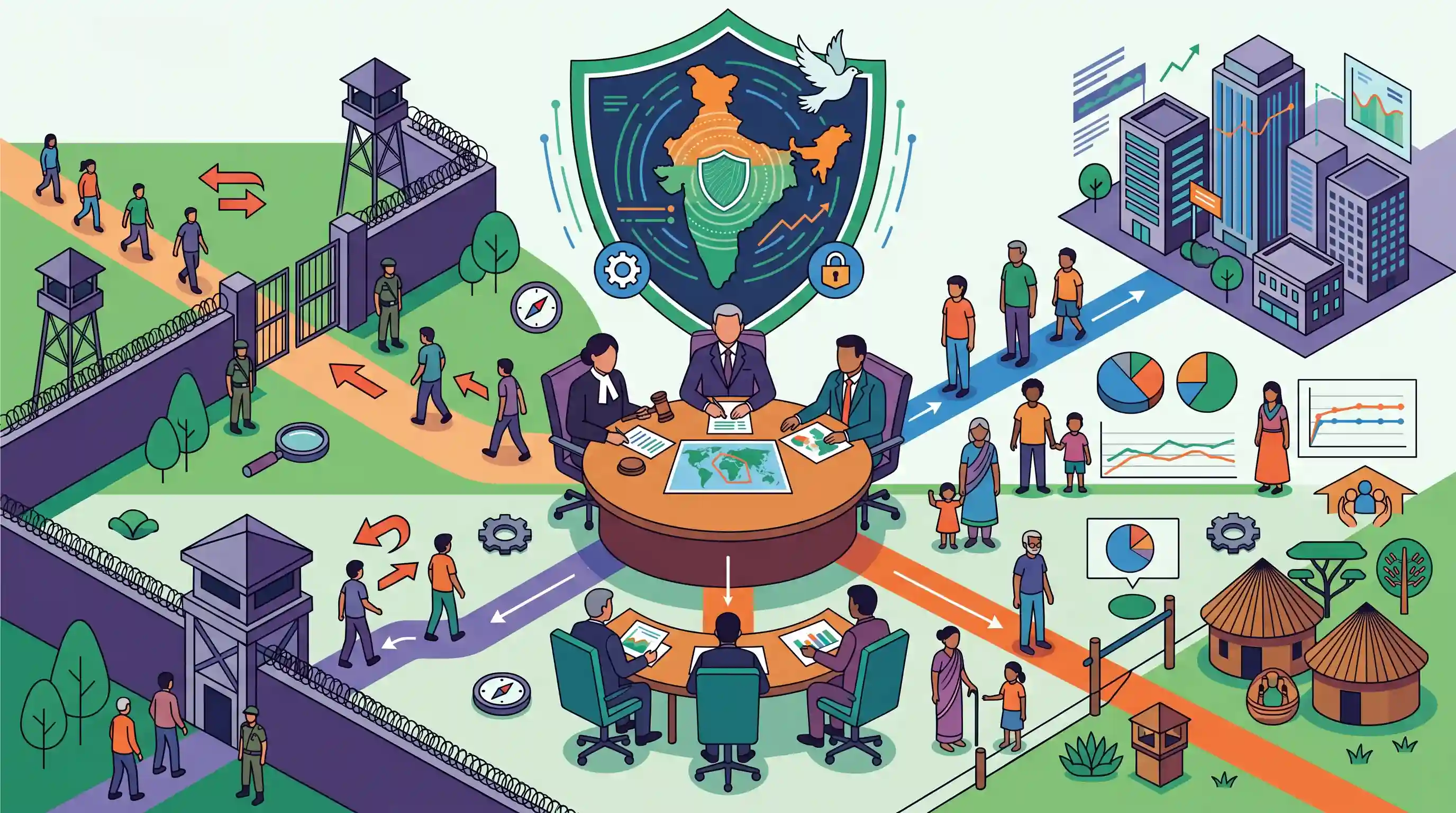
The Ministry of Home Affairs has formed a High-Level Committee on Demographic Changes, chaired by retired Supreme Court Justice Prakash Prabhakar Naolekar, to investigate the causes and consequences of unnatural demographic shifts and illegal immigration in India. Focused on border, tribal, and urban areas, the committee will recommend legal and policy frameworks for identifying and deporting illegal immigrants, reinforcing border management, and ensuring broader population stabilization. The initiative directly aligns with the government's 'Demographic Mission' to safeguard national security and preserve India's socio-economic fabric.
Key Points
- The Ministry of Home Affairs constituted a High-Level Committee on Demographic Changes (HLCDC) led by retired Supreme Court Justice Prakash Prabhakar Naolekar.
- The committee will conduct a scientific study on unnatural demographic changes, illegal immigration, and irregular population mobility across border, urban, and tribal regions.
- Its mandate includes suggesting robust policies and legal frameworks for the detection, detention, and deportation of illegal immigrants.
- The panel will also formulate strategies for border management and population stabilization, building on the Prime Minister's 'Demographic Mission' vision.
Important Terms
Demographic Mission

A national initiative announced in 2025 to monitor and manage India's population transformations—including migration and infiltration—to ensure national security, balanced growth, and socio-economic stability.
UPSC context
GS Paper I (Population issues) & III (Internal Security). Tests demography-security linkages.
High-Level Committee on Demographic Changes
A government panel chaired by Justice P.P. Naolekar investigating "unnatural" demographic shifts and illegal immigration, specifically in border, tribal, and urban areas.
UPSC context
GS Paper III (Internal Security/Border Management). Institutional response to migration-related security threats.
Economic Advisory Council to the Prime Minister (EAC-PM)
An independent body advising the PM on economic issues. Its 2024 report on religious demographics highlighted shifts in population shares, providing the context for current demographic policy debates.
UPSC context
GS Paper II (Governance/Advisory bodies) & III (Economy). Knowledge of evidence-based policymaking.
Ministry of Home Affairs (MHA)
The nodal ministry for internal security, border management, and immigration. It oversees the Naolekar Committee and implements policies related to population stabilization and deportation.
UPSC context
GS Paper II (Executive). Nodal agency for internal security and administrative measures.
Border Management
Securing national boundaries against illegal infiltration and cross-border crimes. The committee aims to strengthen these mechanisms to prevent "unnatural" demographic changes.
UPSC context
GS Paper III (Security). Core theme for external/internal security challenges.
Illegal Immigration
Movement of people across borders in violation of laws. The Naolekar Committee is tasked with recommending frameworks for their identification, detention, and deportation.
UPSC context
GS Paper III (Security). Critical for topics like NRC, CAA, and regional stability.
Population Stabilization
Achieving a state where a population remains constant. The committee links this to national security and the preservation of India’s socio-economic fabric.
UPSC context
GS Paper I (Demography/Society). Essential for resource management and sustainable development.
Prelims Trap
The Demographic Mission and HLCDC are spearheaded by the Ministry of Health and Family Welfare for population stabilization.
The focus on 'population stabilization' and 'demography' masks its true nodal ministry: the Ministry of Home Affairs, given its internal security and illegal immigration mandate.
Static Concepts Connected
What is the constitutional framework for managing foreigners and citizenship in India?
- Article 11: Grants the Union Parliament the exclusive power to regulate the right of citizenship, naturalization, and laws regarding aliens.
- Union List (Schedule VII): Entry 17 (Citizenship, aliens) and Entry 19 (Admission, emigration, expulsion) place immigration and deportation exclusively under the Union government's domain.
How does illegal immigration historically impact internal security in border regions?
- Resource Strain: Unnatural population surges create intense competition for land, jobs, and state resources, frequently triggering localized ethnic conflicts and insurgencies.
- Electoral Shifts: Demographic inversion alters local political power dynamics, a primary driver of historical security challenges like the Assam Agitation.
Cross-Topic Patterns
Border demographics + Sixth Schedule
Illegal immigration into Northeast tribal areas routinely tests the efficacy of Sixth Schedule protections and Inner Line Permits, making this a hybrid Polity and Internal Security issue.
Decolonizing internal security frameworks
The replacement of the 1946 Foreigners Act with the 2025 Immigration Act parallels the recent criminal code overhaul, reflecting a continuous theme of updating colonial-era internal security laws.

Expect a Mains question linking border management to tribal demography, and Prelims statements on the new Immigration Act 2025 vs 1946 Act.
Linked PYQs · 4
Linked PYQs · 4
- 2014MainsGS3
How does illegal transborder migration pose a threat to India's security? Discuss the strategies to curb this, bringing out the factors which give impetus to such migration.
- 2019MainsGS3
Cross-border movement of insurgents is only one of the several security challenges facing the policing of the border in North-East India. Examine the various challenges currently emanating across the India-Myanmar border. Also, discuss the steps to counter the challenges.
- 2020MainsGS3
For effective border area management, discuss the steps required to be taken to deny local support to militants and also suggest ways to manage favourable perception among locals.
- 2023PrelimsGS1
Consider the following statements: 1. Recently, all the countries of the United Nations have adopted the first-ever compact for international migration, the 'Global Compact for Safe, Orderly and Regular Migration (GCM)'. 2. The objectives and commitments stated in the GCM are binding on the UN member countries. 3. The GCM addresses internal migration or internally displaced people also in its objectives and commitments. How many of the above statements are correct?
