Rural demand recovery and high-frequency macroeconomic indicators
Source:The Hindu ↗
Why It Matters
Understanding the relationship between rural demand, agricultural output, and inflation is crucial for analyzing India's macroeconomic stability. High-frequency indicators like PMI are essential tools for tracking real-time economic performance, which is often tested in both Prelims and Mains.
Summary
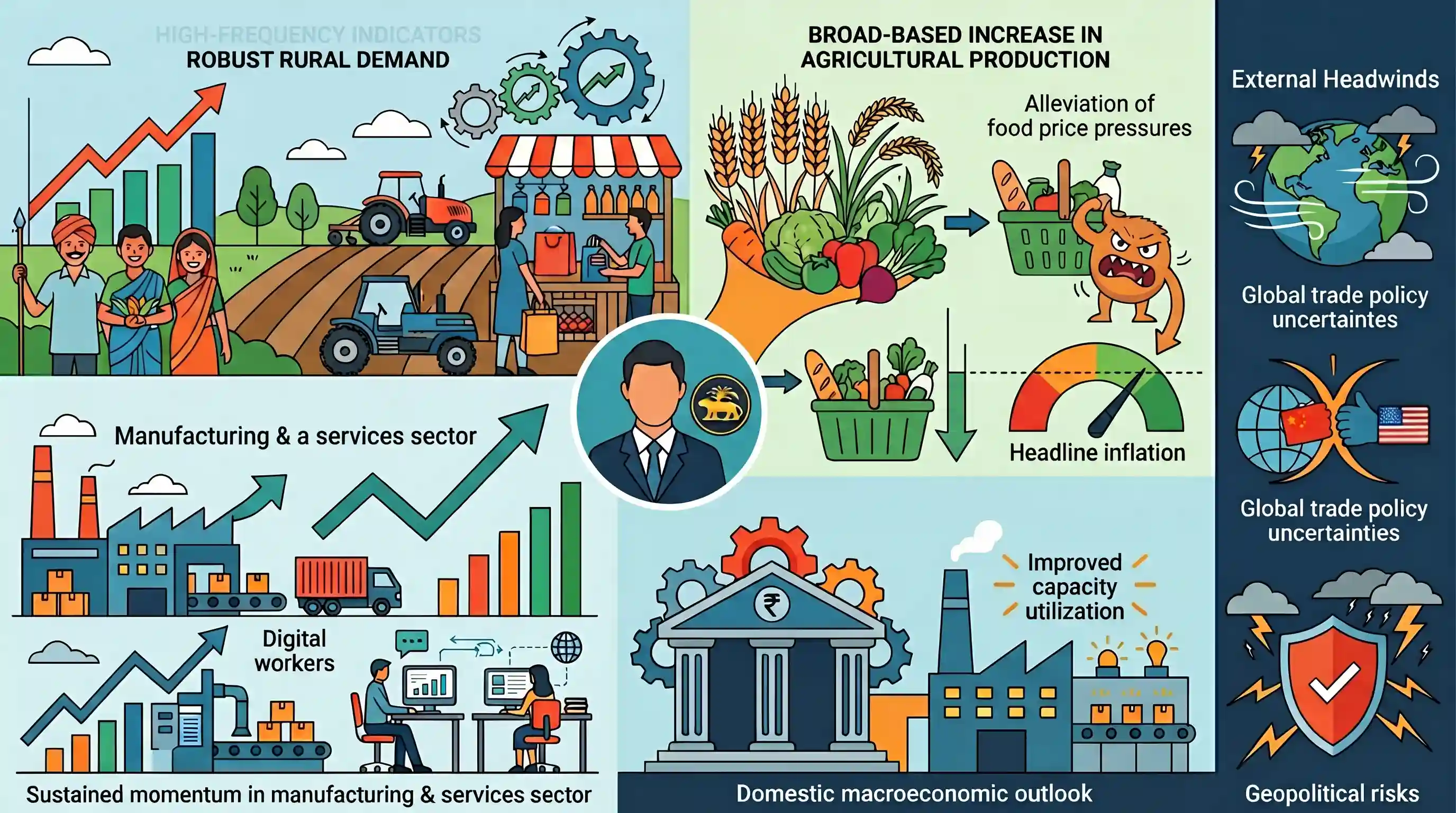
According to the Reserve Bank of India's June Bulletin, high-frequency indicators point to a robust pick-up in rural demand and sustained momentum across the manufacturing and services sectors. RBI officials noted that a broad-based increase in agricultural production is expected to alleviate food price pressures, keeping headline inflation below the central bank's target. While the domestic macroeconomic outlook remains resilient and capacity utilization is improving, the Bulletin cautions that external headwinds from global trade policy uncertainties and geopolitical risks remain a concern.
Key Points
- The RBI's June Bulletin highlights a significant pick-up in rural demand, which is acting as a major driver of economic growth.
- A broad-based increase in agricultural production is expected to ease food price inflation, helping keep headline inflation below the target for the fourth consecutive month.
- High-frequency indicators, including the Purchasing Managers' Index (PMI) and capacity utilization rates, point to strong resilience in India's industrial and services sectors.
- Despite domestic momentum, RBI officials cautioned about external risks arising from global trade policy uncertainties and geopolitical fragmentation.
Important Terms
Reserve Bank of India (RBI)

India's central bank and regulatory body responsible for monetary stability, currency management, and banking supervision. Established under the RBI Act, 1934, it oversees the credit system and maintains price stability.
UPSC context
GS3: Indian Economy. Key for questions on monetary policy, inflation targeting (4%±2%), and banking sector reforms.
High-Frequency Indicators (HFIs)
Real-time economic data points available at short intervals (daily/monthly), such as GST collections, power consumption, and auto sales. They provide timely insights into economic activity before quarterly GDP data release.
UPSC context
GS3: Growth and Development. Tests ability to analyze immediate economic trends and sectoral performance beyond aggregate statistics.
Headline Inflation
The total inflation measure for an economy, calculated using the Consumer Price Index (CPI). It includes volatile categories like food and fuel, representing the actual cost-of-living changes for households.
UPSC context
GS3: Inflation and Monetary Policy. Crucial for understanding the RBI’s flexible inflation targeting framework and its socio-economic impact.
Capacity Utilization
A metric measuring the extent to which a firm or the economy uses its installed productive potential. High utilization indicates robust demand and can trigger fresh private capital expenditure (Capex).
UPSC context
GS3: Indian Economy and Industrial Growth. Important for assessing industrial health and the likelihood of a private investment pick-up.
Rural Demand
The consumption appetite of the rural population, largely influenced by agricultural output, monsoons, and real wages. It is tracked via proxies like tractor sales and FMCG volume growth.
UPSC context
GS3: Agriculture and Growth. Essential for analyzing the broad-based nature of economic recovery and the urban-rural consumption gap.
RBI Bulletin
A monthly flagship publication of the RBI featuring the "State of the Economy" report, research papers, and data. It serves as a primary source for official macroeconomic assessments.
UPSC context
GS3: Economic Development. A vital source for authentic data and official perspectives on India's current macroeconomic outlook.
Prelims Trap
The Purchasing Managers' Index (PMI) is compiled and published by the Reserve Bank of India as a high-frequency indicator.
PMI is a private survey compiled by S&P Global, not the RBI. The RBI conducts its own OBICUS survey to measure manufacturing capacity utilization.
Static Concepts Connected
What are High-Frequency Indicators (HFIs) and how is capacity utilization tracked?
- HFIs Defined: Real-time data points like e-way bills, GST collections, and power consumption used to gauge economic activity between lagging quarterly GDP releases.
- Rural Proxies: Two-wheeler sales, tractor registrations, and FMCG volume growth serve as standard high-frequency proxies to estimate rural consumption health.
- RBI OBICUS: The RBI tracks manufacturing capacity utilization quarterly through its Order Books, Inventories and Capacity Utilisation Survey (OBICUS).
How does the weightage of the CPI basket dictate RBI's monetary policy stance?
- Headline vs Core: The RBI's legal mandate is to target Headline CPI-Combined (4% ± 2%), not WPI or Core Inflation (which excludes food and fuel).
- Food Dominance: Food and beverages constitute nearly 45.9% of the CPI basket. Hence, agricultural production directly controls headline inflation and subsequent interest rate cycles.
Cross-Topic Patterns
Monsoon cycles dictate rural macro-indicators
Transition to La Niña directly boosts agricultural production, which lowers food inflation and simultaneously drives tractor sales and FMCG demand, reducing rural reliance on MGNREGA.
Protectionism as an external macroeconomic headwind
RBI's caution on global trade fragmentation highlights how non-tariff barriers and geopolitical blocs are disrupting supply chains, contrasting India's domestic consumption resilience.

Expect a prelims question comparing RBI’s OBICUS survey with S&P’s PMI, testing who publishes which high-frequency economic indicator.
Linked PYQs · 4
Linked PYQs · 4
- 2020PrelimsGS1
Consider the following statements: 1. The weightage of food in Consumer Price Index (CPI) is higher than that in Wholesale Price Index (WPI). 2. The WPI does not capture changes in the prices of services, which CPI does. 3. Reserve Bank of India has now adopted WPI as its key measure of inflation and to decide on changing the key policy rates. Which of the statements given above is/are correct?
- 1997PrelimsGS1
In India, inflation is measured by the
- 2021PrelimsGS1
Which one of the following is likely to be the most inflationary in its effects?
- 2023MainsGS3
Explain the changes in cropping pattern in India in the context of changes in consumption pattern and marketing conditions.
