Supreme Court Stays Bombay High Court Order on Tax Refund Dispute
Source:The Hindu ↗
Why It Matters
It provides a clear example of the Supreme Court checking a High Court's procedural overreach, particularly emphasizing that constitutional courts must remain neutral and not act as guardians of the executive (Revenue Department) in disputes against private entities settled by specialized tribunals.
Summary
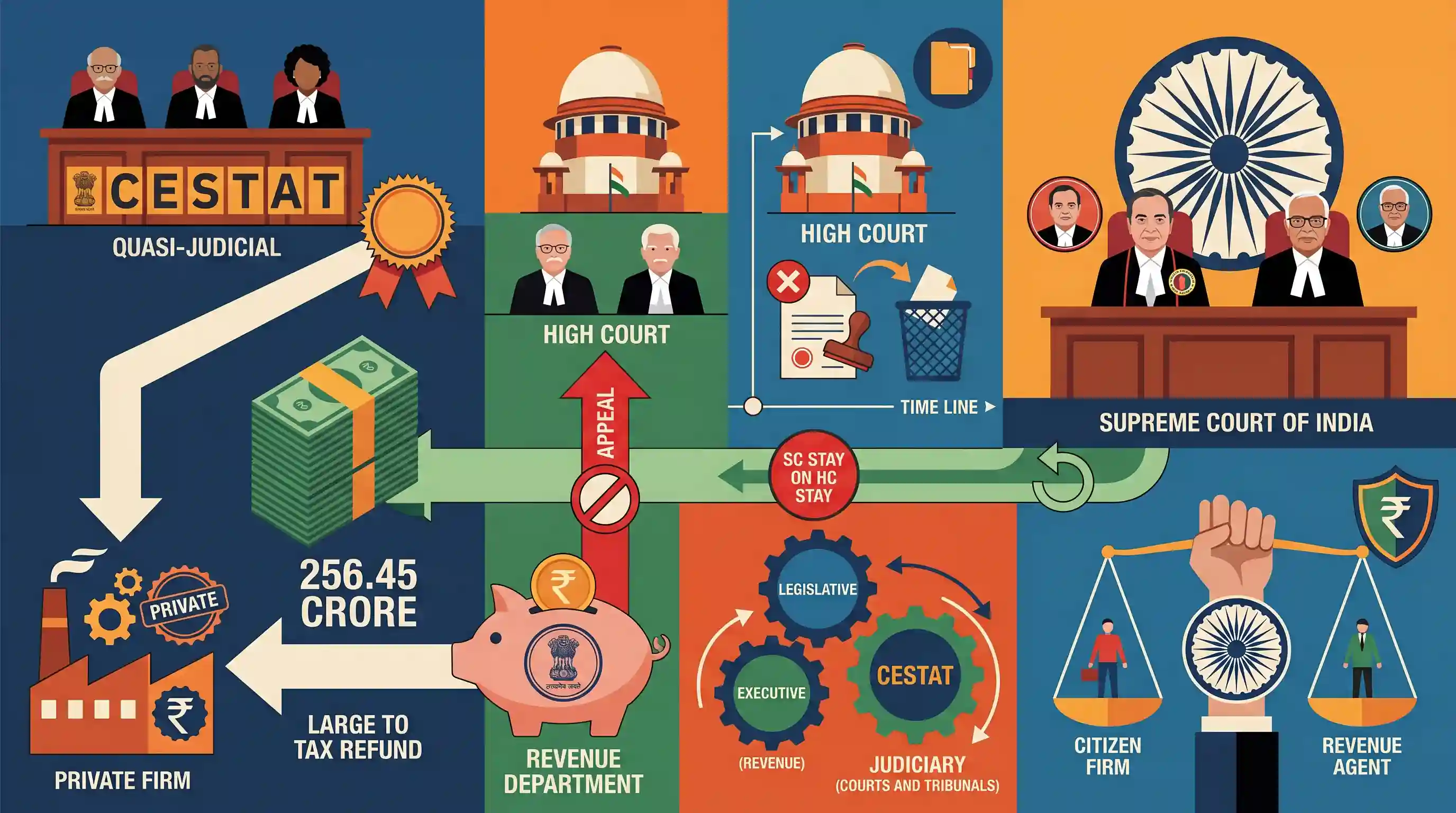
The Supreme Court stayed a Bombay High Court order that had paused a ₹256.45 crore tax refund ordered by the Customs, Excise and Service Tax Appellate Tribunal (CESTAT) to a private firm. A Supreme Court bench, comprising Justices Ujjal Bhuyan and Manmohan, remarked that "the High Court is not the custodian of the Revenue Department." The apex court found it procedurally improper that the High Court had granted a stay on the tribunal's refund directive after previously declaring the Revenue Department's appeal unmaintainable and disposing of the petition. The intervention highlights the limits of High Court interference in tribunal orders and underscores the importance of judicial neutrality when dealing with government revenue agencies.
Key Points
- The Supreme Court stayed a Bombay High Court order that halted a ₹256.45 crore tax refund to a private firm, originally directed by the Customs, Excise and Service Tax Appellate Tribunal (CESTAT).
- The Supreme Court criticized the High Court for acting as a 'custodian' of the Revenue Department.
- The apex court pointed out a procedural anomaly where the High Court passed a stay order despite previously ruling that the Revenue Department's appeal was not maintainable and disposing of the petition.
- The case highlights the boundaries of High Court jurisdiction over tribunal decisions and the necessity of judicial neutrality in tax disputes involving the government.
Important Terms
Customs, Excise and Service Tax Appellate Tribunal (CESTAT)

A quasi-judicial body established under Article 323B of the Constitution to hear appeals against orders passed under the Customs Act, Central Excise Act, and Service Tax laws.
UPSC context
GS Paper II: Statutory, regulatory and various quasi-judicial bodies. Essential for understanding tribunalization and alternative dispute resolution in taxation.
Revenue Department
A wing of the Ministry of Finance responsible for the administration, levy, and collection of all direct and indirect taxes through the CBDT and CBIC.
UPSC context
GS Paper II: Structure, organization and functioning of the Executive. Tests knowledge of India's fiscal administrative machinery.
Supreme Court of India
The apex judicial body in India (Articles 124–147) with original, advisory, and wide appellate jurisdiction, including the power to hear appeals from any tribunal under Article 136.
UPSC context
GS Paper II: Indian Constitution (Judiciary). Tests understanding of appellate powers over tribunals and the doctrine of separation of powers.
Central Excise Act
A 1944 statute governing the levy and collection of excise duties on goods manufactured in India; it remains relevant for items not yet subsumed under the GST regime.
UPSC context
GS Paper III: Indian Economy (Taxation). Relevant for legacy tax issues and the transition to the GST framework.
Commissioner of CGST and Central Excise
A high-ranking executive officer under the CBIC responsible for tax collection, refund processing, and preventing tax evasion within a specific territorial jurisdiction.
UPSC context
GS Paper II: Government policies and interventions. Focuses on the implementation level of tax administration and executive authority.
Appellate Jurisdiction
The power of a higher court or tribunal to review, amend, and overrule the decisions and judgments of lower courts, tribunals, or administrative bodies.
UPSC context
GS Paper II: Judiciary. Tests knowledge of the hierarchy of courts and the limits of judicial review over specialized tribunals.
Prelims Trap
"Appeals against orders of statutory tribunals like CESTAT lie exclusively with the Supreme Court."
Under the L. Chandra Kumar judgment (1997), High Courts retain supervisory jurisdiction over tribunals. Statutes cannot constitutionally bypass the High Court to mandate direct SC appeals.
Static Concepts Connected
What is the High Court's supervisory jurisdiction over tribunals?
- Article 227: Grants High Courts superintendence over all courts and tribunals (except military tribunals) throughout their territorial jurisdiction, covering both administrative and judicial oversight.
- L. Chandra Kumar Case: Ruled that High Court judicial review over tribunals is a 'Basic Structure' feature, striking down exclusionary clauses in the 42nd Amendment (Articles 323A/323B).
- Functus Officio: The legal doctrine meaning "having performed his office." Once a court formally disposes of a petition, its authority to pass substantive orders (like a stay) ceases.
How are tribunals constituted under the Indian Constitution?
- Article 323A: Authorizes Parliament to establish administrative tribunals for disputes relating to recruitment and conditions of public service (e.g., Central Administrative Tribunal).
- Article 323B: Allows Parliament and State Legislatures to set up tribunals for specific matters like taxation, foreign exchange, industrial disputes, and land reforms (e.g., CESTAT).
- 42nd Amendment: Neither article was in the original Constitution; both were added by the 42nd Amendment Act of 1976.
Cross-Topic Patterns
National Litigation Policy & pendency
The State is India's largest litigator. The SC's rebuke against favoring the Revenue Department highlights the necessity of making the government a responsible, rather than compulsive, litigant to curb mounting judicial pendency.
Tax administration & ease of doing business
Pro-revenue bias in courts or tax administration creates a hostile business environment. Strict judicial neutrality over bodies like CESTAT is critical to ensuring tax certainty and improving ease of doing business.

Expect a 2026 question mixing Articles 226/227 and 323A/323B, testing High Court supervisory powers over statutory tribunals.
Linked PYQs · 3
Linked PYQs · 3
- 2018MainsGS2
How far do you agree with the view that tribunals curtail the jurisdiction of ordinary courts? In view of the above, discuss the constitutional validity and competency of the tribunals in India.
- 2025MainsGS2
Comment on the need of administrative tribunals as compared to the court system. Assess the impact of the recent tribunal reforms through rationalization of tribunals made in 2021.
- 2019MainsGS3
Enumerate the indirect taxes which have been subsumed in the Goods and Services Tax (GST) in India. Also, comment on the revenue implications of the GST introduced in India since July 2017.
