Asaram Life Sentence Upheld by Rajasthan High Court
Source:outlook-india ↗
Why It Matters
This case highlights the functioning and appellate jurisdiction of High Courts in reviewing trial court judgements, specifically concerning heinous crimes and the interpretation of laws protecting vulnerable groups like children and women under the IPC and POCSO Act.
Summary
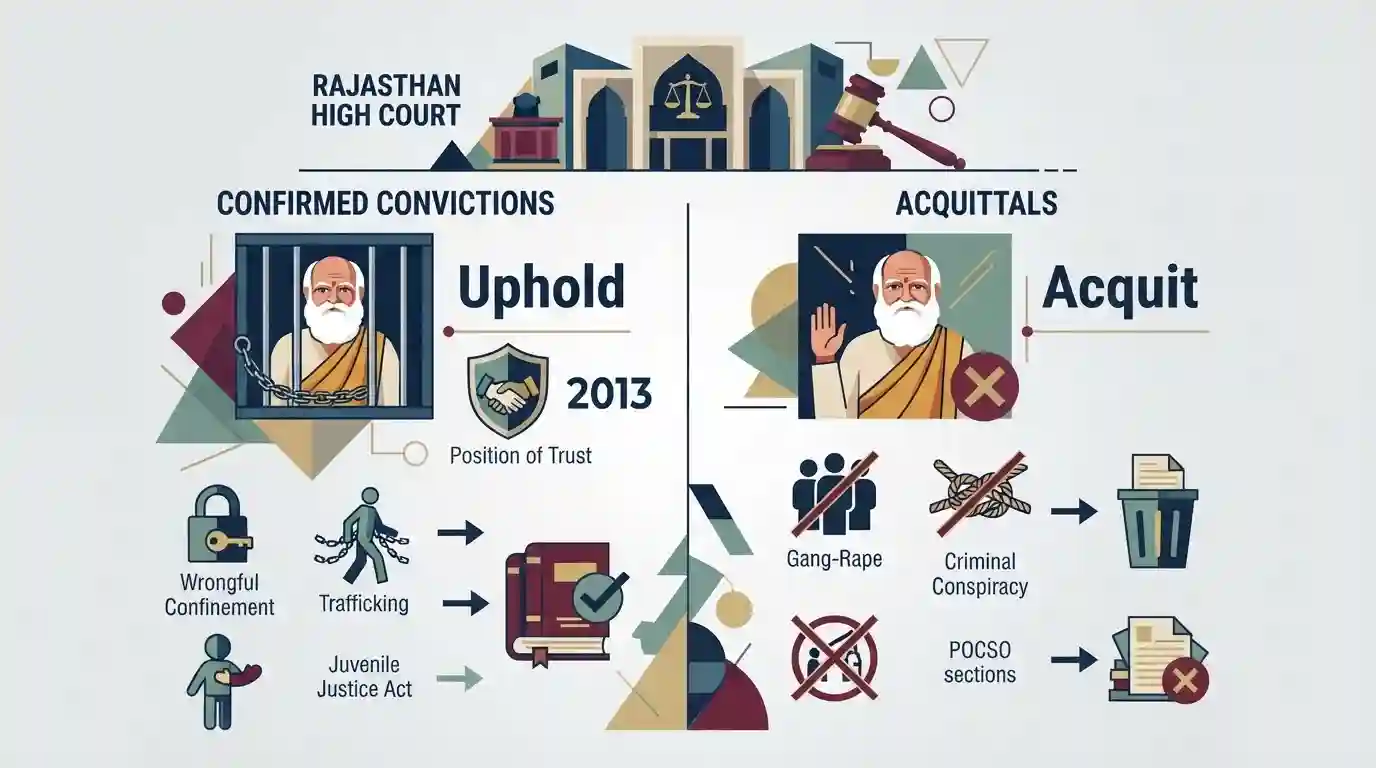
The Rajasthan High Court has upheld the life sentence awarded to Asaram Bapu in a 2013 rape case, affirming his conviction for rape by someone in a position of trust. However, the division bench acquitted him of gang-rape and criminal conspiracy under the IPC and specific sections of the POCSO Act. Convictions relating to wrongful confinement, trafficking, and offences under the Juvenile Justice Act remain unchanged.
Key Points
- The Rajasthan High Court upheld Asaram Bapu's life sentence in the 2013 rape case, maintaining his conviction under Section 376(2)(f) for rape by a person in a position of trust.
- The High Court acquitted him of gang-rape (Section 376-D) and criminal conspiracy (Section 120-B) charges, as well as specific POCSO Act sections (5(g) and 6), citing lack of evidence.
- Other convictions, including human trafficking (Section 370(4)), wrongful confinement (Section 342), insulting modesty of a woman (Section 509), and certain provisions of the Juvenile Justice Act, were confirmed.
- The judgement was delivered by a division bench comprising Justices Arun Monga and Yogendra Kumar Purohit.
Important Terms
Indian Penal Code (IPC)

India's primary criminal code since 1860, defining various offenses and punishments. While replaced by the Bharatiya Nyaya Sanhita (BNS) in July 2024, older cases are still adjudicated under its provisions.
UPSC context
GS Paper 2 (Governance/Polity). Tests understanding of India's foundational criminal justice system and recent legal reforms transitioning from colonial laws.
Protection of Children from Sexual Offences (POCSO) Act
Enacted in 2012, this gender-neutral law creates a comprehensive child-friendly framework to protect minors (under 18) from sexual assault, harassment, and pornography, establishing special courts for faster trials.
UPSC context
GS Paper 2 (Social Justice). Evaluates knowledge of vulnerable populations, legal safeguards for children, and India's compliance with international child rights conventions.
Juvenile Justice (Care and Protection of Children) Act
The 2015 law focusing on the care, protection, and rehabilitation of minors. It distinguishes between children needing care and those in conflict with the law, allowing 16-18 year-olds committing heinous crimes to be tried as adults.
UPSC context
GS Paper 2 (Social Justice). Tests awareness of child welfare mechanisms, institutional frameworks like Juvenile Justice Boards, and the balance between reform and punishment.
Prelims Trap
"The POCSO Act provides statutory protection specifically to minor girls from sexual offences."
Aspirants often assume special sexual violence laws only protect females. The POCSO Act is uniquely gender-neutral, protecting any person under 18 years of age.
Static Concepts Connected
What are the key statutory features of the POCSO Act, 2012?
- Gender-Neutral: It defines a child as any person under 18 years of age, extending equal protection to both boys and girls.
- Overriding Effect: Under Section 42A, the Act explicitly holds an overriding effect over any other inconsistent law in force.
- Burden of Proof: For certain severe offences, the Act presumes the culpable mental state of the accused, effectively shifting the burden of proof.
How does a High Court's criminal appellate jurisdiction function?
- Sessions Court Appeals: Appeals against judgments of Sessions Courts lie to the High Court if the sentence awarded is imprisonment for more than seven years.
- Death Sentence Confirmation: A death sentence awarded by a Sessions Court must be confirmed by the High Court before execution, even if not appealed.
Cross-Topic Patterns
POCSO + Criminal Justice Reforms
Discussions on low conviction rates under POCSO often invoke the Malimath Committee's recommendations on shifting towards an inquisitorial system to improve justice delivery for vulnerable victims.
JJ Act + Adult Trials
Application of the Juvenile Justice Act frequently ties into GS2 debates on whether 16-18 year olds should be tried as adults for 'heinous' offences under the 2015 amendments.

Expect a Prelims statement testing the gender-neutral nature and overriding statutory effect of the POCSO Act against other penal laws.
Linked PYQs · 3
Linked PYQs · 3
- 2023RPSC_PRELIMSGS1
According to Article 217 (1) of the Constitution, the President shall make the appointment of a judge of the Rajasthan High Court (other than the Chief Justice) after consultation with whom?
- 2023RPSC_PRELIMSGS1
According to Article 217(1) of the Constitution, who does the President appoint on the advice of whom, other than the Chief Justice of the Rajasthan High Court?
- 2025RPSC_PRELIMSGS1
Under Section 7 of the Rajasthan Lokayukta and Upa-Lokayukta Act, 1973, the Lokayukta has the power to investigate charges against ministers and public servants in certain cases. Which of the following is not part of those investigations?
