Patna High Court strikes down Bihar reservation increase
Source:drishtiias ↗
Why It Matters
This ruling directly affects state-level reservation policies, federal dynamics, and the implementation of affirmative action programs vis-a-vis the 50% constitutional ceiling limit established by the Supreme Court.
Summary
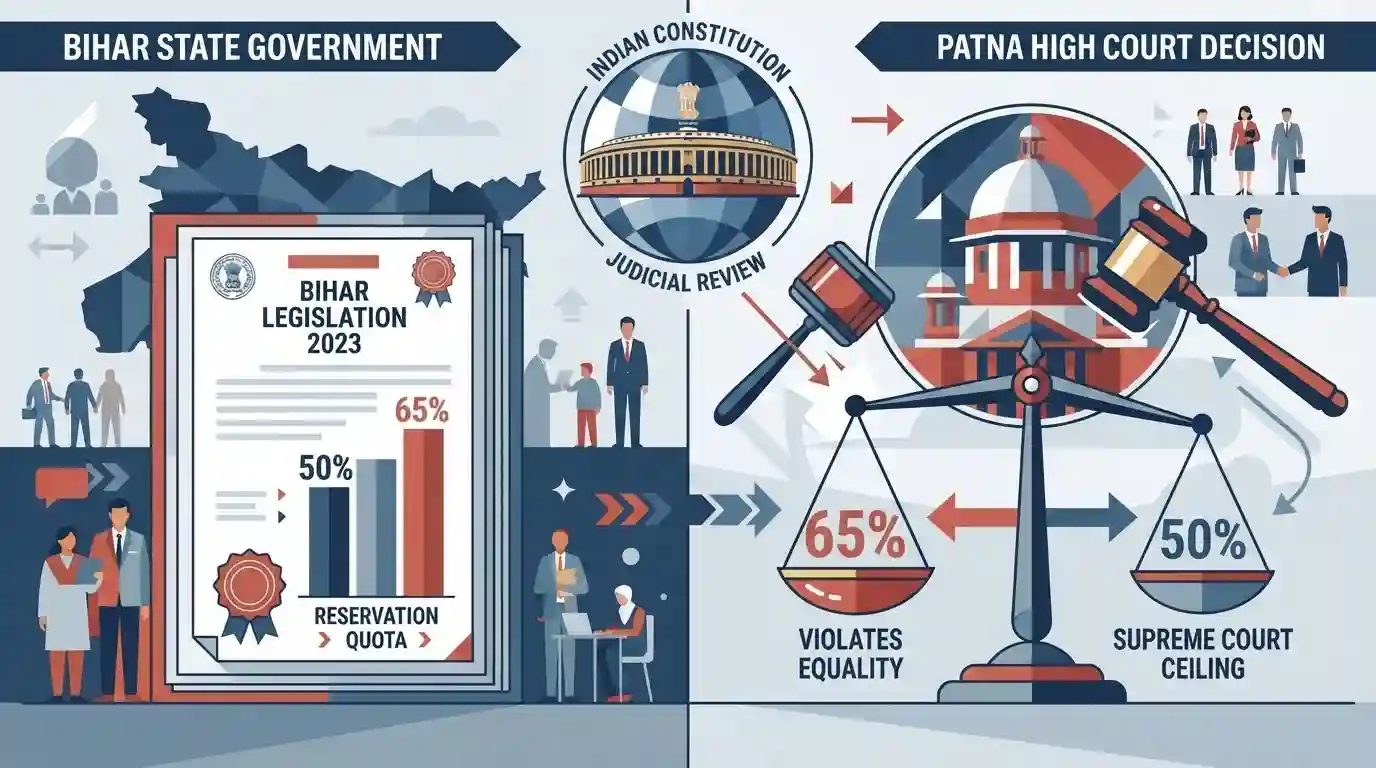
The Patna High Court struck down the Bihar government's 2023 legislation that raised reservations in state government posts and educational institutions from 50% to 65%, holding that the amendment violated constitutional principles of equality and the 50% ceiling limit mandated by the Supreme Court.
Key Points
- The Patna High Court struck down the Bihar government's 2023 amendment that increased reservations for SC, ST, EBC, and OBC communities from 50% to 65%.
- The court ruled that the enhanced quota violated the equality provisions under Articles 14, 15, and 16 of the Constitution and breached the 50% ceiling limit established in the landmark Indra Sawhney case.
- The legislation aimed to provide expanded affirmative action based on a caste survey conducted in the state, but judicial review found it ultra vires and discriminatory against unreserved categories.
Important Terms
Bihar Reservation (Amendment) Act, 2023

Legislation passed by the Bihar government in 2023 to raise reservations in state posts and educational institutions from 50% to 65%, which was subsequently struck down by the Patna High Court as violating constitutional equality and the 50% ceiling limit.
UPSC context
Crucial for BPSC and GS Paper II (Indian Polity & Governance); tests understanding of reservation policies, state legislature powers, and constitutional limits.
Supreme Court of India
The highest constitutional court of India, responsible for interpreting the Constitution, reviewing legislative enactments, and maintaining the 50% judicial ceiling limit on reservations established in landmark cases like Indra Sawhney.
UPSC context
Important for GS Paper II under Judiciary, Judicial Review, and federal structure.
Patna High Court
The highest judicial body in Bihar that exercises constitutional and appellate jurisdiction within the state, having recently struck down the state's 65% reservation law as ultra vires to Articles 14, 15, and 16.
UPSC context
Relevant for BPSC questions concerning state-specific judicial pronouncements, high court jurisdiction, and state administration.
Prelims Trap
State governments can arbitrarily breach the 50% reservation ceiling limit solely based on majority population proportions derived from caste surveys.
Aspirants often assume state legislatures possess absolute power to alter reservation caps based purely on majority population proportions without judicial scrutiny.
Static Concepts Connected
What are the key constitutional provisions and judicial benchmarks governing reservations in India?
- Indra Sawhney Limit: Ceiling limit is generally 50% for total reservations as established in the landmark Indra Sawhney case (1992).
- Fundamental Rights: Equality guarantees under Articles 14, 15, and 16 protect against arbitrary state discrimination in public employment and education.
- Qualifiable Data: Extraordinary circumstances and quantifiable data on backwardness and inadequacy of representation are required to breach the 50% cap.
- Ninth Schedule: Ninth Schedule protection shields specific state enactments from judicial review, though subject to the basic structure doctrine post-I.R. Coelho.
Cross-Topic Patterns
Caste Census & DPSP Socio-Economic Planning
The 2023 caste survey data used to justify the quota hike connects demographic enumeration policy with socio-economic welfare planning under Directive Principles.
Judicial Review & Federal Reservation Limits
Judicial review of state-level affirmative action amendments tests the doctrine of basic structure and federal balance between legislative intent and constitutional limits.

Patna HC striking down the 65% quota hike tests Indra Sawhney norms, Article 16, and Ninth Schedule placement questions in BPSC prelims.
Linked PYQs · 2
Linked PYQs · 2
- 2025BPSC_PRELIMSGS1
The constitution of India provides for reasonable restrictions on Fundamental Rights but reasonableness must keep in mind that: 1. The restrictions must be necessary for the protection of the rights of others. 2. The restrictions must be proportionate to the end sought. 3. The restrictions must be reasonable in the light of the circumstances. 4. The restrictions must be in the public interest.
- 2017BPSC_PRELIMSGS1
50% reservation for women in Panchayati Raj Institutions is legalized in certain States such as 1. Bihar 2. Uttarakhand 3. Madhya Pradesh 4. Himachal Pradesh
