Delhi High Court Seeks Report on Water Quality
Source:The Hindu ↗
Why It Matters
The article practically demonstrates the application of Article 21 (Right to Life) concerning civic amenities like clean drinking water, making it a highly relevant case study for GS2 (Governance/Polity). It also touches upon emerging environmental threats like microplastic pollution in groundwater, useful for GS3 (Environment).
Summary
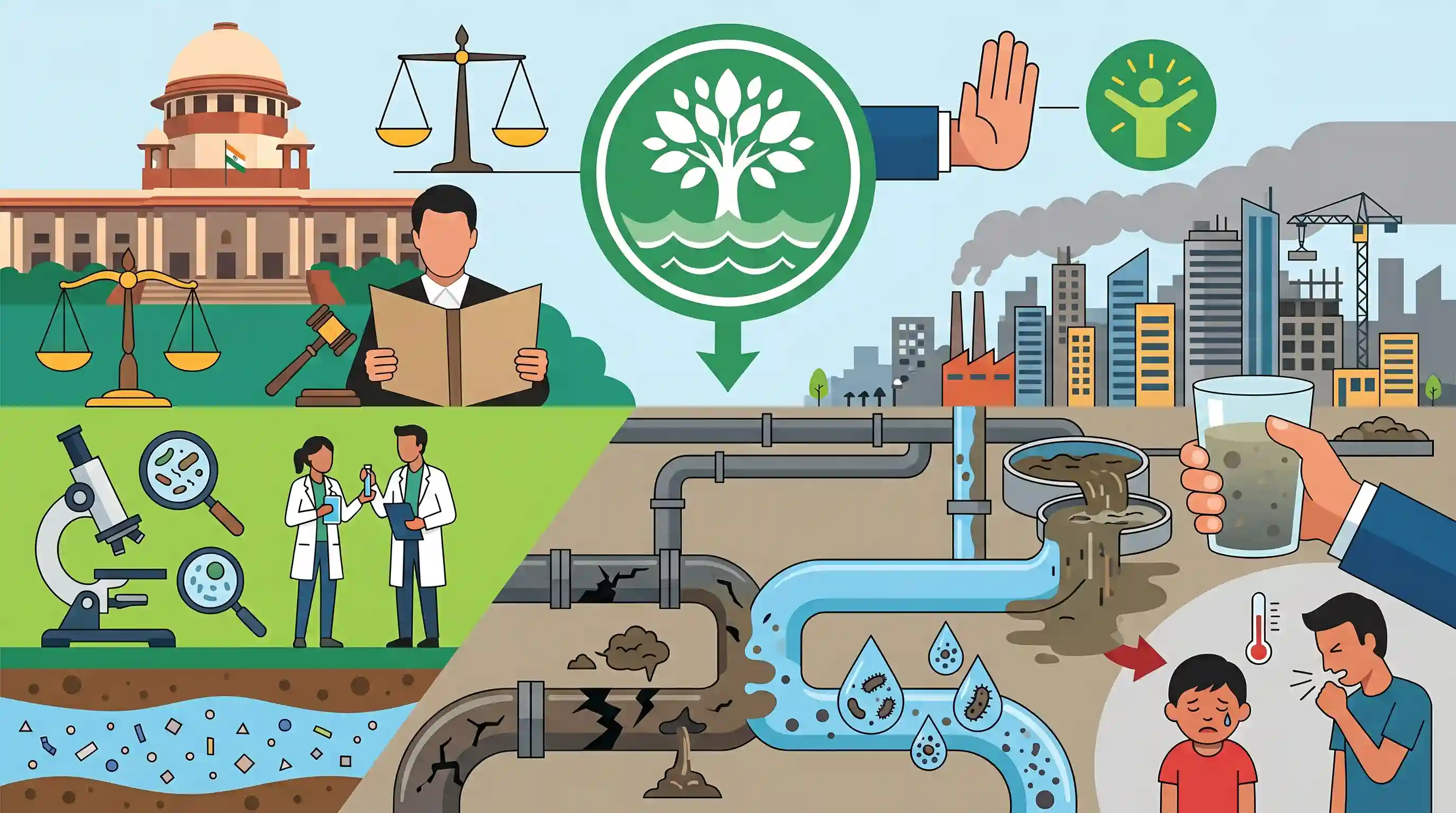
The Delhi High Court has sought a detailed report from the Delhi Jal Board (DJB) following a Public Interest Litigation (PIL) concerning the supply of contaminated, sewage-mixed drinking water in East Delhi. The petitioner asserted that access to clean and safe drinking water is intrinsically linked to the fundamental right to life under Article 21 of the Indian Constitution. Furthermore, the petition referenced a recent study by the Chintan Environmental Research and Action Group, which revealed the alarming presence of microplastics in Delhi's groundwater. This issue highlights broader urban governance challenges, including the decay of civic infrastructure, ineffective sewage treatment, and associated public health risks in rapidly urbanizing areas.
Key Points
- The Delhi High Court has directed the Delhi Jal Board (DJB) to submit a status report on the supply of contaminated, sewage-mixed drinking water in East Delhi.
- A Public Interest Litigation (PIL) argued that the failure to provide clean drinking water violates the fundamental right to life enshrined under Article 21 of the Constitution.
- The plea highlighted a study by the Chintan Environmental Research and Action Group, which detected microplastics in Delhi's groundwater.
- The crisis underscores severe systemic challenges in urban water management, infrastructure maintenance, and public health protection in metropolitan regions.
Important Terms
Article 21 of the Indian Constitution

A fundamental right ensuring life and personal liberty; judicially expanded to include the right to clean drinking water and a healthy environment as essential for living with dignity.
UPSC context
GS Paper II (Polity) and I (Social Issues). Focuses on the judicial evolution of fundamental rights to include environmental and socio-economic entitlements.
Public Interest Litigation (PIL)
Legal action initiated in a court of law to protect 'Public Interest', such as environmental safety; it relaxes traditional 'locus standi' to empower citizens to seek justice for others.
UPSC context
GS Paper II (Judiciary). Tests understanding of judicial activism and the mechanisms used to hold the executive accountable for public welfare.
Microplastics
Small plastic fragments less than 5mm in diameter; they are persistent environmental pollutants that bioaccumulate in food chains and have been detected in human blood and organs.
UPSC context
GS Paper III (Environment). Relevant for topics on emerging pollutants, plastic waste management rules, and their impact on human health and biodiversity.
Delhi Jal Board (DJB)
The statutory body established under the Delhi Water Board Act, 1998, responsible for the production and distribution of potable water and sewage management in Delhi.
UPSC context
GS Paper II (Governance). Serves as a case study for urban governance challenges, infrastructure decay, and state responsibility in providing basic utilities.
Article 226 of the Indian Constitution
The power of High Courts under the Constitution to issue directions and writs for the enforcement of Fundamental Rights and other legal remedies.
UPSC context
GS Paper II (Judiciary). Essential for understanding the original jurisdiction of High Courts and their role in constitutional remedies alongside the Supreme Court.
Chintan Environmental Research and Action Group
A Delhi-based NGO focused on environmental justice and sustainable consumption; it conducts research on waste management, air pollution, and microplastics to influence urban policy.
UPSC context
GS Paper II (Social Justice/Civil Society). Example of the role of NGOs and research groups in highlighting environmental issues through data-driven advocacy.
Prelims Trap
The Right to clean drinking water is explicitly provided under Article 21 of the Indian Constitution.
The Right to Water is not explicitly written in the Constitution. It is a judicially inferred fundamental right under Article 21 (Right to Life) established through Supreme Court judgments.
Static Concepts Connected
How does the Indian Constitution address the right to clean drinking water?
- Article 21 (Inferred): Not explicitly mentioned, but expanded by the Supreme Court (e.g., Subhash Kumar case) to include pollution-free water as an intrinsic part of the Right to Life.
- Article 47 (DPSP): Directs the State to regard the improvement of public health, which implicitly requires safe drinking water, as among its primary duties.
- Article 51A(g): Imposes a fundamental duty on every citizen of India to protect and improve the natural environment, including lakes, rivers, and wildlife.
Why are microplastics a critical threat to urban groundwater reserves?
- Size and Mobility: Measuring less than 5mm, these synthetic particles effortlessly bypass standard municipal water filtration and sewage treatment plant (STP) barriers.
- Vector for Toxins: They absorb persistent organic pollutants (POPs) and heavy metals, acting as carriers that transport these highly toxic chemicals directly into groundwater aquifers.
- Bioaccumulation: Once in the water supply, they are ingested by organisms, accumulating in tissues over time and bypassing biological barriers in humans, posing severe health risks.
Cross-Topic Patterns
Microplastics + Persistent Organic Pollutants (POPs)
Microplastics act as 'sponges' for POPs in wastewater. This links localized urban civic failures to global environmental treaties like the Stockholm Convention on Persistent Organic Pollutants.
Article 21 + NGT vs Constitutional Courts
While the National Green Tribunal handles statutory environmental issues, PILs invoking the fundamental Right to Life (Article 21) continue to be admitted directly by High Courts to enforce civic accountability.

Expect a multi-statement prelims question combining Article 21's implicit environmental rights and the properties of microplastics.
Linked PYQs · 5
Linked PYQs · 5
- 2015MainsGS2
Does the right to clean environment entail legal regulations on burning crackers during Diwali? Discuss in the light of Article 21 of the Indian Constitution and Judgement(s) of the Apex Court in this regard.
- 2024MainsGS2
Explain the reasons for the growth of public interest litigation in India. As a result of it, has the Indian Supreme Court emerged as the world's most powerful judiciary ?
- 2025MainsGS3
Examine the factors responsible for depleting groundwater in India. What are the steps taken by the government to mitigate such depletion of groundwater?
- 2024MainsGS3
Industrial pollution of river water is a significant environmental issue in India. Discuss the various mitigation measures to deal with this problem and also the government's initiatives in this regard.
- 2018MainsGS1
The ideal solution of depleting ground water resources in India is water harvesting system." How can it be made effective in urban areas?
