Kerala High Court Dismisses Plea on Temple Entry Rules
Source:The Hindu ↗
Why It Matters
Provides a contemporary legal perspective on the limits of delegated legislation (rules vs. parent act) and serves as an excellent case study on the judiciary applying constitutional values to promote inter-faith harmony and pluralism.
Summary
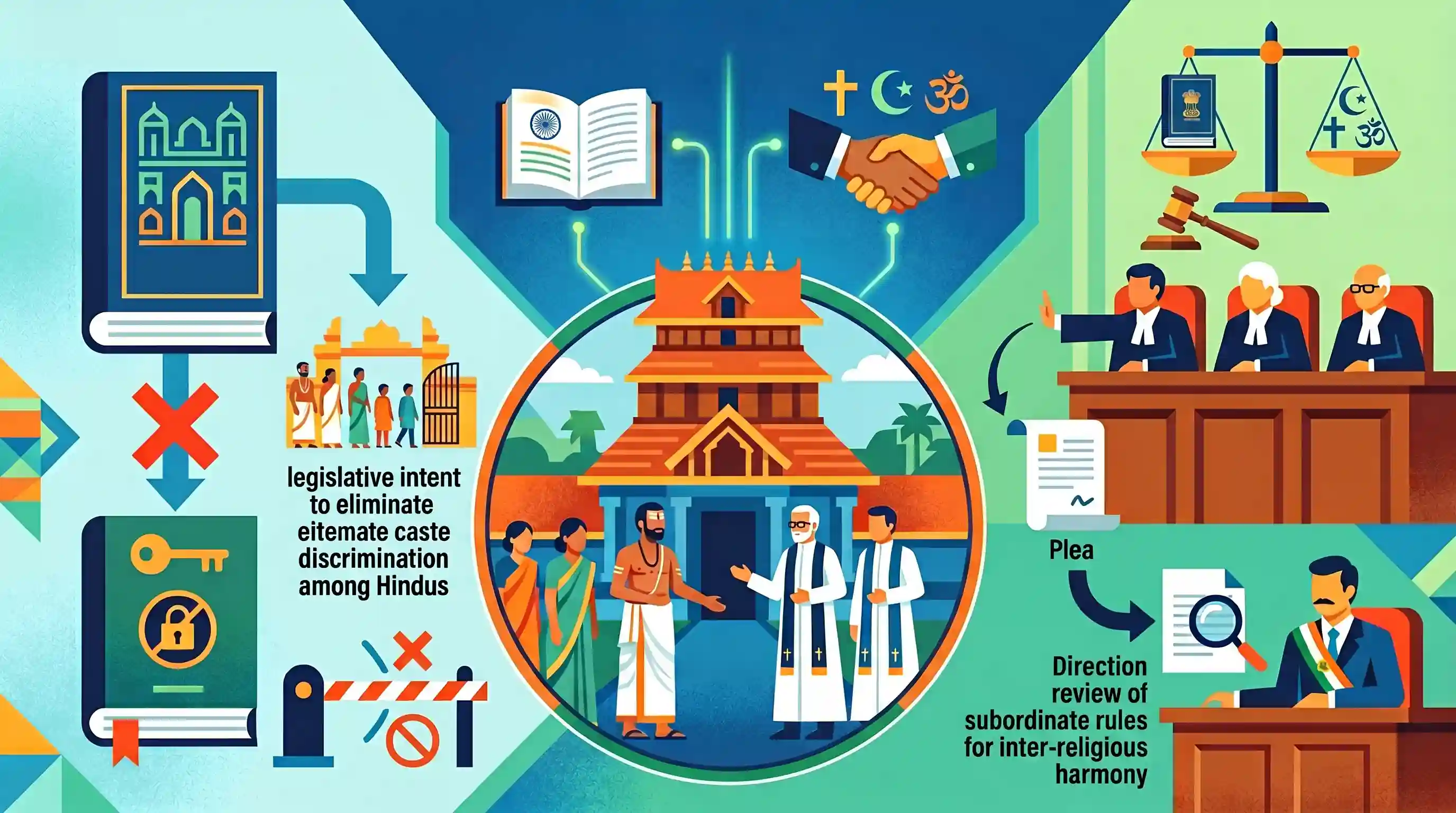
The Kerala High Court dismissed a plea seeking action against the entry of Christian priests into a Hindu temple as invited guests. The court observed that Rule 3(a) of the Kerala Hindu Places of Public Worship (Authorisation of Entry) Rules, 1965, which bars non-Hindus, lacks support from its parent Act, whose actual legislative intent was to eliminate caste-based discrimination among Hindus rather than banning other faiths. Emphasizing secularism and constitutional values, the court urged the government to review the subordinate rule so it does not foment inter-religious discord.
Key Points
- The Kerala High Court dismissed a petition challenging the entry of Christian priests, invited as guests, into the Adoor Sree Parthasarathy Temple.
- The court noted that Rule 3(a) of the Kerala Hindu Places of Public Worship Rules, which prohibits non-Hindu entry, extends beyond the original intent of its parent Act.
- The parent 1965 Act was enacted to eradicate caste discrimination among different sects of Hindus regarding temple entry, rather than universally restricting non-Hindus.
- The judgment reiterates a core principle of administrative law: subordinate legislation (rules) cannot contradict or expand beyond the scope and objective of the parent Act.
- The judiciary emphasized that religious statutes and rules must not be weaponized to disrupt communal harmony, reinforcing India's constitutional ethos of pluralism and secular tolerance.
Important Terms
Kerala Hindu Places of Public Worship (Authorisation of Entry) Act, 1965

A 1965 Kerala statute enacted to ensure temple entry for all sections and classes of Hindus, aimed at eliminating caste-based discrimination and ensuring social inclusion within the community.
UPSC context
Relevant for GS Paper 2 (Polity and Governance) and GS Paper 1 (Social Empowerment/Caste), testing understanding of statutes promoting social equality.
Delegated Legislation
Laws, rules, or regulations made by the executive branch (subordinate authority) under power granted by a parent Act passed by the legislature; they must stay within the Act's scope.
UPSC context
Key concept for GS Paper 2 (Polity/Executive-Legislature relations), testing knowledge of administrative law and judicial control over executive rulemaking.
Ultra Vires
A Latin term meaning "beyond the powers"; used when a body (like the executive) exceeds its legal authority, such as when a rule contradicts its parent statute.
UPSC context
Essential legal doctrine for GS Paper 2 (Judiciary/Judicial Review), specifically regarding the limits of administrative power and statutory interpretation.
Article 25 of the Constitution
Guarantees all persons the freedom of conscience and the right to freely profess, practice, and propagate religion, subject to public order, morality, health, and other fundamental rights.
UPSC context
Core Fundamental Right in GS Paper 2, often tested in the context of religious freedom versus state regulation of secular temple activities.
Constitutional Morality
The principle that government and judiciary must adhere to constitutional values like equality, liberty, and justice, rather than being guided by traditional, popular, or religious morality.
UPSC context
Crucial judicial philosophy for GS Paper 2 and GS Paper 4 (Ethics), testing the application of democratic values in complex social/religious cases.
Secularism
In the Indian context, it refers to "Sarva Dharma Sambhava" (equal respect for all religions) and state neutrality, rather than a strict separation between religion and state.
UPSC context
A basic feature of the Constitution and a frequent topic in GS Paper 1 (Social Issues) and GS Paper 2 (Polity).
Prelims Trap
Article 25(2)(b) empowers the State to throw open all religious institutions of a public character to all citizens.
Article 25(2)(b) specifically applies only to "Hindu religious institutions" and mandates throwing them open to "all classes and sections of Hindus," not universally to all citizens.
Static Concepts Connected
What is the Doctrine of Ultra Vires regarding delegated legislation?
- Substantive Ultra Vires: When subordinate rules expand upon, contradict, or exceed the scope and legislative intent of the parent Act.
- Unconstitutional Rules: When the delegated rules violate Fundamental Rights (like Article 14 or 25) or other constitutional provisions.
- Procedural Ultra Vires: When the executive fails to follow mandatory procedures prescribed by the parent Act, such as prior publication.
What are the constitutional limitations on Freedom of Religion under Article 25?
- Overarching Caveats: The right is strictly subject to public order, morality, health, and other Fundamental Rights in Part III.
- Secular Activities: The State can regulate or restrict economic, financial, political, or other secular activities associated with religious practice.
- Social Reform: The State can enact laws for social welfare and mandate opening Hindu public religious institutions to all Hindu classes.
Cross-Topic Patterns
Subordinate Rules vs Constitutional Morality
Similar to the Sabarimala verdict striking down Rule 3(b), this case demonstrates how state-framed temple rules (delegated legislation) are frequently tested against constitutional morality and parent-Act intent.
Indian Secularism vs Western Separation
The legal protection of inter-faith temple guests reinforces India's assimilative secularism (principled distance), which promotes mutual tolerance over a strict Western-style church-state separation.

A Prelims statement mixing Article 25(2)(b)'s exact phrasing on Hindu temple entry with the ultra vires doctrine is highly probable.
Linked PYQs · 2
Linked PYQs · 2
- 2022MainsGS1
Are tolerance, assimilation and pluralism the key elements in the making of an Indian form of secularism? Justify your answer.
- 2024MainsGS2
Discuss India as a secular state and compare with the secular principles of the US constitution.
