Ladakh High Court Bench Approved for Enhanced Access to Justice
Source:The Hindu ↗
ఇది ఎందుకు ముఖ్యం
This development highlights the evolving governance model and judicial infrastructure of Ladakh post the reorganization of Jammu and Kashmir in 2019. It addresses Article 39A (equal justice and free legal aid) and underscores the federal challenge of balancing direct central administration in a strategically sensitive border UT with local demands for democratic representation and cultural safeguards (Sixth Schedule).
సారాంశం
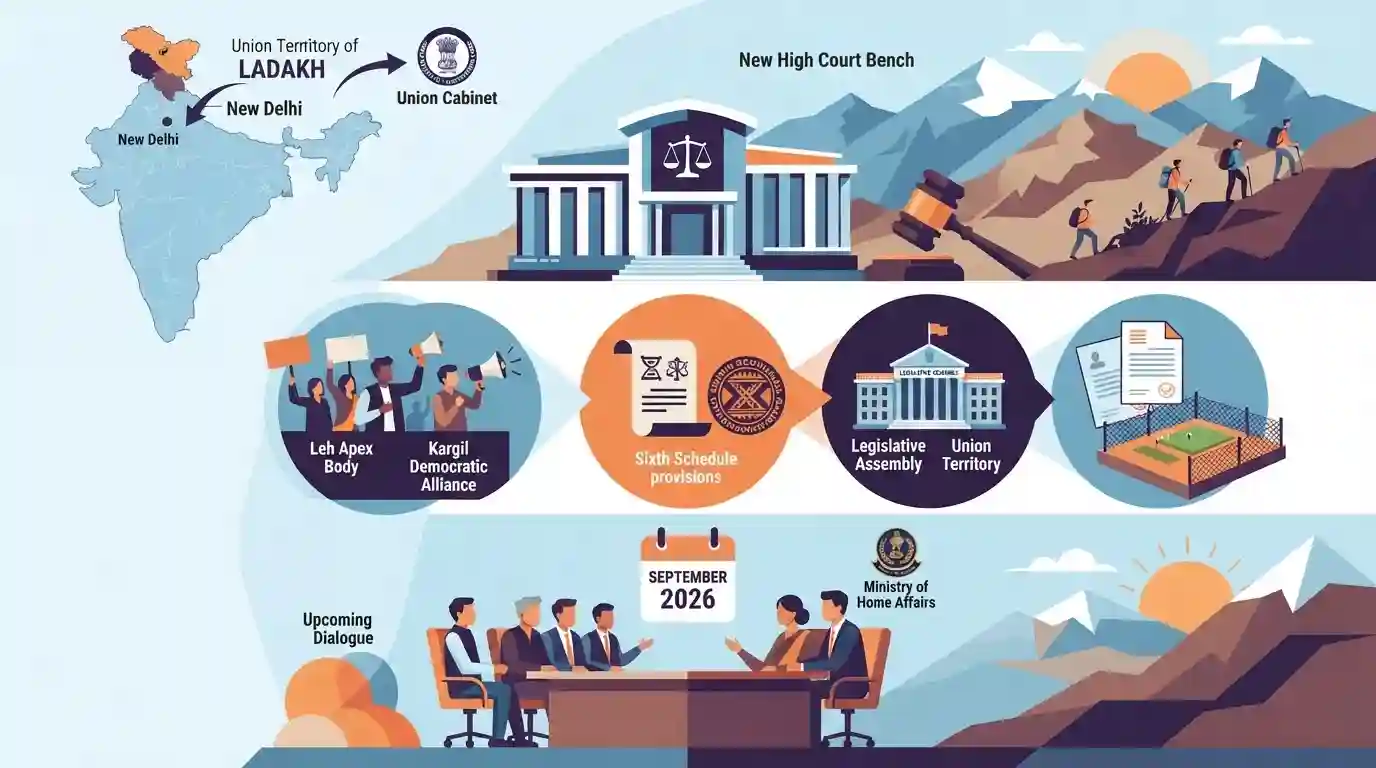
The Union Cabinet has approved the establishment of a High Court Bench in the Union Territory of Ladakh, expanding the reach of the High Court of Jammu and Kashmir and Ladakh to ease access to justice in remote, geographically challenging areas. This decision comes amidst ongoing agitations by regional groups like the Leh Apex Body and the Kargil Democratic Alliance, who are demanding robust constitutional safeguards (such as the Sixth Schedule status), a legislative setup, and local employment and land protections. Formal talks between these groups and the Ministry of Home Affairs are scheduled for early September 2026.
ముఖ్య అంశాలు
- The Union Cabinet, under Prime Minister Narendra Modi, approved the establishment of a High Court Bench of the Jammu and Kashmir High Court in the Union Territory of Ladakh.
- Home Minister Amit Shah stated that the bench is aimed at improving access to justice and significantly reducing the time and geographical hurdles required for citizens in remote areas of Ladakh to access legal services.
- Ladakh Lt Governor Vinai Kumar Saxena welcomed the move as a historic decision that reaffirms the Centre's commitment to Ladakh's all-round development and constitutional safeguards.
- The development occurs against the backdrop of ongoing local agitations led by the Leh Apex Body (LAB) and Kargil Democratic Alliance (KDA) demanding greater administrative autonomy and protections.
- Ahead of formal talks with the MHA in September 2026, the LAB and KDA submitted a memorandum of 'non-negotiable' demands, which includes requests for a legislative and executive assembly setup, financial powers, and land, job, and cultural safeguards for Ladakh.
ముఖ్యమైన పదాలు
Sixth Schedule of the Constitution of India

A constitutional framework under Articles 244(2) and 275(1) providing autonomous administration for tribal areas in Assam, Meghalaya, Tripura, and Mizoram through Autonomous District and Regional Councils.
UPSC context
GS Paper II: Decentralized governance, federalism, and administration of scheduled and tribal areas.
Article 241 of the Constitution of India
A constitutional provision under Part VIII empowering Parliament to establish a High Court for a Union Territory or designate any existing court as a High Court.
UPSC context
GS Paper II: Structure of the judiciary, administration of Union Territories, and legislative powers of Parliament.
Article 39A of the Constitution of India
A Directive Principle of State Policy (added by the 42nd Amendment) mandating that the State secure equal justice and provide free legal aid to economically or socially disadvantaged citizens.
UPSC context
GS Paper II: Directive Principles of State Policy, access to justice, and welfare mechanisms.
Leh Apex Body (LAB)
A political and social coalition representing civil, religious, and political organizations in Leh, Ladakh, advocating for statehood, Sixth Schedule status, and local protections since the 2019 reorganization.
UPSC context
GS Paper II: Regional aspirations, federal structure, and influence of pressure groups.
Kargil Democratic Alliance (KDA)
A socio-political alliance of regional parties, religious groups, and civil society in Kargil, Ladakh, cooperating with the Leh Apex Body to demand political representation and constitutional safeguards.
UPSC context
GS Paper II: Pressure groups, federal dynamics, and governance challenges in border regions.
High Court of Jammu and Kashmir and Ladakh
The common High Court exercising judicial jurisdiction over the Union Territories of Jammu and Kashmir and Ladakh, originally established in 1928 and restructured under the 2019 Reorganisation Act.
UPSC context
GS Paper II: Structure and jurisdiction of High Courts in Union Territories, and post-reorganization judicial administration.
ప్రిలిమ్స్ ఉచ్చు
Establishing a new High Court Bench in a Union Territory requires a separate Act of Parliament.
Parliament's law-making power is required to create a new High Court (Article 241), but the establishment of a regional bench of an existing High Court is done via Executive Order by the President (under the States Reorganisation Act) in consultation with the Chief Justice and Governor/LG.
అనుసంధానమైన స్థిర భావనలు
How are High Court Benches established in India?
- Executive Power: While Parliament establishes High Courts (Art 214/241), the creation of regional/circuit benches is an executive power of the President.
- Consultation Process: The President issues the order after formal consultation with the Chief Justice of the concerned High Court and the State Governor/UT Lieutenant Governor.
- Statutory Basis: Governed by Section 51 of the States Reorganisation Act, 1956, or specific provisions in UT Reorganisation Acts.
Sixth Schedule vs UT without Legislature
- Current UT Status: Ladakh is directly governed by the President through a Lieutenant Governor under Article 239, possessing no local legislative body.
- Sixth Schedule powers: Article 244(2) creates Autonomous District Councils (ADCs) with legislative and judicial powers over land, forests, and customs. It is currently restricted to Assam, Meghalaya, Tripura, and Mizoram.
అంతర-అంశ నమూనాలు
Ecological fragility vs Border security
Ladakh's strategic border location demands rapid infrastructure development, creating administrative friction with local tribal demands for land conservation under the Sixth Schedule.
Judicial decentralization as integration tool
Establishing benches in remote border regions directly translates Article 39A's mandate of equal justice into geographic access, mitigating regional alienation.

Expect questions contrasting Sixth Schedule applicability (AMTM limits) with the President's power to establish High Court Benches.
అనుసంధాన PYQలు · 3
అనుసంధాన PYQలు · 3
- 2015PrelimsGS1
The provisions in Fifth Schedule and Sixth Schedule in the Constitution of India are made in order to
- 2019PrelimsGS1
Under which Schedule of the Constitution of India can the transfer of tribal land to private parties for mining be declared null and void?
- 2021PrelimsGS1
Which one of the following in Indian polity is an essential feature that indicates that it is federal in character?
