Rajasthan High Court Bans Night Safaris and Drones in Leopard Reserve
Source:Indian Express ↗
Why It Matters
The issue highlights the continuous tension between eco-tourism and wildlife conservation. For UPSC aspirants, it serves as an excellent case study on the 'carrying capacity' of ecosystems (GS3), the impact of unregulated tourism on biodiversity, and the proactive role of the judiciary in environmental protection (GS2).
Summary
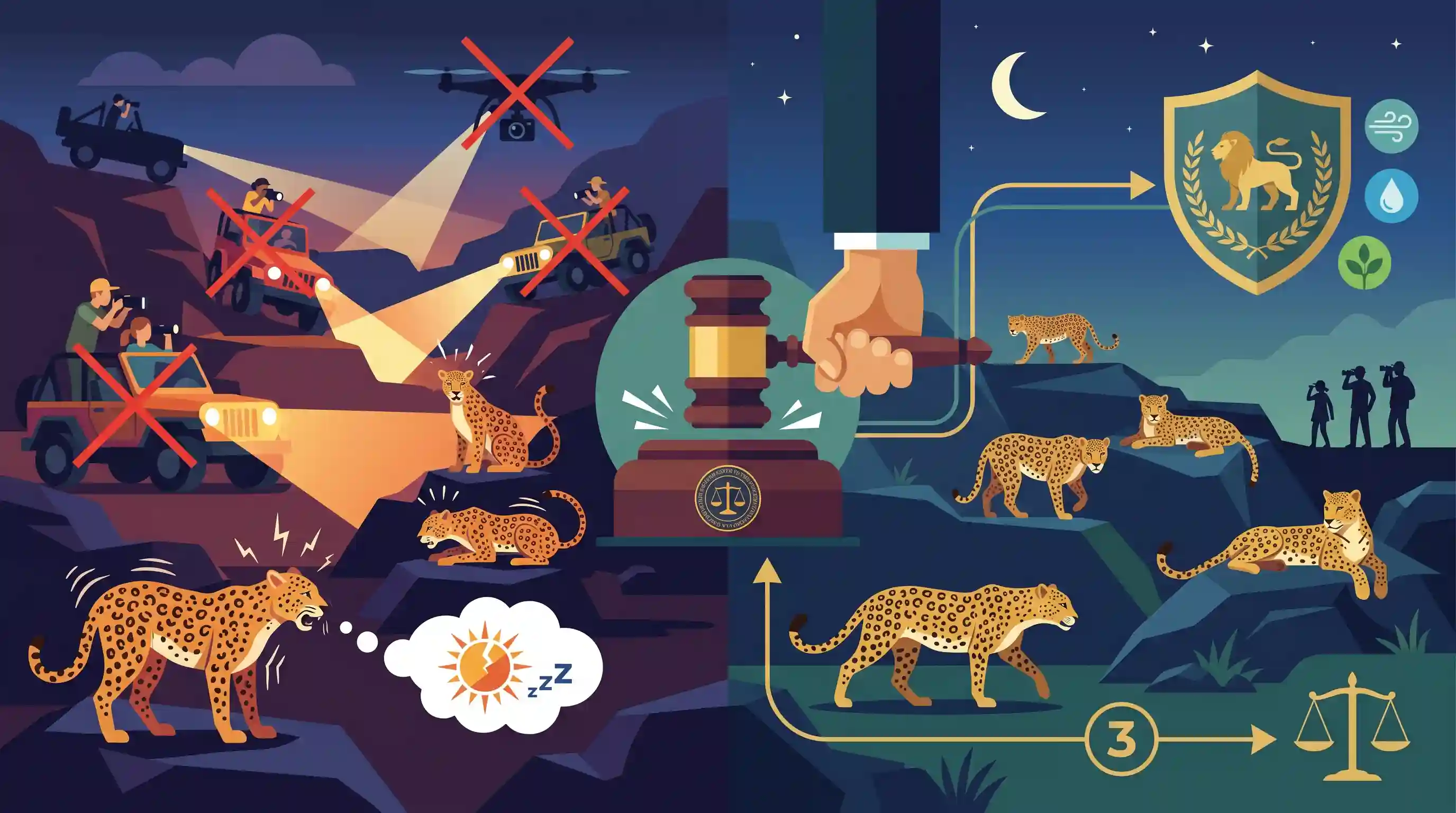
The Rajasthan High Court has banned night safaris, the use of drones, and spotlights in the Jawai Leopard Reserve to shield wildlife from the adverse impacts of unregulated tourism. The judicial intervention comes in response to concerns that commercial eco-tourism was causing severe distress to leopards, particularly by disrupting their nocturnal habits. This ruling highlights the critical need to respect the carrying capacity of sensitive ecosystems and reinforces the protections envisioned under the Wildlife Protection Act, 1972.
Key Points
- The Rajasthan High Court imposed a ban on night safaris, the use of drones, and high-intensity spotlights in the Jawai Leopard Reserve.
- The decision was taken to curb unregulated eco-tourism, which has been causing severe distress to leopards and disrupting their nocturnal behavior.
- Intrusive activities by tourists and operators highlighted the failure to adhere to the ecosystem's carrying capacity, prompting the judicial intervention.
- The ruling reinforces the mandate of the Wildlife Protection Act, 1972, prioritizing animal welfare and habitat preservation over commercial tourism interests.
Important Terms
Wildlife Protection Act, 1972

India's primary legal framework for the protection of plants and animal species. It established protected areas and schedules that categorize species based on the level of protection required.
UPSC context
GS Paper 3: Environment. Essential for understanding the legal mechanism behind wildlife conservation and the powers of the Forest Department.
Jawai Leopard Reserve
A protected area in Rajasthan's Pali district notified in 2010. It is renowned for its high density of cave-dwelling leopards and a unique model of human-wildlife coexistence.
UPSC context
GS Paper 3: Biodiversity. A key example of community-inclusive conservation and specific threats like unregulated tourism in sensitive zones.
Conservation Reserve
A protected area category introduced in the 2002 amendment of the WPA, typically acting as a buffer zone or connector between established national parks and sanctuaries.
UPSC context
GS Paper 3: Environment. Tests knowledge of the different categories of protected areas under the Wildlife Protection Act.
Carrying Capacity
The maximum population size or level of human activity that an ecosystem can sustain indefinitely without undergoing permanent environmental degradation or resource depletion.
UPSC context
GS Paper 3: Sustainable Development. Frequently tested in the context of urban planning and ecological management in tourism hotspots.
Judicial Activism
The proactive role of the judiciary in enforcing legal and constitutional rights, often intervening when the executive or legislature fails to act on public concerns like environmental protection.
UPSC context
GS Paper 2: Polity. Relevant for discussing the separation of powers and the judiciary’s role as an 'environmental watchdog' under Article 226.
Article 48A
A Directive Principle of State Policy (added by the 42nd Amendment) that mandates the State to endeavor to protect and improve the environment and safeguard forests and wildlife.
UPSC context
GS Paper 2: Constitution. Highlights the constitutional basis for environmental governance and the state's obligations toward natural resource conservation.
Prelims Trap
"Jawai Leopard Reserve is located in the Ganga river basin, and Jawai river is a tributary of the Banas."
Jawai is a left-bank tributary of the west-flowing Luni river, not the Banas. Aspirants frequently mix up Rajasthan's eastern (Ganga basin) and western (inland drainage) river systems.
Static Concepts Connected
What is the "carrying capacity" of an ecosystem?
- Definition: The maximum population size or commercial activity level an environment can sustain indefinitely without causing long-term ecological degradation.
- Tourism Context: It dictates the threshold of visitors and vehicles a reserve can handle before wildlife behavior, such as nocturnal hunting, is adversely disrupted.
- Limiting Factors: It is regulated by resource availability (water, prey base) and spatial requirements (buffer zones, undisturbed breeding areas).
What is the conservation status of the Indian Leopard?
- WPA 1972: Placed under Schedule I, granting the species absolute protection and enforcing the highest penalties for hunting or habitat disruption.
- IUCN Status: Categorized as 'Vulnerable' globally. They face threats from habitat fragmentation, human-wildlife conflict, and poaching.
- Habitat Adaptability: Highly adaptable species found in almost all forest types; uniquely capable of surviving near human settlements, as seen in Jawai.
Cross-Topic Patterns
Ecotourism vs. Carrying Capacity
The tension between generating state revenue through wildlife tourism and maintaining habitat integrity often appears in GS-3. Jawai joins Jim Corbett in debates over strictly enforcing tourist carrying capacities.
Ecocentric Judicial Activism
High Courts increasingly adopt an 'ecocentric' approach over an anthropocentric one, extending constitutional protections and Article 21 principles to wildlife habitats against unregulated commercial interests.
Rabari Tribe & Leopard Coexistence
Jawai is renowned for the peaceful coexistence of leopards with the Rabari pastoralist tribe. This serves as a prime GS-3 case study for community-led conservation and human-wildlife harmony.

Expect a prelims pair matching Luni tributaries (Jawai) or a GS-3 question on the carrying capacity of ecotourism in fragile ecosystems.
Linked PYQs · 3
Linked PYQs · 3
- 2022MainsGS2
“The most significant achievement of modern law in India is the constitutionalization of environmental problems by the Supreme Court.” Discuss this statement with the help of relevant case laws.
- 2019MainsGS3
Define the concept of carrying capacity of an ecosystem as relevant to an environment. Explain how understanding this concept is vital while planning for sustainable development of a region.
- 2022PrelimsGS1
With reference to Indian laws about wildlife protection, consider the following statements : 1. Wild animals are the sole property of the government. 2. When a wild animal is declared protected, such animal is entitled for equal protection whether it is found in protected areas or outside. 3. Apprehension of a protected wild animal becoming a danger to human life is sufficient ground for its capture or killing. Which of the statements given above is/are correct?
