Calcutta High Court ruling on judicial commission appointment
Source:thestatesman ↗
Why It Matters
This ruling highlights the legal parameters surrounding state-appointed judicial inquiry commissions and executive accountability in West Bengal, making it relevant for local governance and judicial oversight topics.
Summary
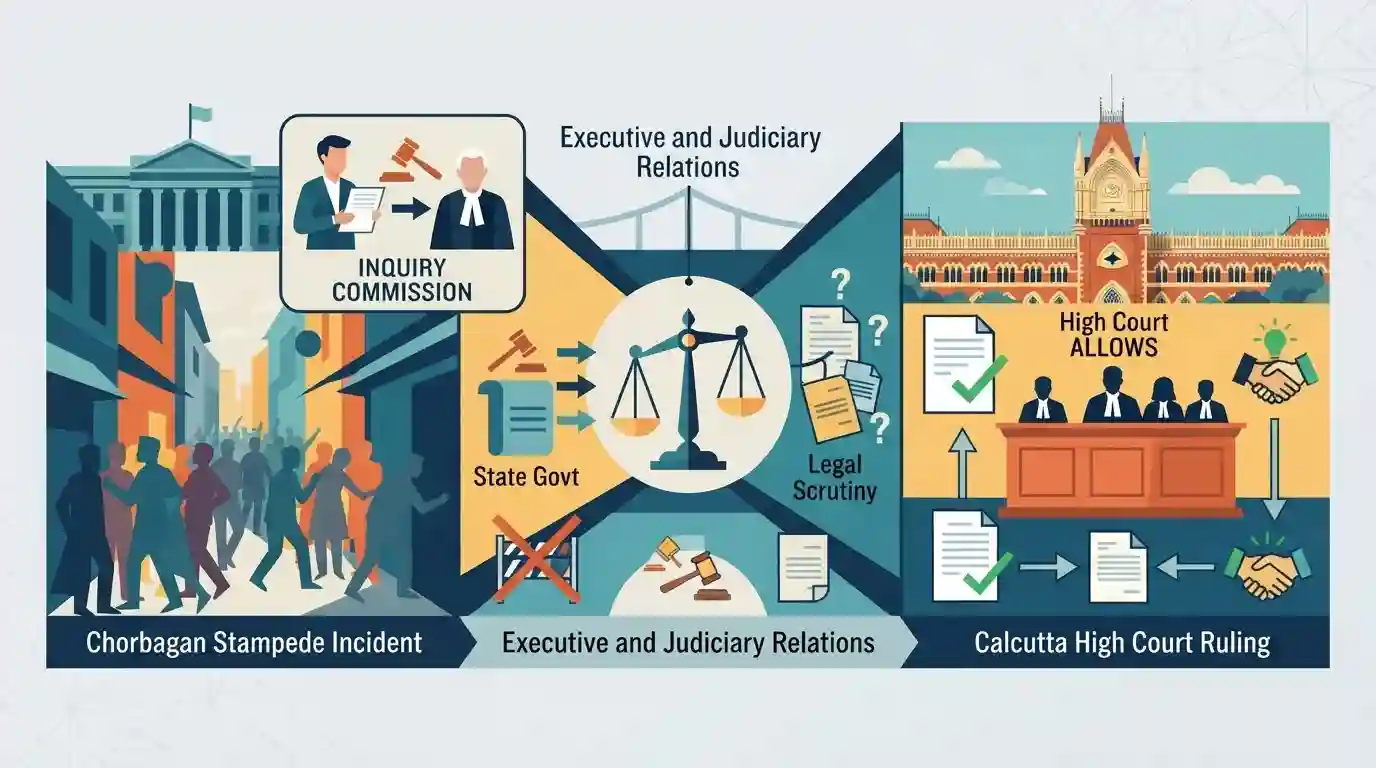
The Calcutta High Court has allowed the West Bengal government to appoint a retired judge to investigate the Chorbagan stampede incident through an inquiry commission, navigating legal scrutiny on executive commissions of inquiry within the state.
Key Points
- The Calcutta High Court permitted the West Bengal government to appoint a retired judge to lead a judicial probe into the Chorbagan stampede incident.
- The ruling clarifies administrative and legal frameworks regarding state-appointed inquiry commissions for public tragedies in West Bengal.
- The decision addresses the balance of judicial oversight and executive action in handling public safety disasters and urban administrative accountability within Kolkata.
Important Terms
Commission of Inquiry Act

Statutory framework enabling central and state governments to establish independent bodies to investigate definite matters of public importance and administrative failures.
UPSC context
WBCS Polity / Governance: Tests knowledge of statutory mechanisms used by state executive authorities for administrative inquiries.
Calcutta High Court
India's oldest high court, established in 1862, exercising constitutional jurisdiction over West Bengal and the Andaman and Nicobar Islands under Articles 226 and 227.
UPSC context
WBCS Judiciary / Constitutional Law: Tests jurisdiction, judicial review, and supervisory authority over state executive decisions.
West Bengal Government
The parliamentary state administration system led by the Governor as constitutional head and the Chief Minister with the Council of Ministers wielding executive power.
UPSC context
WBCS West Bengal Administration: Tests understanding of state governance, executive decision-making, and administrative actions.
Static Concepts Connected
What are the key provisions and powers of the Commissions of Inquiry Act, 1952?
- Statutory Power: Enacted by Parliament, it empowers central and state governments to appoint commissions to inquire into definite matters of public importance.
- Civil Court Powers: A commission under this Act has the powers of a civil court under CPC, 1908, including summoning witnesses and compelling document production.
- Nature of Report: Inquiry reports are generally recommendatory in nature and not legally binding on the appointing government, though they carry immense moral and political weight.
Cross-Topic Patterns
Crowd Management & Urban Disaster Accountability
Disaster management protocols during mass religious festivals like Durga Puja intersect with municipal urban administration, police accountability, and judicial inquiry frameworks.
Separation of Powers & Judicial Independence
The Supreme Court's bar on deputing sitting judges to executive commissions highlights the delicate constitutional separation of powers between judiciary and executive.

Commissions of Inquiry Act provisions, especially civil court powers and sitting vs. retired judge norms, are prime for matching or statement traps.
Linked PYQs · 2
Linked PYQs · 2
- 2020WBCS_PRELIMSGS1
'Chancellor' of the State-run Universities in West Bengal is
- 2015WBCS_PRELIMSGS1
The local self-government of Kolkata is
